
English speaking fluency is a practical skill, not only a grammar skill. The 2025 EF English Proficiency Index used data from 2.2 million test takers across 123 countries and regions, showing how widely English ability is measured for study, work, and global communication.
Speaking fluently can improve confidence, interviews, workplace communication, and daily conversations.
The 12 daily habits that support speaking fluency are:
Let’s dive in.

Speaking English out loud for 10 minutes every day trains your mouth, voice, and brain to produce English faster. This habit builds speaking fluency because it turns passive knowledge into active speaking ability.
Many learners know English words but cannot use them quickly in conversation. This usually happens because they read and listen more than they speak. Speaking is a physical skill. Your tongue, lips, jaw, breathing, and rhythm need regular practice.
By speaking out loud daily, you develop the necessary neuromuscular coordination and build phonetic muscle memory. This direct application of articulatory phonetics bridges the gap between recognizing a word and physically producing it.
Start with simple topics. Talk about your day, your work, your family, your food, your plans, or something you watched. The topic does not need to be difficult. The goal is to speak without stopping for a few minutes.
For example, say:
“Today I woke up at 7 o’clock. I had breakfast and checked my messages. After that, I started my English practice. I want to speak more clearly, so I am practising every day.”
This type of speaking may feel basic, but it builds control. Fluency starts when you can explain simple ideas without translating every word in your head.
A good 10-minute speaking routine can include 3 minutes of free speaking, 3 minutes of repeating useful phrases, 2 minutes of reading aloud, and 2 minutes of correcting one mistake. This short routine covers speaking, pronunciation, rhythm, and review in one session.

Learning common English phrases helps you speak faster because phrases give you ready-made sentence patterns. Single words are useful, but phrases show how words work together in real speech.
Many learners memorize words like “appointment,” “decision,” “improve,” or “problem.” But when they speak, they do not know how to use these words naturally.
Native and fluent speakers often use word groups, not isolated words.
For example, do not only learn the word “decision.” Learn phrases like “make a decision,” “take a quick decision,” “change my decision,” and “the right decision.” These phrase groups help you speak with better grammar and smoother word order.
English fluency depends on chunks. A chunk is a group of words that speakers use together. Common chunks include “I think,” “I would like to,” “Can you help me with,” “I’m not sure about,” “The main reason is,” and “In my opinion.”
These phrases reduce speaking pressure. You do not need to build every sentence from zero. You can start with a phrase and add your own meaning.
For example:
Daily phrase learning should be small. Learn 5 useful phrases per day. Then use each phrase in your own sentence. After 30 days, you will have 150 practical phrases that can support real conversation.
Listening to real English conversations daily helps you speak English more fluently because it trains your ears to understand natural pronunciation, connected words, sentence rhythm, and common speaking patterns.
Many learners can understand slow classroom English, but they feel lost when real people speak. This happens because daily English is not spoken word by word. Speakers connect sounds, shorten words, use contractions, pause naturally, and often answer in short phrases.
For example, in real conversation, people may say:
These phrases are common in daily speaking. Learners need to hear them many times before they can understand them quickly and use them naturally.
Real listening also improves pronunciation. When you hear the same sentence several times, your brain starts to notice which words are stressed, which sounds are weak, and where the speaker pauses. This helps you speak with better flow instead of saying every word separately. This active tracking sharpens your auditory processing and heightens your phonological awareness. Over time, your brain begins to automatically decode complex streams of speech into identifiable lexical chunks.
The best way to practice is not passive listening. Do not only play English in the background and expect fast improvement. Use focused listening for 5 to 10 minutes every day.
A simple daily listening method can follow this process:
For example:
Original phrase: “Let me check.”
Your sentence: “Let me check my schedule.”
Your sentence: “Let me check the answer again.”
Original phrase: “That sounds good.”
Your sentence: “That sounds good to me.”
Your sentence: “Your plan sounds good.”
This method turns listening into speaking practice. It helps you move from understanding English to using English in real conversation.
Repeating sentences after native and fluent speakers improves pronunciation, rhythm, and speaking speed. This habit is often called shadowing, and it helps learners copy natural English speech patterns.
Shadowing means listening to a sentence and repeating it as closely as possible. You copy the speaker’s pronunciation, stress, pauses, and tone. The goal is not only to say the words. The goal is to sound closer to natural English.
For example, listen to this sentence:
“I usually practice English for ten minutes before work.”
Then repeat it several times. Notice where the speaker goes faster, where the voice rises, and which words are stressed. In English, content words like “practice,” “English,” “ten minutes,” and “work” often carry stronger stress.
Research on second language speaking shows that feedback and repeated oral practice can support pronunciation and speaking improvement. Automatic speech recognition tools, teacher feedback, and peer correction can also help learners notice pronunciation gaps.
Use short sentences first. Do not start with long speeches. Choose 5 to 8 sentences from a video or audio clip. Repeat each sentence 3 times. Then say it without listening.
A simple shadowing routine can look like this:
This practice builds fluency because it trains accuracy and speed together.
Recording your voice helps you find speaking mistakes that you cannot notice while speaking. It improves pronunciation, clarity, sentence flow, and confidence over time.
Many learners feel uncomfortable when they hear their own voice. This is normal. But recording is one of the most practical ways to improve speaking because it gives you real evidence of your pronunciation and fluency.
When you speak, your brain focuses on ideas. It may not notice missing sounds, unclear endings, weak grammar, or long pauses. When you listen to the recording, you can hear the problem more clearly.
Start with a short task. Speak for 60 seconds about one topic. Then listen and check three things: pronunciation, pauses, and sentence structure.
Ask yourself:
You do not need to correct everything at once. Choose one mistake per day. For example, one day you may work on the “th” sound. Another day you may work on past tense endings. Another day you may reduce long pauses.
This keeps practice simple and measurable.
Voice recording also helps confidence. When you save recordings weekly, you can compare your progress. A learner may not notice daily improvement, but after 4 weeks, the difference becomes easier to hear.
Reading short English texts out loud improves English fluency because it trains your pronunciation, sentence flow, grammar patterns, and speaking confidence at the same time.
Many learners can understand English when they read silently, but they feel stuck when they try to speak. Reading aloud helps close this gap. It gives you correct sentences to practice, so you do not need to create every sentence from your own mind.
This habit is especially useful for beginners because it builds speaking rhythm in a safe way. You can practice alone, repeat the same paragraph, and improve your voice without pressure.
Choose texts that match your level. A good text should be easy enough to understand but still include a few useful new words or phrases. If the text has too many difficult words, your focus will move away from speaking.
Good short texts for reading aloud include:
Start with 80 to 150 words. This length is enough for speaking practice but not too long for a beginner. A short paragraph lets you repeat the same text several times without feeling tired.
Use this simple 3-step reading aloud method:
For example, take this short sentence:
“One of the best ways to improve English speaking is to practice out loud every day.”
First, read it slowly. Then read it again with better flow. After that, say it without looking at the text.
This method helps your brain remember useful sentence patterns. It also trains your mouth to produce English more smoothly.
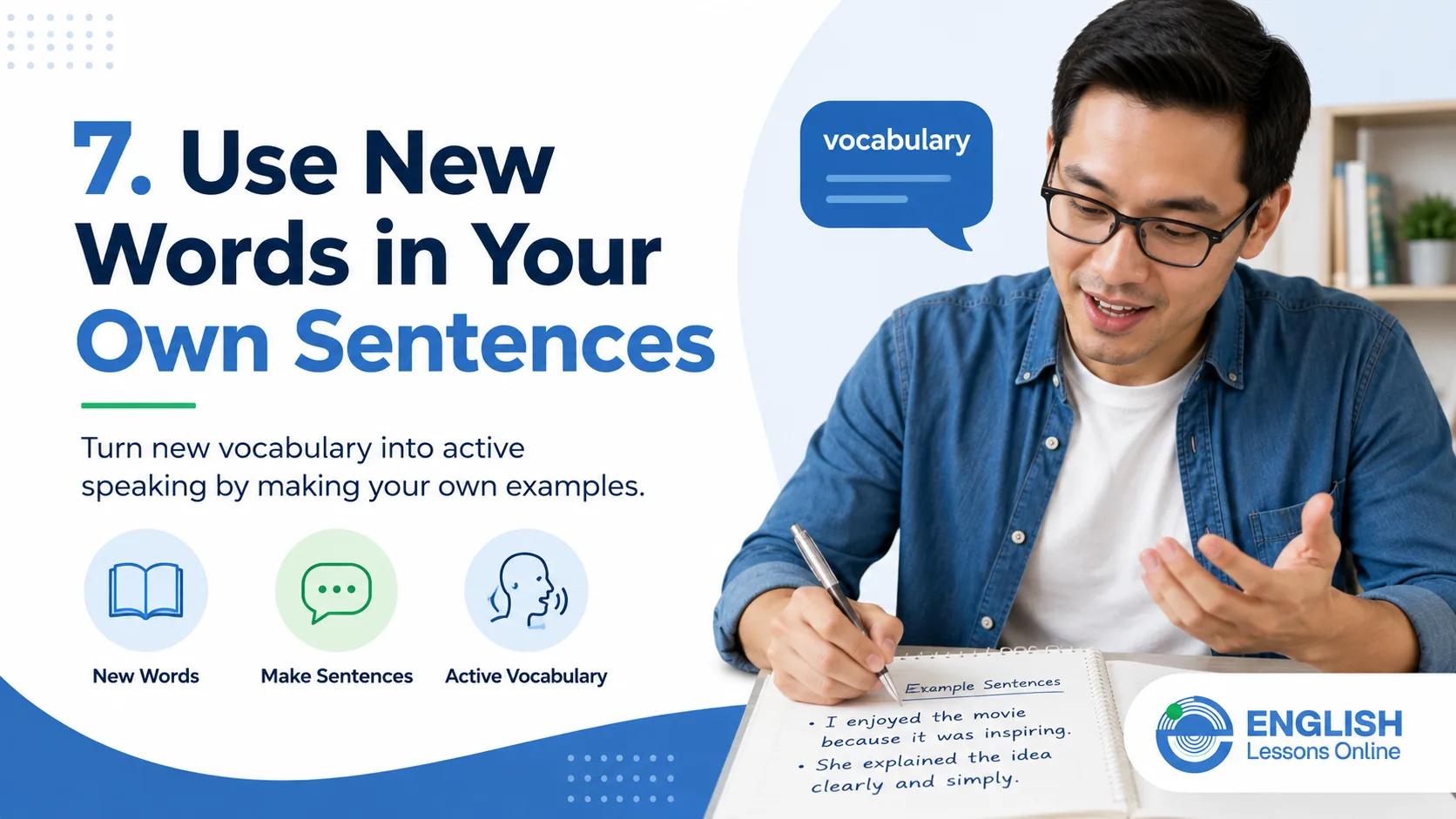
Using new words in your own sentences helps you turn vocabulary into real speaking skills. A word becomes useful when you can use it naturally while talking, not only when you remember its meaning.
Many learners write long vocabulary lists. They may know the meaning of many words, but they still pause when speaking. This happens because the word is stored in memory, but it is not ready for real conversation.
For example, if you learn the word “confident,” do not only memorize the meaning. Use it in simple spoken sentences.
“I feel more confident when I practice every day.”
“I want to become confident in English conversations.”
“Speaking with friends helps me feel confident.”
This method helps you understand the word, its grammar, and its natural position in a sentence. You learn how the word connects with verbs, nouns, and real situations.
English words often become easier to use when you learn them with common word partners. For example, people say “feel confident,” “become confident,” “sound confident,” “gain confidence,” and “speak with confidence.” These word groups help your English sound smoother and more natural.
A simple daily habit is to choose 3 new words and make 2 sentences with each word. Then say the sentences out loud. This trains your brain to use the word while speaking.
For example:
“I feel confident today.”
“I feel more confident when I speak slowly.”
“I feel more confident when I practice English with someone.”
Small sentence changes like these build flexible speaking patterns. You are not memorizing one fixed line. You are learning how to use one word in different real-life situations.

Thinking in English helps you speak more fluently because it reduces translation time. When you think directly in English, your answers become faster and more natural.
Many learners speak slowly because they translate from their first language before speaking. They think of an idea in their own language, search for English words, check grammar, and then speak. This process creates long pauses.
Thinking in English trains your brain to connect ideas directly with English words. You do not need perfect grammar at the beginning. The first goal is to describe simple things in English. This process leverages neuroplasticity to forge direct pathways between your thoughts and target-language vocabulary. By bypassing the native-language translation loop, you drastically minimize your cognitive load and organically adapt to the rules of linguistic relativity.
Start with objects around you. Say the names in your mind.
“This is my phone.”
“I am sitting at my desk.”
“The weather is hot today.”
“I need to finish my work.”
“I will practice English for 10 minutes.”
This habit looks simple, but it builds fast recall. You begin to use English for daily thoughts, not only for study time.
After a few days, move from single sentences to small internal conversations. Ask and answer questions in your mind.
“What will I do today?”
“I will complete my work first. Then I will practice speaking.”
“What did I eat today?”
“I had rice, vegetables, and chicken.”
This habit is useful because real conversations require quick answers. You do not have much time to translate while speaking. Thinking in English helps your brain prepare short responses faster.
A good method is to choose 3 fixed times each day. Think in English while brushing your teeth, walking, or preparing food. These daily moments become natural practice points.

Small English conversations build real speaking confidence because they train you to respond, ask questions, and continue communication. Fluency improves when learners use English with another person regularly.
Many learners wait until they feel ready before speaking. This delays progress. Speaking confidence grows after practice, not before practice. Small conversations are better than no conversations.
A small conversation can be 2 minutes long. It does not need to be advanced. You can talk with a teacher, classmate, friend, language partner, or online speaking group.
For example:
“How was your day?”
“It was good. I worked in the morning and studied English in the evening.”
“What are you learning now?”
“I am learning how to speak more fluently. I practice short sentences every day.”
These small exchanges help you practice real communication skills. You learn how to listen, answer, ask follow-up questions, and continue the topic.
This is different from speaking alone. Speaking alone builds control, but conversation builds response speed. You must understand the other person and reply in real time.
Language anxiety is one reason many learners avoid speaking. Recent studies on foreign language anxiety show that fear of mistakes, fear of negative evaluation, and low confidence can reduce speaking performance.
This is why short, low-pressure conversations are useful. They make speaking feel normal instead of scary. In linguistics, this environment lowers what is known as the “affective filter.” When your anxiety drops, your brain shifts away from hyper-correcting every sentence (monitored output) and focuses entirely on building genuine communicative competence.
A beginner can start with 3 daily questions:
“What did you do today?”
“What are you learning?”
“What do you want to practice?”
Answer each question in 2 or 3 sentences. Then ask the same question to another person. This creates a simple speaking routine that can be repeated every day.
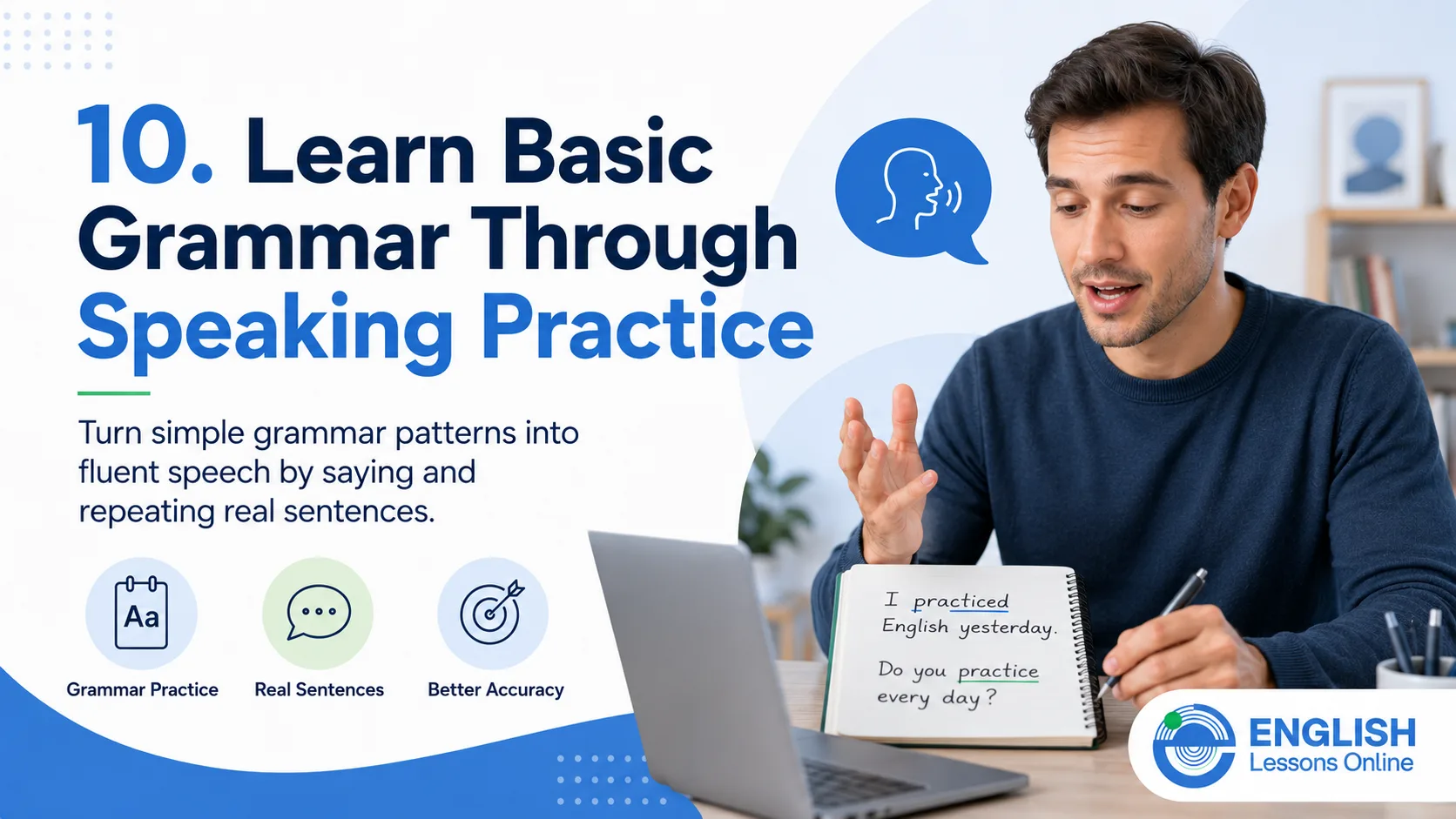
Learning basic grammar through speaking practice helps you use grammar naturally in real communication. Grammar becomes more useful when you practice it inside spoken sentences.
Many learners study grammar rules for years but still cannot speak fluently. This happens because they know the rule but cannot use it quickly. Speaking requires automatic grammar control.
For example, a learner may know the past simple tense. But during conversation, they may still say, “Yesterday I go to market.” The learner understands the rule, but the speaking habit is not strong yet.
To fix this, practice one grammar pattern at a time. Do not study too many rules in one session. Choose one structure and use it in many spoken sentences.
For example, practice the past simple:
“I watched a video yesterday.”
“I practiced English last night.”
“I called my friend in the morning.”
“I learned 5 new phrases.”
“I made 3 mistakes and corrected them.”
This helps your brain connect grammar with real speaking. You are not only reading the rule. You are training your mouth to use the rule.
Basic grammar areas for English speaking include present simple, past simple, future forms, question forms, subject-verb agreement, prepositions, and common sentence patterns. These are more important for daily fluency than rare grammar rules.
A good daily grammar routine is simple. Choose one grammar point. Make 5 sentences. Say them out loud. Turn 2 of them into questions. Then answer those questions.
For example:
“I practice English every day.”
“Do I practice English every day?”
“Yes, I practice English every day.”
This method builds grammar, speaking rhythm, and confidence together.

Watching English videos with a clear purpose improves fluency because it turns passive watching into active learning. Videos help learners hear real pronunciation, see facial movement, and understand language in context.
Many learners watch English videos for hours but do not improve much. The problem is not the video. The problem is passive learning. If you only watch without repeating, noting phrases, or using the language, your speaking may not improve.
A clear purpose means you know what you want before watching. You may watch to learn 5 useful phrases, understand pronunciation, practice shadowing, or learn how speakers answer questions.
For example, choose a 5-minute video. Watch it once to understand the main idea. Watch it again and write down 5 phrases. Then repeat those phrases out loud. After that, use 2 phrases in your own sentences.
This method turns one short video into a complete speaking lesson.
For beginners, videos with subtitles can be useful. Subtitles help connect spoken sounds with written words. But learners should not depend on subtitles forever. After watching with subtitles, watch the same part again without subtitles. This trains listening confidence.
Choose videos that match your level. A beginner should not start with fast comedy shows or complex debates. Better options include English learning channels, simple interviews, slow news, daily conversation videos, and short educational clips.
A useful video practice routine can be:
This routine works because it connects listening, vocabulary, pronunciation, and speaking output.

Reviewing your speaking mistakes helps you improve faster because it turns errors into clear practice targets. Fluency improves when learners notice mistakes, correct them, and repeat the correct version.
Mistakes are a normal part of speaking practice. The problem is not making mistakes. The problem is repeating the same mistakes without correction.
Common speaking mistakes include wrong verb tense, missing articles, unclear pronunciation, incorrect word order, long pauses, and direct translation. These mistakes can reduce clarity, but they can be corrected with focused review.
For example, a learner may say:
“She go to school every day.”
The corrected version is:
“She goes to school every day.”
The learner should not only read the correction. They should repeat the correct sentence several times. Then they should make similar sentences.
“She goes to work every day.”
“He goes to the gym every morning.”
“My brother goes to university.”
This repetition helps the correct pattern become automatic.
A simple mistake review system can include 3 steps. First, write down one mistake after speaking practice. Second, write the corrected sentence. Third, say the corrected sentence 5 times.
Do not review too many mistakes at once. Too many corrections can reduce confidence. One or two corrections per day are enough for steady improvement.
Feedback can come from teachers, fluent speakers, language partners, pronunciation apps, speech recognition tools, or your own recordings. Automatic speech recognition research has shown that speech technology can help learners identify pronunciation issues, although human feedback is still useful for meaning, tone, and context.
The goal is not perfect English. The goal is clearer and more confident English. When you review mistakes daily, your speaking becomes more accurate without stopping your natural flow.
Most learners struggle to speak English fluently because they understand more English than they can use in real conversation. Speaking needs fast recall, clear pronunciation, sentence control, and confidence at the same time.
Many learners can read or listen well, but they pause when speaking. This happens because passive knowledge is not the same as active speaking skill.
Common reasons include:
Research on language anxiety shows that fear of negative evaluation can affect speaking performance. That is why learners need simple daily habits like speaking out loud, listening to real conversations, recording their voice, and correcting small mistakes.
The fastest daily habits for English speakers are speaking out loud, shadowing fluent speakers, listening to real conversations, recording your voice, using new words in sentences, and having small conversations every day.
These habits work faster because they train real speaking output. They do not only build knowledge. They build the ability to speak under normal conversation pressure.
Here is a simple comparison of the most useful habits:
| Daily Habit | Main Skill Improved | Best Practice Time |
| Speaking out loud | Fluency and confidence | 10 minutes daily |
| Shadowing | Pronunciation and rhythm | 5 to 10 minutes daily |
| Listening to conversations | Natural phrases and speed | 10 minutes daily |
| Voice recording | Mistake correction | 3 to 5 minutes daily |
| Reading aloud | Sentence flow and clarity | 5 minutes daily |
| Small conversations | Real response speed | 5 to 15 minutes daily |
The best results come when these habits work together. Listening gives input. Speaking creates output. Recording gives feedback. Review improves accuracy. Conversation builds confidence.
A learner does not need to practice all habits for hours. A 30-minute daily routine can include 10 minutes of speaking, 10 minutes of listening and shadowing, 5 minutes of vocabulary sentences, and 5 minutes of mistake review.
This kind of routine is realistic. It is easier to repeat every day. Fluency grows when practice is consistent.
Beginners can start speaking English without fear by using short sentences, safe topics, daily repetition, and low-pressure conversations. Confidence grows when speaking practice feels small, clear, and manageable.
Many beginners wait until their English becomes good before speaking. This is a mistake. Speaking is the practice that makes English better.
The first step is to remove pressure. A beginner does not need to speak perfectly. The goal is to communicate simple meaning. Grammar and pronunciation can improve later through correction and repetition.
Start with fixed sentence patterns. These patterns help beginners speak without building every sentence from zero.
For example:
“My name is…”
“I live in…”
“I like…”
“I want to learn…”
“Today I…”
“I usually…”
“I need help with…”
These patterns are simple, but they support many real sentences.
A beginner can say:
“My name is Rahim.”
“I live in Bangladesh.”
“I like learning English.”
“I want to speak more fluently.”
“Today I practiced for 10 minutes.”
“I usually listen to English videos.”
“I need help with pronunciation.”
This kind of speaking builds early confidence. It also teaches the brain that speaking English is possible.
The second step is to choose familiar topics. Beginners should talk about daily life, family, food, work, study, hobbies, weather, plans, and routines. These topics use common vocabulary and simple grammar.
The third step is to practice alone before speaking with others. Speaking alone reduces fear. Learners can record their voice, repeat sentences, and correct mistakes without pressure.
After that, beginners can practice with one safe person. This may be a teacher, friend, classmate, or language partner. The conversation should be short. Even 2 minutes is useful.
A beginner can prepare 3 questions before the conversation:
“How are you today?”
“What did you do today?”
“What are you learning now?”
Prepared questions reduce fear because the learner knows what to say first.
Fear also decreases when learners accept mistakes as part of learning. A mistake shows what needs practice. It is not a sign of failure.
A good beginner speaking rule is simple: speak first, correct later. If you correct every word while speaking, you will stop too much. Speak to express the idea. Then review one or two mistakes after the conversation.
It can take 6 to 12 months to build basic conversational fluency in English with daily practice. Strong fluency can take 1 to 3 years, depending on your level, practice time, speaking exposure, and learning method.
There is no fixed timeline for every learner. A beginner needs more time than an intermediate learner. A learner who speaks for 30 minutes every day will usually improve faster than someone who studies only once a week.
Cambridge English explains that moving from one CEFR level to the next can take around 200 guided learning hours. This means fluency develops in stages, not in a few days or weeks.
A1 learners can use simple sentences about daily life. A2 learners can speak about familiar topics. B1 learners can handle many everyday conversations. B2 learners can explain ideas with more detail and confidence.
Practice time also matters. Twenty minutes of daily practice gives about 10 hours per month. One hour per day gives about 365 hours in a year.
To improve faster, learners should:
Fluency does not mean perfect English. It means you can express ideas clearly, continue conversations, understand common speech, and fix mistakes while speaking.
A daily English speaking plan helps beginners practice fluency in a clear order. The best plan includes listening, speaking, phrase practice, pronunciation, conversation, and mistake review.
Here is a simple daily plan:
| Time | Practice Activity | Purpose |
| 5 minutes | Listen to a short conversation | Build real English input |
| 5 minutes | Repeat useful sentences | Improve pronunciation and rhythm |
| 10 minutes | Speak out loud | Build fluency and confidence |
| 5 minutes | Use new words in sentences | Activate vocabulary |
| 5 minutes | Review one mistake | Improve accuracy |
This plan can be adjusted by level. A complete beginner can use easier dialogues and shorter sentences. An intermediate learner can use interviews, podcasts, and longer speaking topics.
The most important rule is consistency. Practicing 30 minutes every day is better than practicing 3 hours only once a week. Daily practice keeps English active in the brain.
A weekly plan can also help. For example, Monday can focus on pronunciation. Tuesday can focus on vocabulary. Wednesday can focus on grammar in speaking. Thursday can focus on listening and shadowing. Friday can focus on conversation. Saturday can focus on review. Sunday can focus on free speaking.
This gives structure without making practice boring.
English fluency grows through small daily actions. Speaking, listening, repeating, correcting mistakes, and having real conversations all work together to build confidence.
The 12 habits in this guide help different parts of speaking. Speaking out loud builds fluency. Common phrases make sentences easier. Listening improves natural understanding. Shadowing helps pronunciation and rhythm. Recording your voice helps you notice mistakes.
You do not need perfect grammar before you start speaking. Start with 10 minutes a day. Talk about simple topics, repeat useful sentences, and use new words in your own examples.
Building fluency takes daily practice, the right guidance, and real speaking support. At EnglishLessons.Online, you can learn English with live online classes designed for your level, goals, and schedule.
Start today: Take the placement test or book a free trial class and begin improving your English speaking confidence.
Helpful next steps: