
English remains one of the most measured second-language skills worldwide. The EF English Proficiency Index 2025 ranked English skills across 123 countries and regions, based on test results from 2.2 million adults.
For beginners, the CEFR A1 level focuses on everyday phrases, personal questions, and simple interaction when speech is slow and clear.
A step-by-step learning order supports study, work, travel, and online communication by building English from sounds to real use.
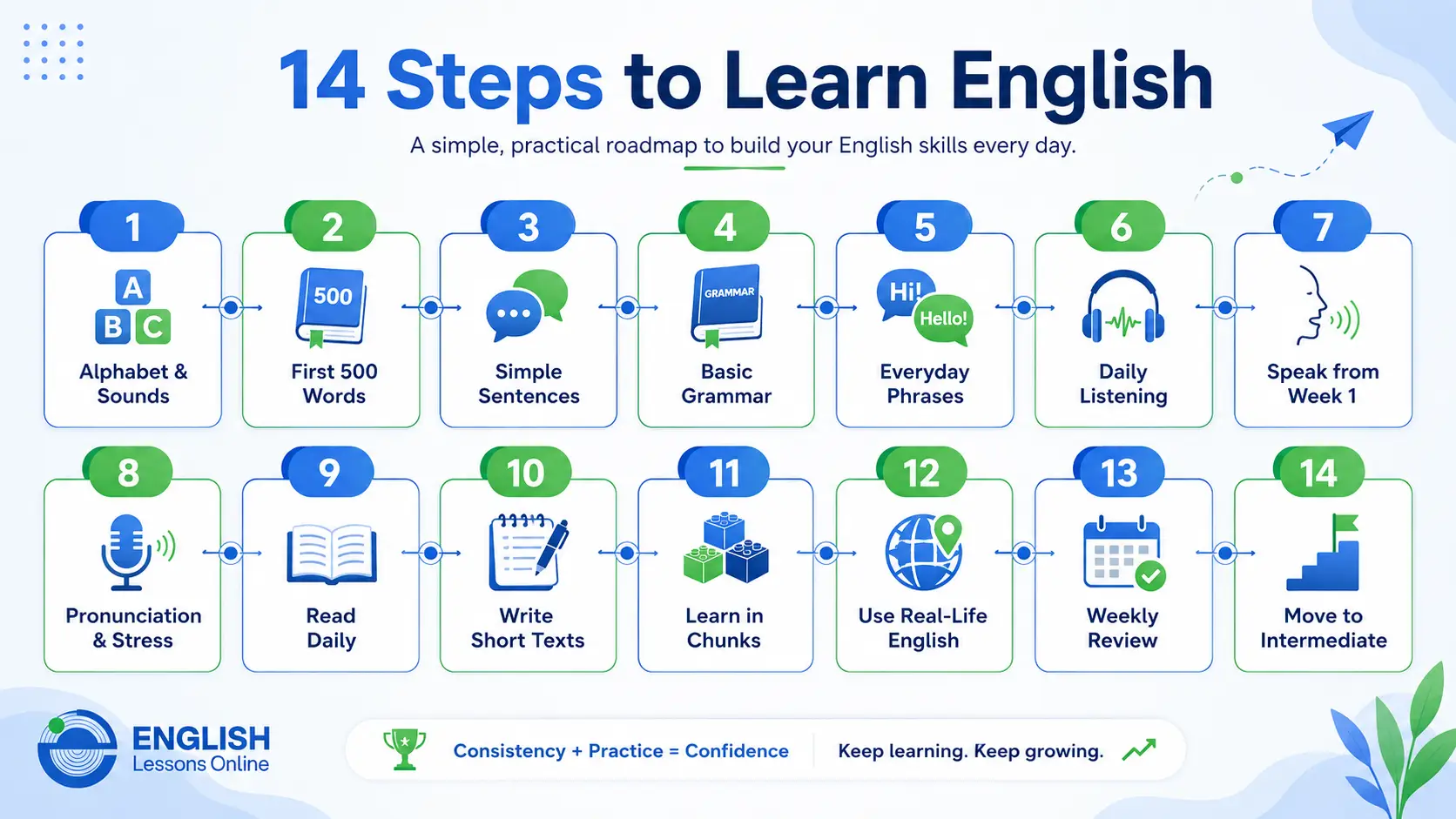
The 14 steps are:
- Learn the basic English alphabet and sounds
- Build your first 500 common English words
- Learn simple English sentence structure
- Understand basic English grammar rules
- Learn everyday English phrases
- Start listening to simple English every day
- Practise speaking English from the first week
- Improve English pronunciation and word stress
- Read simple English texts every day
- Write short English sentences and paragraphs
- Learn English in chunks, not word by word
- Use English in real-life situations
- Review vocabulary and grammar every week
- Move from beginner English to intermediate English
Step 1: Learn the Basic English Alphabet and Sounds
The first step in learning English is to learn the 26 letters, their common sounds, and how those sounds form simple words. This builds the foundation for reading, spelling, listening, and pronunciation.
English has 5 main vowel letters: A, E, I, O, and U. It has 21 consonant letters, including B, C, D, F, G, H, J, K, L, M, N, P, Q, R, S, T, V, W, X, Y, and Z. These letters do not always make one fixed sound. A letter can sound different depending on the word.
For example, the letter A sounds different in apple, name, and car. The letter C sounds different in cat, city, and chair. This is why beginners should not only memorise the alphabet. They should connect each letter with real words and sounds.
English also uses letter groups to create sounds. These are common in beginner reading. Examples include sh in ship, ch in chair, th in think, and oo in book or food. Learning these patterns early helps beginners read simple words faster.
This connection is known as mapping graphemes (the written letters) to phonemes (the individual units of vocal sound). By training your auditory processing to clearly distinguish these units early on, you drastically reduce your cognitive load (the mental energy needed to read) as you move to real words.
A study of 358 children found a strong two-way relationship between letter knowledge and phonological awareness during early literacy development.
Beginners should learn English sounds in small groups, not as a long memorisation task. This makes the first stage easier and more practical.
| Sound Area | What to Learn First | Simple Examples |
| Letter names | The names of A to Z | A, B, C, D |
| Short vowel sounds | Common vowel sounds in short words | cat, pen, sit, hot, cup |
| Consonant sounds | Clear sounds at the start of words | bag, dog, fan, man |
| Common letter groups | Two letters that make one sound | ship, chair, this, book |
| Word endings | Final sounds in simple words | bed, map, fish, milk |
This order is useful because beginners first learn what letters look like, then how they sound, then how they work inside real words.
A beginner should start with short words that are easy to hear and pronounce. Words like cat, dog, sun, pen, cup, book, fish, and milk are better than words like though, enough, island, or business.
The goal of this stage is not a perfect accent. The goal is to recognise letters, hear common sounds, read simple words, and pronounce basic words clearly enough for others to understand.
A simple 7-day sound practice can make this step easier. On Day 1, learn the alphabet names. On Day 2, practise short vowel sounds. On Day 3, practise consonant sounds. On Day 4, practise simple three-letter words. On Day 5, practise sh, ch, th, and oo sounds. On Day 6, read 10 short words out loud. On Day 7, review the words and record your voice.
This gives beginners a clear starting point. It also prepares them for the next step: learning common English words.
Step 2: Build Your First 500 Common English Words
A beginner should first learn 500 high-frequency English words that appear in daily speech, short messages, simple stories, beginner conversations, and classroom instructions.
This does not mean memorising 500 random words from a dictionary. The first 500 words should help learners talk about people, places, actions, objects, time, feelings, food, work, travel, and daily needs.
Vocabulary research supports this order. Nation’s vocabulary-size research shows that independent reading and listening require thousands of word families, around 8,000 to 9,000 for written text and 6,000 to 7,000 for spoken English at high coverage. That number is too large for beginners, so the first stage should focus on the most useful words first.
Frequency also matters. The most common English words appear again and again in real use. The Oxford English Corpus is often cited for showing that the top 100 English lemmas cover about 50% of written English. This does not mean 100 words are enough to speak English, but it proves why high-frequency vocabulary should come before rare words.
A 500-word base gives beginners enough language to build simple sentences such as “I need water,” “She works today,” “We live near school,” and “Can you help me?”
The best way to learn these words is to group them by use, not by alphabet. A beginner needs words that answer real communication needs: who, what, where, when, how, and why.
Here is a practical way to divide the first 500 English words:
| Vocabulary Group | Suggested Word Count | What It Helps Learners Do |
| People and relationships | 50 words | Talk about family, friends, teachers, workers, and common roles |
| Places and daily locations | 50 words | Talk about home, school, office, shop, road, city, and travel places |
| Common objects | 80 words | Name things used at home, work, school, shops, and transport |
| Daily action verbs | 100 words | Explain what people do every day |
| Basic adjectives | 60 words | Describe size, colour, feeling, quality, speed, and condition |
| Time and number words | 50 words | Talk about days, dates, time, age, price, and quantity |
| Food, body, and health words | 50 words | Handle meals, basic health, and personal needs |
| Question words, pronouns, and function words | 60 words | Build questions, short answers, and simple grammar patterns |
This structure is stronger than learning random lists because every word has a job. A learner can use the words immediately in speaking, listening, reading, and writing.
Identifying Core Noun Entities: People, Places, and Domains
Common nouns help beginners name the people, places, and things they meet every day. These words create the base for simple English sentences.
People words should include family members, common jobs, and social roles. Useful examples include mother, father, brother, sister, friend, teacher, student, doctor, driver, worker, customer, child, man, woman, and neighbour.
Place words should include locations used in daily life. Useful examples include home, school, office, shop, market, hospital, bank, street, bus stop, station, airport, hotel, city, room, kitchen, and bathroom.
Object words should include things learners see or use often. Useful examples include phone, bag, book, pen, table, chair, door, window, key, money, ticket, computer, glass, bottle, plate, shirt, and shoes.
These words are useful because they can quickly become sentences. For example, a learner can say “My phone is here,” “The teacher is in the room,” “I need a ticket,” and “The shop is near the station.”
Beginners should not only memorise the meaning. They should learn each noun with one short sentence. This helps the word become usable, not just recognisable.
Mastering High-Frequency Verbs for Daily Syntactic Control
Action words help beginners explain what people do. These words are verbs, and verbs are the engine of English sentences.
A beginner should first learn daily verbs before rare or academic verbs. Useful beginner verbs include be, have, do, go, come, eat, drink, read, write, speak, listen, work, study, live, like, want, need, make, take, give, buy, open, close, start, stop, help, call, wait, meet, and use.
These verbs cover many daily situations. A learner can say “I study English,” “She works today,” “They live in London,” “We need help,” and “Can you call me?”
The most useful verbs should be learned with common sentence patterns. For example:
“I want + noun” gives sentences such as “I want water,” “I want tea,” and “I want a ticket.”
“I need + noun” gives sentences such as “I need help,” “I need money,” and “I need a doctor.”
“I go to + place” gives sentences such as “I go to school,” “I go to work,” and “I go to the market.”
This method teaches vocabulary and sentence structure together. It also helps beginners speak earlier because they are not learning isolated words.
Utilizing Descriptive Adjectives for Modifying Core Structures
Adjectives help beginners describe people, places, objects, feelings, and conditions. They make short sentences more exact.
Common beginner adjectives should include words for size, colour, feeling, quality, temperature, speed, age, and condition. Useful examples include big, small, long, short, new, old, good, bad, easy, difficult, hot, cold, happy, sad, tired, hungry, clean, dirty, fast, slow, beautiful, important, expensive, cheap, right, and wrong.
Adjectives are useful because they work well with the verb be. This gives beginners a simple sentence pattern: subject + be + adjective.
Examples include “I am tired,” “She is happy,” “The room is clean,” “This lesson is easy,” “The food is hot,” and “The ticket is expensive.”
This pattern is important because beginners can use it in many real situations without needing complex grammar.
Adjectives also help learners answer common questions. For example, “How are you?” can be answered with “I am fine,” “I am tired,” or “I am happy.” “How is the food?” can be answered with “It is good,” “It is hot,” or “It is expensive.”
How Should Beginners Learn These 500 Words?
Beginners should learn the first 500 English words through sentences, pictures, listening, and review. A word is not fully learned until the learner can understand it, say it, read it, and use it in a sentence.
Learning only the translation is weak. A learner may remember that water means পানি, but still fail to use it in a sentence. The stronger method is to learn “water” with examples such as “I drink water,” “I need water,” and “The water is cold.”
A practical daily target is 10 new words per day. At this speed, a learner can study 300 words in 30 days and reach 500 words in about 7 weeks. This is more realistic than trying to memorise hundreds of words in a few days.
Each new word should be learned in 4 simple ways:
- Read the word.
- Listen to the pronunciation.
- Say the word out loud.
- Use the word in one short sentence.
This multi-sensory strategy ensures that a word transitions swiftly from your passive vocabulary (words you recognize but cannot recall) into your active vocabulary (words you can freely use when speaking).
Focusing on high-frequency words speeds up your lexical coverage—meaning you will quickly understand up to 50% of any basic English text you encounter. To prevent memory decay over time, track your review intervals using a Spaced Repetition System (SRS) layout.
For example, with the word “market,” the learner can say “I go to the market,” “The market is near my home,” and “My mother buys food from the market.”
This creates stronger memory because the word is connected to sound, meaning, grammar, and real use.
A beginner should also review old words every week. Vocabulary is easy to forget without repetition. Spaced review, flashcards, short writing, and speaking practice help move words from memory into real communication.
The goal is not to know 500 words as a list. The goal is to use 500 words to build simple English sentences, understand beginner materials, and start basic conversations.
Step 3: Learn Simple English Sentence Structure
Simple English sentence structure shows how words work together to make a clear meaning. Beginners should first learn who does the action, what the action is, and who or what receives the action.
English usually follows a fixed word order. In most basic sentences, the subject comes before the verb, and the object comes after the verb. Lund University’s academic grammar guide explains that subjects, verbs, objects, and complements usually appear in a fixed order in English.
This matters because English depends strongly on word position. The sentence “The girl reads a book” is clear because each word is in the correct place. If the order changes to “A book reads the girl,” the words are almost the same, but the meaning becomes wrong.
For beginners, sentence structure is more important than memorising many grammar rules at the start. A learner who knows 100 common words and 5 sentence patterns can create many useful sentences for daily life.
Here are the basic sentence parts beginners should understand first:
| Sentence Part | What It Means | Simple Example |
| Subject | The person or thing doing the action | I, she, the boy, my mother |
| Verb | The action or state | eat, read, go, like, am, is |
| Object | The person or thing receiving the action | rice, a book, English, water |
| Time word | When something happens | today, every day, at night |
| Place word | Where something happens | at home, in school, at work |
A simple sentence can start with only 3 parts. After that, beginners can add time and place words to give more detail.
Example: “I study English.”
With time: “I study English every day.”
With place: “I study English at home.”
With time and place: “I study English at home every day.”
This method helps beginners expand sentences without making them confusing.
Subject + Verb + Object Sentences
Subject + verb + object is the most useful beginner sentence pattern in English. It helps learners say who does something, what they do, and what they do it to.
This pattern is often called SVO. The World Atlas of Language Structures gives “The dog chased the cat” as a clear English example where the subject comes first, the verb comes next, and the object comes last.
The pattern looks like this:
| Pattern | Example | Meaning |
| Subject + Verb | I work. | A complete action |
| Subject + Verb + Object | I drink water. | A complete action with an object |
| Subject + Verb + Object + Time | I drink water every morning. | Adds when |
| Subject + Verb + Object + Place | I read books at home. | Adds where |
| Subject + Verb + Object + Time + Place | I study English every night at home. | Adds more detail |
Beginners should practise this pattern with daily verbs because these verbs appear often in real communication.
Examples include:
“I eat rice.”
“She reads a book.”
“He drinks water.”
“They watch TV.”
“We speak English.”
“My brother plays football.”
“My mother cooks dinner.”
“The teacher explains grammar.”
These sentences are simple, but they are not weak. They teach the main logic of English.
The subject starts the sentence. The verb shows the action. The object completes the meaning.
This is why “I drink” is possible, but “I drink water” gives clearer information. “She reads” is possible, but “She reads a book” gives a complete idea.
Beginners should build 20 to 30 sentences with the same pattern before moving to longer grammar. This creates sentence control. It also helps learners speak faster because the structure becomes familiar.
Positive, Negative, and Question Forms
Beginners should learn positive, negative, and question forms together because daily communication needs all 3. A learner must give information, say something is not true, and ask for information.
A positive sentence gives a clear statement.
Example: “I like English.”
A negative sentence says the opposite.
Example: “I do not like coffee.”
A question asks for an answer.
Example: “Do you like English?”
These 3 forms are important because one idea can be used in different communication situations. The learner does not need to learn a completely new sentence each time.
Here is a simple pattern table:
| Sentence Type | Pattern | Example |
| Positive | Subject + verb + object | I like English. |
| Negative | Subject + do not + verb + object | I do not like coffee. |
| Yes or no question | Do + subject + verb + object? | Do you like English? |
| Wh-question | Question word + do + subject + verb? | What do you like? |
For he, she, and it, beginners must notice the verb change in the present simple.
“She likes English.”
“She does not like coffee.”
“Does she like English?”
The main verb returns to its base form after does. This is why “Does she likes English?” is wrong. The correct form is “Does she like English?”
The verb be works differently. It does not use do or does in simple beginner sentences.
Examples include:
“I am ready.”
“I am not ready.”
“Are you ready?”
“She is happy.”
“She is not happy.”
“Is she happy?”
This difference is important because be is one of the most common verbs in English. Beginners use it to talk about name, age, job, feeling, place, nationality, and description.
Examples include “I am a student,” “She is tired,” “They are at home,” and “He is from Canada.”
A beginner should not study too many sentence forms at once. It is better to master one simple idea in positive, negative, and question form.
Short Sentences for Daily Communication
Short sentences help beginners communicate faster because they reduce grammar pressure. A short sentence can still solve a real problem, ask for help, or express a complete idea.
The CEFR A1 level describes beginner communication as the ability to use familiar everyday expressions and very basic phrases. This means short practical sentences are exactly what beginners need first.
Useful beginner sentences include:
“I need help.”
“I am hungry.”
“I do not understand.”
“Please speak slowly.”
“Can you repeat that?”
“Where is the station?”
“How much is this?”
“I want a ticket.”
“I am learning English.”
“Can I pay by card?”
These sentences work because they are connected to real situations. They help with travel, shopping, food, study, online messages, and simple conversation.
A beginner who can use 30 to 50 short daily sentences can handle many basic situations. For example, they can introduce themselves, ask for help, buy something, give simple information, and respond politely.
Short sentences also support listening practice. When learners know common sentence patterns, they can recognise them faster in dialogues, videos, podcasts, and classroom conversations.
The best way to practise short sentences is to change one word at a time.
Example:
“I need help.”
“I need water.”
“I need a pen.”
“I need your phone number.”
“I need to study.”
This method teaches sentence flexibility. The learner does not only memorise one sentence. They learn how to create new sentences from the same pattern.
Beginners should practise short sentences every day by reading them out loud, writing 5 new examples, and using them in small conversations. This builds the bridge from vocabulary learning to real English communication.
Step 4: Understand Basic English Grammar Rules
Basic English grammar helps beginners show time, action, people, things, and relationships between words. Grammar should be learned through real sentences because beginners need to use English, not only remember rules.
At the beginner level, grammar should answer simple communication needs. A learner should be able to say what they do every day, what they did before, what they will do later, who people are, where things are, and what things they mean.
The British Council describes A1 English learners as people who can understand and use common everyday expressions, introduce themselves, ask simple personal questions, and communicate when the other person speaks slowly and clearly. This means beginner grammar should support simple daily communication first, not advanced grammar theory.
The most useful beginner grammar areas are present simple, past simple, future forms, articles, pronouns, and prepositions. These appear in daily conversations, short messages, beginner stories, forms, emails, and classroom English.
| Grammar Area | Main Use | Beginner Example |
| Present simple | Daily habits, facts, routines, likes | I study English every day. |
| Past simple | Finished actions | I watched a video yesterday. |
| Future forms | Plans, decisions, predictions | I am going to study tonight. |
| Articles | General or specific nouns | I saw a dog. The dog was small. |
| Pronouns | Replace names and nouns | Sara is my friend. She is kind. |
| Prepositions | Time, place, direction, connection | I study at home in the evening. |
Beginners should not study all grammar rules at the same depth. They should learn the forms that help them speak and write simple English first.
Present Simple for Daily Habits
The present simple tense describes daily habits, repeated actions, permanent situations, likes, and general facts. It is one of the first grammar forms beginners should learn because most beginner conversations are about daily life.
The British Council explains that the present simple is used for repeated actions, permanent states, and things that are always true. These are common topics in beginner English, such as work, study, family, hobbies, food, and routines.
Examples include:
- “I study English every day.”
- “She works in an office.”
- “He likes tea.”
- “They live in Canada.”
- “We eat rice at night.”
This tense is useful because beginners often need to answer simple questions.
Examples include:
- “What do you do?”
- “Where do you live?”
- “What time do you wake up?”
- “Do you like English?”
A beginner should learn the present simple with daily verbs first. Common verbs include work, study, live, eat, drink, like, want, need, go, come, read, write, speak, and listen.
The most important beginner rule is the -s or -es ending with he, she, and it.
- “I work.”
- “She works.”
- “They live.”
- “He lives.”
- “I watch TV.”
- “She watches TV.”
This rule is small, but it appears often. Learners should practise it with real sentences, not only grammar charts.
A useful practice method is to write the same sentence with different subjects.
- “I study English.”
- “You study English.”
- “He studies English.”
- “She studies English.”
- “We study English.”
- “They study English.”
This shows how the verb changes and when it stays the same.
Past Simple for Finished Actions
The past simple tense describes actions that started and finished before now. Beginners use it to talk about yesterday, last night, last week, last month, past experiences, and completed activities.
The British Council explains that the past simple is used to talk about the past, including actions and states that are finished. This makes it important for beginner conversations about daily life and personal experience.
Examples include:
- “I watched a movie yesterday.”
- “She visited her friend.”
- “We studied English last night.”
- “They played football.”
- “He went to work.”
The past simple helps learners answer common questions.
Examples include:
- “What did you do yesterday?”
- “Where did you go last weekend?”
- “Did you study English last night?”
- “What time did you wake up?”
Regular past verbs usually end in -ed. Examples include worked, watched, helped, cleaned, opened, listened, studied, and visited.
Irregular verbs do not follow the same pattern. Common examples include go to went, come to came, eat to ate, drink to drank, see to saw, have to had, make to made, take to took, and write to wrote.
Beginners should learn irregular verbs in small useful groups.
Daily life verbs are the best starting point because they appear often.
Examples:
- “I went to school.”
- “I ate breakfast.”
- “I had tea.”
- “I saw my friend.”
- “I came home late.”
Past simple questions use did.
Positive: “I watched a video.”
Negative: “I did not watch TV.”
Question: “Did you watch the video?”
The main verb returns to its base form after did. This is why “Did you watched the video?” is wrong. The correct form is “Did you watch the video?”
This pattern is important because it helps beginners ask and answer past questions correctly.
Future Simple for Plans and Predictions
Future grammar helps beginners talk about plans, intentions, decisions, offers, and predictions. Beginners should first learn will and going to because these forms cover many common future meanings.
The British Council explains that will can be used for future predictions, such as “I will be a teacher” or “You will not have any problems.” It also explains that English can talk about the future in different ways, depending on meaning and context.
Going to is often used when a learner already has a plan or intention.
Examples include:
- “I am going to study tonight.”
- “She is going to visit her mother.”
- “We are going to watch a lesson.”
- “They are going to travel next month.”
Will is often used for predictions, quick decisions, offers, and promises.
Examples include:
- “I will call you later.”
- “She will pass the test.”
- “I will help you.”
- “We will arrive soon.”
Beginners do not need to master every future form at the start. They only need enough grammar to talk about simple plans and likely future actions.
A simple way to understand the difference is this:
| Future Form | Best Beginner Use | Example |
| Going to | A plan or intention | I am going to practise speaking tonight. |
| Will | A quick decision | I will answer the phone. |
| Will | A prediction | It will rain tomorrow. |
| Will | An offer | I will help you. |
This distinction helps learners avoid confusion. “I am going to study tonight” sounds like a planned action. “I will study now” sounds like a decision made at the moment.
Future practice should use real learner situations.
Examples include:
“I am going to learn 10 new words.”
“I will speak slowly.”
“I am going to watch an English video.”
“I will write 5 sentences.”
These sentences connect grammar with the learner’s real study routine.
Articles, Pronouns, and Prepositions
Articles, pronouns, and prepositions are small grammar words, but they control meaning in almost every English sentence. Beginners should learn them early because they appear in speaking, reading, writing, and listening every day.
Articles show whether a noun is general or specific. Cambridge Dictionary explains that a, an, and the are articles, and they go before a noun. A or an usually shows that the noun is not already known to the listener or reader.
Examples include:
- “I saw a dog.”
- “The dog was black.”
- “She has an umbrella.”
- “The umbrella is new.”
Use a before a consonant sound.
Examples: a book, a car, a teacher.
Use an before a vowel sound.
Examples: an apple, an egg, an office.
Use the when the noun is specific or already known.
Example: “I bought a phone. The phone is expensive.”
Pronouns replace names and nouns. They make sentences shorter and avoid repetition.
Examples include:
- “Sara is my friend. She is kind.”
- “My brother is at home. He is tired.”
- “I have a book. It is new.”
- “Rahim and Mina are students. They study English.”
Beginners should learn subject pronouns and object pronouns together.
| Subject Pronoun | Object Pronoun | Example |
| I | me | She helps me. |
| You | you | I know you. |
| He | him | I called him. |
| She | her | We met her. |
| It | it | I like it. |
| We | us | They saw us. |
| They | them | I helped them. |
Prepositions show time, place, direction, and relationships between words. Cambridge Dictionary describes prepositions as grammar words used before nouns, noun phrases, or pronouns to connect them with other words.
Common beginner prepositions include in, on, at, under, near, beside, before, after, from, to, and with.
Examples include:
- “I live in New York.”
- “The book is on the table.”
- “She is at school.”
- “I study in the evening.”
- “We go to work.”
- “He came from Canada.”
Prepositions are often difficult because one preposition can have several meanings. For example, in can show place, time, or situation.
Examples:
- “I am in my room.”
- “I was born in June.”
- “She is in trouble.”
Beginners should not memorise prepositions as single translated words. They should learn them in short phrases.
Examples include:
- at home
- at school
- in the morning
- on Monday
- on the table
- from Bangladesh
- to the station
- with my friend
This method is more accurate because prepositions depend on context. Learning full phrases helps beginners use them naturally.
Step 5: Learn Everyday English Phrases
Everyday English phrases help beginners speak faster because they provide ready-made language for common situations. A beginner does not need to build every sentence from zero when useful phrases are already available.
The British Council describes A1 learners as people who can use very common everyday expressions and simple phrases for immediate needs. This means beginner English should include phrases for greetings, help, food, directions, time, work, and family.
A phrase is a group of words commonly used together. Some phrases are complete sentences, such as “Can you help me?” Others are sentence starters, such as “I would like…” or “I am looking for…”
Phrases are useful because real conversation is repetitive. People often use the same patterns in shops, classrooms, workplaces, restaurants, airports, online meetings, and daily messages.
Research on formulaic language also shows that fixed word groups can support speaking fluency because learners can remember and use them as complete units instead of building every sentence word by word.
Here are the most useful beginner phrase groups:
| Situation | Main Purpose | Example Phrase |
| Greetings | Start a conversation | Good morning. |
| Introductions | Share personal details | My name is Sara. |
| Help | Continue when confused | Can you repeat that? |
| Food and drinks | Order politely | I would like a coffee. |
| Directions | Find a place | Where is the station? |
| Time | Talk about schedules | What time does it start? |
| Work | Explain simple tasks | I start work at 9. |
| Family | Talk about personal life | I live with my parents. |
Beginners should learn phrases with situations. This makes the phrases easier to remember and easier to use in real life.
Greetings and Introductions
Greetings and introductions help beginners start conversations politely and give basic personal information. These are often the first spoken phrases learners use in English.
Common greetings include “Hello,” “Good morning,” “Good afternoon,” “Good evening,” “How are you?”, and “Nice to meet you.”
These phrases are short, but they are important. They help learners begin a conversation without needing advanced grammar.
Introductions help learners answer simple personal questions. Common introduction phrases include “My name is…”, “I am from…”, “I live in…”, “I work as…”, and “I am learning English.”
A simple introduction can be:
“Hello, my name is Sara. I am from Bangladesh. I live in Dhaka. I am learning English.”
This short introduction gives 4 useful pieces of information: name, country, city, and learning goal.
Beginners should practise introductions with small changes.
- “My name is Rahim.”
- “I am from Australia.”
- “I live in London.”
- “I work in a shop.”
- “I am a student.”
This method is better than memorising one fixed paragraph. It helps learners create their own introduction in different situations.
Greetings and introductions are useful in classrooms, workplaces, online meetings, interviews, travel situations, and social conversations.
Asking for Help
Asking for help is one of the most important beginner English skills because it keeps the conversation open when the learner does not understand. A beginner who can ask for help can continue learning inside real communication.
Useful help phrases include:
- “Can you help me?”
- “Please speak slowly.”
- “Can you repeat that?”
- “What does this mean?”
- “How do you say this in English?”
- “I do not understand.”
- “Can you write it down?”
- “Can you show me?”
These phrases are practical because they solve real problems. A learner may not understand a word, miss a sentence, need a direction, or need someone to speak more clearly.
A beginner does not need perfect grammar to ask for help. Clear meaning is more important at this stage.
For example, “Please speak slowly” is more useful than staying silent. “Can you repeat that?” is more useful than pretending to understand.
These phrases also reduce speaking anxiety. Learners often feel nervous because they think conversation must be perfect. Help phrases show them how to manage a conversation when English becomes difficult.
A simple help conversation can be:
- “Can you help me?”
- “Yes, what do you need?”
- “I do not understand this word.”
This type of exchange is short, clear, and realistic.
Ordering Food and Drinks
Ordering food and drinks teaches beginners polite requests, numbers, prices, food vocabulary, and common service phrases. It is one of the easiest real-life situations for practising English.
Useful ordering phrases include:
- “I would like a coffee.”
- “Can I have a menu?”
- “How much is this?”
- “I want chicken rice, please.”
- “No sugar, please.”
- “Can I pay by card?”
- “Can I have the bill, please?”
- “Is this spicy?”
These phrases are useful in restaurants, cafes, hotels, airports, food shops, and online delivery chats.
“I would like…” is usually more polite than “I want…” in service situations. Both are understandable, but “I would like a coffee, please” sounds more natural and respectful.
Beginners can practise one sentence pattern with many food words.
- “I would like tea.”
- “I would like coffee.”
- “I would like water.”
- “I would like rice.”
- “I would like chicken.”
- “I would like a sandwich.”
This kind of pattern practice helps learners speak faster because only one part changes.
A simple food-ordering conversation can be:
- “Can I have a menu, please?”
- “Yes, here you are.”
- “I would like chicken rice and water.”
- “Anything else?”
- “No, thank you.”
This dialogue uses common words, polite requests, and clear answers. It is simple, but it prepares learners for real situations.
Asking for Directions
Asking for directions helps beginners use English while travelling, walking around a city, visiting offices, or finding places. It combines question words, place vocabulary, prepositions, and short instructions.
Useful direction phrases include:
- “Where is the bus stop?”
- “How can I go to the station?”
- “Is it near here?”
- “Is it far from here?”
- “Go straight.”
- “Turn left.”
- “Turn right.”
- “It is next to the bank.”
- “It is opposite the school.”
- “It is near the hospital.”
Direction phrases are useful because they connect language with physical movement. This helps learners remember them more easily.
Beginners should learn common place words with direction phrases. Useful words include hospital, school, market, bank, hotel, airport, station, street, office, pharmacy, restaurant, bus stop, and train station.
A simple direction conversation can be:
- “Excuse me, where is the station?”
- “Go straight and turn left.”
- “Is it far?”
- “No, it is near the bank.”
- “Thank you.”
This type of practice teaches learners how to ask, listen, confirm, and respond politely.
Prepositions are especially important in direction phrases. Words like near, next to, opposite, behind, in front of, and between help explain location clearly.
Beginners should practise directions with maps, real streets, or pictures. This makes the phrases easier to understand than learning them from a list only.
Talking About Time, Work, and Family
Time, work, and family phrases help beginners take part in common daily conversations. These topics appear often in beginner lessons, speaking tests, introductions, workplace messages, and casual chats.
Time phrases help learners talk about schedules and daily routines.
Useful time phrases include:
- “What time is it?”
- “It is 9 o’clock.”
- “What time does it start?”
- “I wake up at 7.”
- “I study in the evening.”
- “See you tomorrow.”
- “I am free on Monday.”
- Work phrases help learners explain jobs, tasks, and basic schedules.
- Useful work phrases include:
- “I work in an office.”
- “I am a student.”
- “I have a job.”
- “I start work at 9.”
- “I finish work at 5.”
- “I need to send an email.”
- “I have a meeting today.”
Family phrases help learners answer personal questions and describe people close to them.
Useful family phrases include:
- “I have two brothers.”
- “My mother is a teacher.”
- “My father works in a shop.”
- “My family lives in Dhaka.”
- “I live with my parents.”
- “My sister is younger than me.”
These phrases are useful because people often ask simple personal questions in English.
Examples include:
- “Where do you live?”
- “What do you do?”
- “Do you have brothers or sisters?”
- “What time do you start work?”
Beginners should practise answering these questions in short, clear sentences. A good answer does not need to be long.
Example:
“I live in Dhaka. I work in an office. I start work at 9. I live with my parents.”
This type of answer is simple, but it gives enough information for a real conversation.
The best way to learn everyday phrases is to practise them in small groups. A beginner can choose one situation each day, such as greetings on Monday, asking for help on Tuesday, ordering food on Wednesday, and asking for directions on Thursday.
This keeps phrase learning organised and connected to real use.
Step 6: Start Listening to Simple English Every Day
Beginners should listen to simple English every day because listening builds word recognition, pronunciation awareness, sentence understanding, and speaking confidence. At the beginner level, listening materials should be short, slow, clear, and repeated.
The CEFR A1 level describes a beginner as someone who can understand familiar everyday expressions when the other person speaks slowly and clearly. This means beginners should not start with fast movies, native-level podcasts, or long interviews.
They should first use simple listening materials such as:
- Beginner dialogues about daily life
- Slow English podcasts for learners
- Short videos with subtitles
- Simple English stories
- Audio lessons with repeated sentences
Good listening topics include greetings, family, food, shopping, work, school, travel, weather, and daily routines. These topics use common words and repeated sentence patterns, so learners can understand more without stopping every few seconds.
A useful method is to listen to one short audio 3 times:
- Listen for the main meaning.
- Listen for important words.
- Listen again and repeat 3 to 5 useful sentences out loud.
Short videos with subtitles are also helpful because learners can hear the sentence and see the written words together. This improves listening, spelling, and pronunciation at the same time.
Beginner stories are useful because words appear inside a clear situation. A story about a student going to school or a person ordering food is easier to remember than a random word list.
Step 7: Practise Speaking English from the First Week
Beginners should practise speaking English from the first week because speaking develops confidence, pronunciation, sentence recall, and fluency. Waiting for perfect grammar often delays real communication.
Many learners study vocabulary and grammar for months but still struggle to speak. This happens because speaking is a separate skill. It needs mouth movement, memory recall, listening response, and confidence.
Speaking practice does not need to be long. Even 5 to 10 minutes of daily speaking can help a beginner become more comfortable with English sounds and sentence patterns.
Read Sentences Out Loud
Reading sentences out loud helps beginners turn written English into spoken English. It trains the mouth, tongue, lips, and voice to produce English words more naturally.
A beginner can start with short sentences such as “I live in Dhaka,” “She works in an office,” “We study English,” and “Can you help me?”
This practice is useful because the learner does not need to create new sentences at first. The focus is pronunciation, rhythm, and confidence.
Reading silently is good for comprehension. Reading out loud is better for speaking practice.
A learner should read 10 to 20 simple sentences every day. The sentences should include common words, useful verbs, and daily phrases.
Repeat After Native Speakers
Repeating after native speakers helps beginners copy pronunciation, rhythm, sentence stress, and natural pauses. This practice is often called listen and repeat.
The learner listens to one sentence, pauses the audio, and repeats the sentence out loud. The sentence should be short enough to copy accurately.
For example, the learner hears “Can you repeat that, please?” Then the learner says the same sentence with the same rhythm.
This practice is useful because English pronunciation is not only about single sounds. It is also about stress, linking, and intonation.
Beginners should use learner-friendly audio with clear pronunciation. They should avoid very fast native speech at the start because it can create confusion and frustration.
Record Your Voice
Recording your voice helps you hear pronunciation, grammar, and fluency more clearly. It also shows progress over time.
Many beginners cannot notice their own speaking mistakes while speaking. Recording creates distance. The learner can listen again and compare their speech with the original audio.
A simple method is to record 30 seconds every day. The learner can answer questions like “What did you do today?”, “What food do you like?”, or “Why are you learning English?”
The first recordings may feel uncomfortable. That is normal. The purpose is not to sound perfect. The purpose is to notice unclear words, missing endings, long pauses, and repeated mistakes.
After 2 to 4 weeks, learners often notice that their sentences become smoother and easier to produce.
Practise Short Daily Conversations
Short daily conversations help beginners use English for real meaning. They are more useful than memorising long dialogues that never appear in daily life.
A beginner can practise small conversations about name, country, job, family, food, time, hobbies, shopping, and directions.
For example:
- “Where are you from?”
- “I am from Bangladesh.”
- “What do you do?”
- “I am a student.”
These short exchanges teach turn-taking. The learner practises asking, answering, and continuing a conversation.
A beginner can practise with a teacher, friend, language partner, speaking app, or even alone by playing both roles. The main goal is daily use.
Step 8: Improve English Pronunciation and Word Stress
English pronunciation improves when beginners practise sounds, word stress, sentence stress, and intonation. Clear pronunciation helps other people understand the message, even when the grammar is simple.
Pronunciation is not the same as accent. A beginner does not need to sound like a native speaker. The main goal is understandable speech.
Many English words become unclear when the sound or stress is wrong. For example, ship and sheep are different words. The word present can also change stress depending on whether it is used as a noun or a verb.
Beginners should practise pronunciation in small parts instead of trying to fix every sound at once.
Important pronunciation areas include:
- Common English sounds: Practise vowel and consonant sounds that may not exist in your first language, such as /θ/ in think, /ð/ in this, /v/ in very, /w/ in water, /ɪ/ in sit, and /iː/ in seat.
- Minimal pairs: Compare similar words to hear small sound differences, such as ship and sheep, bit and beat, live and leave, and bad and bed.
- Syllable stress: Learn which part of a word is stronger. For example, teacher has stress on the first syllable, while beginner has stress on the second syllable.
- Sentence stress: Speak the most important words more clearly. In “I want a cup of tea,” the stronger words are want, cup, and tea.
- Intonation: Use voice movement to show questions and answers. Yes or no questions often rise at the end, while wh-questions often fall.
The best method is simple: listen first, repeat slowly, record your voice, and compare it with clear beginner audio.
Step 9: Read Simple English Texts Every Day
Reading simple English every day helps beginners build vocabulary, grammar awareness, spelling, sentence structure, and comprehension. The best reading material for beginners is short, clear, familiar, and written with common words.
Beginners should not start with difficult books or advanced news websites. Hard texts often contain long sentences, idioms, complex grammar, and unfamiliar topics. This can slow reading and make learners depend too much on a dictionary.
Simple reading works better because learners see useful words again and again. Repeated exposure helps them remember vocabulary and understand how English sentences are formed. Reading also supports writing because learners who read more simple sentences can write better simple sentences.
Good beginner reading materials include:
- Short stories: These connect vocabulary, grammar, and meaning in one clear situation. For example, “Ali wakes up at 7. He eats breakfast. He goes to school.”
- Beginner news articles: These help learners read about real topics such as countries, cities, weather, sports, health, technology, and daily events in simple English.
- Product labels and signs: Words like open, closed, exit, entrance, sale, price, wash, dry, keep frozen, and best before help learners understand English in shops, streets, airports, hospitals, and transport stations.
- Simple emails and messages: These teach real written communication, including greetings, requests, times, dates, thanks, and short instructions.
A beginner should read for 5 to 10 minutes every day. After reading, they can write 3 to 5 new words and one example sentence for each word. This keeps reading connected to vocabulary growth and daily English use.
Step 10: Write Short English Sentences and Paragraphs
Beginners should write short English sentences before writing long paragraphs. Writing helps learners practise vocabulary, grammar, spelling, punctuation, and clear thinking.
Writing is useful because it slows the language down. Learners have more time to choose words, check grammar, and correct mistakes.
At the beginner level, writing should be simple and practical. A learner does not need to write essays. Short daily writing is enough.
The best writing practice starts with personal topics because the learner already knows the meaning.
1. Daily Journal Sentences
Daily journal sentences help beginners describe their life in English. This builds fluency with common verbs, time phrases, and personal vocabulary.
A beginner can write 3 to 5 sentences every day.
Examples include “Today I woke up at 7,” “I ate rice and fish,” “I studied English for 20 minutes,” and “I talked to my friend.”
Journal writing is useful because it repeats daily vocabulary. Words like today, yesterday, morning, evening, eat, work, study, go, and feel appear often.
Learners should keep sentences short. Accuracy is easier when the sentence is clear and simple.
2. Simple Messages
Simple messages help learners write English for real communication. These messages are useful for friends, teachers, classmates, customers, and coworkers.
Examples include “I am late,” “Can you call me?”, “Please send the address,” “I will come tomorrow,” and “Thank you for your message.”
This type of writing is practical because many people use English in online chats, social media, email, and work communication.
Beginners should practise polite messages too. Phrases such as please, thank you, sorry, and could you make messages clearer and more respectful.
The goal is to write messages that another person can understand quickly.
3. Short Descriptions
Short descriptions help beginners explain people, places, objects, and daily situations. This improves vocabulary and sentence connection.
A beginner can describe a room, a family member, a meal, a photo, a city, a job, or a daily routine.
For example, “My room is small. It has one bed, one table, and two chairs. The room is clean. I study there every night.”
This practice helps learners use nouns, adjectives, prepositions, and the verb be.
Descriptions are also useful for speaking practice. After writing a short description, the learner can read it out loud.
4. Basic Emails
Basic emails help beginners write in a clear and organised way. They teach greetings, purpose, details, closing lines, and polite tone.
A simple beginner email can include four parts: greeting, reason, details, and closing.
Example:
“Dear Sir,
I want to ask about the English class. What time does the class start? Please send me the details.
Thank you.
Best regards,
Rahim”
This kind of email is useful for study, work, travel, and online communication.
Beginners should not start with long formal emails. They should first learn simple request emails, thank-you emails, appointment emails, and information emails.
Step 11: Learn English in Chunks, Not Word by Word
Beginners learn faster when they study common word groups instead of single words only. English chunks help learners speak more naturally because many sentences use repeated patterns.
A chunk is a group of words that native and fluent speakers often use together. Examples include “I would like,” “Can you help me,” “How much is,” “I am going to,” and “at the same time.”
This method is useful because real speech is not built one word at a time. People often use ready-made phrases, collocations, and sentence starters.
Research on formulaic language shows that repeated word combinations support fluency because speakers can retrieve them as complete units instead of building every sentence from zero.
Common Word Combinations
Common word combinations are words that often appear together. These combinations help learners sound more natural and understand English faster.
Examples include make a decision, take a break, have breakfast, do homework, go home, get ready, heavy rain, strong coffee, fast food, and close friend.
A beginner may know the words strong and coffee separately. But learning strong coffee as a phrase helps the learner use the words correctly.
English often uses specific word partnerships. Learners say make a mistake, not do a mistake. They say take a photo, not make a photo in most common English use.
Beginners should collect word combinations from dialogues, stories, videos, and simple articles. This creates practical vocabulary for real communication.
Daily Conversation Patterns
Daily conversation patterns are repeated sentence forms used in common situations. They help beginners speak with less hesitation.
Useful patterns include “I want to…”, “I need to…”, “Can I…?”, “Do you have…?”, “Where is…?”, “How much is…?”, “I am looking for…”, and “I do not know how to…”
These patterns are powerful because learners can change one part of the sentence and create many new sentences.
For example, “I want to learn English” can become “I want to drink water,” “I want to go home,” or “I want to buy a ticket.”
This type of practice gives beginners control over sentence building. It also helps them speak before they know advanced grammar.
Useful Sentence Starters
Sentence starters help beginners begin speaking or writing without feeling stuck. They provide a clear opening for simple ideas.
Useful sentence starters include “I think…”, “I like…”, “I do not like…”, “My favourite…”, “In the morning…”, “On weekends…”, “At work…”, and “In my country…”
These starters are helpful in speaking practice, writing tasks, classroom answers, and online conversations.
For example, a beginner can write “In the morning, I drink tea,” “On weekends, I visit my family,” or “At work, I use a computer.”
Sentence starters also help learners organise thoughts. They reduce the pressure of starting from a blank sentence.
Step 12: Use English in Real-Life Situations
Beginners should use English in real-life situations because language becomes easier to remember when it is connected to daily tasks. English should not stay only in notebooks, apps, or grammar exercises. It should appear in small actions at home, work, shops, travel, and online conversations.
Real-life practice does not need to be difficult. A beginner can start with simple words, short phrases, and one-sentence communication. This turns English from study material into a practical communication tool.
Useful real-life practice includes:
- At home: Label common objects such as door, window, chair, table, bed, phone, mirror, bag, cup, plate, and book. This connects vocabulary with real objects and helps learners remember words through daily repetition.
- Daily home actions: Say short sentences while doing normal tasks, such as “I open the door,” “I drink water,” “I cook rice,” and “I clean my room.” This builds the habit of thinking in English.
- At work: Use simple workplace phrases such as “I will send the file,” “The meeting is at 10,” “Please check this,” “Can you help me?”, and “I finished the task.” These phrases help with messages, schedules, tasks, and polite requests.
- Work communication: Start with small phrases, short emails, and simple task updates. This builds confidence for job interviews, office communication, and international work settings.
- While shopping: Practise questions about prices, sizes, colours, food, clothing, and payment. Useful phrases include “How much is this?”, “Do you have a smaller size?”, “I would like this one,” “Can I pay by card?”, and “Where can I find rice?”
- Reading while shopping: Read product labels, receipts, signs, price tags, and online shopping pages. This builds vocabulary and helps learners understand English in real buying situations.
- While travelling: Use English for asking questions, reading signs, understanding time, following directions, and asking for help. Useful phrases include “Where is the airport?”, “I need a taxi,” “How much is the ticket?”, “Is this seat free?”, and “Can you show me the way?”
- Travel vocabulary: Learn common travel words such as passport, ticket, hotel, station, bus, train, gate, road, map, and luggage. Learners can practise these words through videos, maps, booking websites, and role-play conversations.
- In online conversations: Practise English through messages, comments, video calls, and learning communities. Online English gives beginners more time to read, think, write, and check before replying.
- Online phrases: Use simple phrases such as “Can you explain this?”, “I am learning English,” “Please correct my sentence,” “What does this word mean?”, and “Thank you for your help.” The goal is clear communication, not perfect grammar.
Using English in real life helps beginners connect vocabulary, grammar, listening, speaking, reading, and writing. Small daily use is more effective than waiting until English feels perfect.
Step 13: Review Vocabulary and Grammar Every Week
Weekly review helps beginners remember English words, grammar rules, phrases, and pronunciation patterns for longer. New English is easy to forget when learners do not use it again.
Learning English is not only about studying new lessons. It is also about returning to old words and using them again in better sentences.
Memory research from Hermann Ebbinghaus showed that people forget new information quickly when they do not review it. This is why weekly review is important for beginners. It keeps old vocabulary active and stops grammar from becoming weak.
A simple weekly review should include:
- 20 to 30 vocabulary words learned during the week
- 5 to 10 useful English phrases
- 2 or 3 grammar patterns
- 5 short speaking answers
- 1 short writing task
- Common mistakes from the week
This type of review gives beginners a clear system. It also shows what they remember well and what they need to practise again.
Spaced Repetition
Spaced repetition means reviewing English words and sentences several times with gaps between each review. It helps beginners remember vocabulary, phrases, grammar forms, and pronunciation patterns for longer.
A beginner should not review a word only once. The word should appear again after 1 day, 3 days, 7 days, and 14 days.
A simple spaced repetition plan can look like this:
- Day 1: Learn the new word or phrase
- Day 2: Review it again
- Day 4: Use it in a sentence
- Day 7: Say it out loud
- Day 14: Use it in speaking or writing
This method works well because the learner sees the word before it fully disappears from memory.
Beginners should review full sentences, not only single words. A sentence shows meaning, grammar, and real use together.
For example:
- Weak review: breakfast
- Better review: I have breakfast at 8.
- Weak review: go
- Better review: I go to work by bus.
- Weak review: tired
- Better review: I am tired after work.
Spaced repetition is useful for:
- Common vocabulary
- Irregular verbs
- Daily English phrases
- Prepositions
- Pronunciation examples
- Grammar patterns
- Short conversation answers
This keeps review connected to real English use.
Flashcards
Flashcards help beginners review vocabulary, phrases, grammar, and pronunciation quickly. They can be written on paper or created in a digital flashcard app.
A good flashcard should not contain only one English word and one translation. It should show the word inside a real sentence.
A strong beginner flashcard should include:
- The English word
- The meaning
- The pronunciation
- One simple example sentence
- One related phrase if useful
Example:
- Front: thirsty
- Back: needing water
- Example: I am thirsty. I need water.
- Related phrase: a glass of water
Another example:
- Front: arrive
- Back: to reach a place
- Example: I arrive at school at 8.
- Related phrase: arrive at work
Example sentences make flashcards more useful because beginners see how the word works in real English.
Flashcards can be used for grammar too.
Example:
- Front: She work or She works?
- Back: She works.
- Rule: Use -s with he, she, and it in the present simple.
Beginners should keep flashcard review small and focused.
A good weekly flashcard target is:
- 10 to 15 new words
- 5 useful phrases
- 3 grammar examples
- 2 pronunciation examples
Ten useful flashcards reviewed properly are better than 50 flashcards forgotten after one day.
Weekly Speaking Practice
Weekly speaking practice helps beginners turn learned words and grammar into active English. A word is not fully learned until the learner can use it in speaking or writing.
A beginner should choose one simple topic each week. The topic should match the words and phrases learned during that week.
Good beginner speaking topics include:
- Family
- Food
- Work
- Daily routine
- Shopping
- Travel
- Hobbies
- Weather
- Home
- Study
The learner can speak for 1 to 2 minutes using short sentences.
For example, after learning food vocabulary, the learner can say:
- I like rice and chicken.
- I drink tea in the morning.
- My favourite fruit is mango.
- I do not like very spicy food.
- I cook dinner at home.
This type of practice shows which words are easy to use and which words need more review.
A weekly speaking review can include:
- 5 sentences about one topic
- 3 questions and answers
- 1 short self-recording
- 1 pronunciation check
- 1 repeated answer after correction
Speaking review also helps learners notice:
- Long pauses
- Missing words
- Wrong verb forms
- Unclear pronunciation
- Repeated grammar mistakes
- Weak sentence order
Beginners should record their voice once a week. A 60-second recording is enough to check progress.
Mistake Correction
Mistake correction helps beginners improve accuracy without studying too many rules at once. Mistakes are normal, but repeated mistakes should be reviewed every week.
A beginner should not try to correct every mistake in one day. This can create stress and stop speaking confidence.
The best method is to choose 2 or 3 common mistakes each week and practise the correct form.
Useful mistake correction examples include:
- Wrong: He work in an office.
- Correct: He works in an office.
- Wrong: I am go to school.
- Correct: I go to school.
- Wrong: I went to home.
- Correct: I went home.
- Wrong: She is my friend. He is kind.
- Correct: She is my friend. She is kind.
- Wrong: I study English on the morning.
- Correct: I study English in the morning.
Beginners should keep a simple mistake list.
A weekly mistake list can include:
- The wrong sentence
- The corrected sentence
- The grammar point
- One new example
- One speaking practice sentence
Example:
- Wrong sentence: He go to work.
- Correct sentence: He goes to work.
- Grammar point: Use -s with he, she, and it.
- New example: She studies English.
- Speaking practice: My brother works in a shop.
Writing mistakes are easier to see than speaking mistakes. This is why short writing tasks and voice recordings are useful for correction.
The goal of mistake correction is not perfect English. The goal is steady improvement.
A beginner should review mistakes every week, use the correct forms in new sentences, and practise them again in speaking.
Step 14: Move from Beginner English to Intermediate English
A beginner moves toward intermediate English when they can understand simple texts, speak about daily topics, write short paragraphs, and follow slow conversations. Intermediate learning adds longer sentences, faster listening, and wider vocabulary.
This stage does not happen in one day. It grows from steady practice.
The CEFR A2 level describes a learner who can understand sentences and common expressions related to personal information, shopping, local areas, and work. B1 describes a learner who can handle familiar situations, produce connected text, and describe experiences, plans, and opinions.
This means progress from beginner to intermediate is not only about learning more grammar. It is about using English with more independence.
1. Longer Sentences
Longer sentences help learners explain reasons, time, contrast, and details. They make communication more complete.
A beginner may say, “I study English.” A stronger sentence is “I study English every evening because I want to improve my speaking.”
This sentence adds time and reason. It gives more meaning without becoming too difficult.
Learners can build longer sentences with words like because, but, and, so, when, before, and after.
Examples include “I was tired, but I studied English,” “I went to the shop because I needed milk,” and “I will call you after work.”
The goal is not to write long sentences all the time. The goal is to add useful details clearly.
2. More Natural Conversations
More natural conversations include follow-up questions, short answers, reactions, and topic changes.
Beginner conversations often stop after one answer. Intermediate learners learn how to continue.
For example:
“What do you do?”
“I work in a shop.”
“Do you like your job?”
“Yes, I like it because I meet many people.”
This kind of exchange is more natural because it includes follow-up information.
Learners can improve conversation by practising question chains. One topic can create several questions: Where do you live? Do you like your city? What places are near your home? How do you go to work?
This builds real speaking ability.
3. Better Listening Speed
Better listening speed means understanding English when speakers talk a little faster and use more natural rhythm. This is a key step from beginner to intermediate.
Beginners often need slow and clear audio. Intermediate learners start listening to slightly faster dialogues, simple interviews, short lessons, and natural conversations.
The change should be gradual. Moving from very slow English to native-level speech too quickly can create confusion.
A useful method is to listen to the same topic at two speeds. First, use learner audio. Then listen to a slightly more natural version.
Subtitles can help at first, but learners should also practise without subtitles. This trains the ear to understand spoken English directly.
4. Topic-Based Vocabulary
Topic-based vocabulary helps learners speak about real subjects in more detail. Instead of learning random words, learners group vocabulary by topic.
Useful beginner-to-intermediate topics include health, work, travel, food, education, technology, hobbies, weather, family, shopping, and daily problems.
For example, the topic health may include doctor, medicine, headache, fever, cough, appointment, hospital, pain, and rest.
This method helps learners prepare for real conversations. If the topic is travel, the learner can study ticket, airport, hotel, luggage, passport, map, station, and reservation.
Topic-based learning also supports reading and listening because related words appear together.
Can You Learn English Online Without a Teacher?
You can start learning English online without a teacher, but beginners usually improve better with guided online lessons, speaking practice, and correction. Self-study helps with basic words, simple grammar, listening practice, and short phrases, but it does not always show learners where they are making mistakes.
Many beginners repeat the same errors in pronunciation, sentence order, verb forms, or direct translation from their first language. A teacher helps correct these problems early before they become habits.
Online English lessons are useful because learners can study from home while still getting real guidance. A teacher can explain grammar in simple words, check speaking, correct writing, and help learners practise real conversations.
The best method is to combine self-study with online teacher support. Learners can practise vocabulary, listening, and reading alone. Then they can use online classes for speaking, pronunciation, grammar correction, and progress checks.
This balanced method gives beginners structure, confidence, and a clearer path from basic English to real communication.
30-Day Beginner English Study Plan
A 30-day beginner English study plan builds sounds, words, grammar, listening, speaking, reading, writing, review, and real communication in a clear order. The goal is to create a strong beginner foundation, not full fluency in one month.
| Week | Main Focus | What to Study | Daily Practice | End-of-Week Goal |
| Week 1: Sounds, Words, and Simple Sentences | Learn the alphabet, common sounds, basic words, and simple sentence patterns. | English alphabet, vowel sounds, consonant sounds, 100 to 150 common words, basic nouns, verbs, adjectives, and subject + verb + object sentences. | Practise letter sounds, read 10 simple words aloud, learn 15 to 20 new words, write 3 to 5 short sentences, and listen to slow beginner dialogues for 5 to 10 minutes. | Introduce yourself, name common objects, understand basic sounds, and write 10 to 20 simple sentences such as “I am a student,” “I like tea,” and “This is my book.” |
| Week 2: Grammar, Listening, and Daily Phrases | Learn basic grammar and useful phrases for daily communication. | Present simple, past simple, future simple, positive sentences, negative sentences, questions, greetings, asking for help, ordering food, asking for directions, and talking about time, work, and family. | Practise 5 grammar sentences, listen for 10 to 15 minutes, repeat short phrases after audio, write simple questions, and use 5 daily English phrases aloud. | Ask simple questions, answer personal questions, understand slow dialogues, and use common phrases such as “Can you help me?”, “I would like…”, and “Where is…?” |
| Week 3: Speaking, Reading, and Writing Practice | Use English actively through speaking, reading, and writing. | Short stories, simple messages, product labels, signs, beginner news articles, daily journal sentences, short descriptions, basic emails, and 1-minute speaking topics. | Speak for 1 minute on one simple topic, read one short text, write 5 to 7 sentences, record your voice, and review unclear words from reading or listening. | Write a short paragraph, speak about familiar topics, read simple texts with less dictionary use, and explain daily topics such as family, food, home, work, hobbies, and routine. |
| Week 4: Review, Real Conversations, and Progress Check | Review the first 3 weeks and use English in real situations. | Vocabulary review, grammar correction, phrase review, pronunciation practice, speaking correction, real-life English tasks, and beginner progress check. | Review 20 to 30 words, correct 2 to 3 common mistakes, speak with a friend or language partner, write a short email, listen to a beginner dialogue, and record a self-introduction. | Introduce yourself clearly, describe your day, read a short text, understand a beginner dialogue, write a simple email, and know which areas need more practice next month. |
Frequently Asked Questions
These beginner English questions answer the most common problems learners face at the start. Each answer gives a direct explanation with practical guidance.
What should I learn first in English?
You should learn English sounds, the alphabet, common words, and simple sentence patterns first. These basics help you read, listen, speak, and write simple English.
Start with words for people, places, objects, actions, and daily needs. Then use those words in short sentences.
Do not begin with difficult grammar rules or advanced vocabulary. A strong beginner foundation makes later learning easier.
How can I start learning English by myself?
You can start learning English by yourself with a simple daily routine. Study common words, listen to slow English, repeat sentences out loud, read short texts, and write simple sentences.
Use beginner-level materials. Choose A1 lessons, short dialogues, graded stories, flashcards, and learner videos.
Self-study works best when you practise every day and review every week.
How many English words should a beginner learn first?
A beginner should first learn around 500 common English words. These words are enough to build simple sentences and understand basic daily communication.
The first 500 words should include nouns, verbs, adjectives, pronouns, numbers, time words, food words, place words, and common phrases.
After that, learners can move toward 1,000 to 2,000 high-frequency words.
Should I learn grammar or vocabulary first?
You should learn vocabulary and simple sentence structure before studying grammar deeply. Vocabulary gives you the words, and sentence structure shows how to use them.
Basic grammar is still important. But it should be learned through useful examples, not isolated rules.
For example, learn “I study English,” “She studies English,” and “Do you study English?” before reading long grammar explanations.
How can I practise English speaking alone?
You can practise English speaking alone by reading sentences out loud, repeating after audio, recording your voice, describing your day, and answering simple questions.
Good solo speaking topics include your name, family, food, work, home, hobbies, and daily routine.
Record 30 to 60 seconds every day. Then listen again and notice unclear words, long pauses, and repeated grammar mistakes.
How long should I study English every day?
A beginner should study English for 30 to 60 minutes every day. Daily practice is more effective than studying for several hours only once a week.
A simple routine can include vocabulary, listening, speaking, reading, writing, and review.
Even 20 minutes can help if the learner practises consistently. The key is regular use.
What is the fastest way to improve beginner English?
The fastest way to improve beginner English is to learn common words, use simple sentences, listen every day, speak from the first week, and review mistakes regularly.
Fast improvement does not come from memorising grammar rules only. It comes from using English in small daily actions.
A beginner should focus on useful English first: introductions, questions, daily routines, food, work, shopping, travel, and online communication.
Conclusion
Learning English step by step helps beginners build a strong foundation without confusion. The best order is sounds, common words, simple sentences, basic grammar, everyday phrases, listening, speaking, pronunciation, reading, writing, chunks, real-life use, review, and gradual movement toward intermediate English.
English improves through regular use, not only through memorisation. A beginner who studies 30 to 60 minutes a day, listens to simple English, speaks from the first week, writes short sentences, and reviews weekly can make steady progress.
The goal at the beginning is clear communication. Perfect grammar, advanced vocabulary, and fast speaking can come later. A strong beginner foundation makes every next stage easier.
Ready to Start Learning English Step by Step?
Learning English becomes easier when you follow the right roadmap, practise every day, and get support from experienced teachers. At EnglishLessons.Online, you can improve your speaking, listening, grammar, pronunciation, and confidence through live online English classes.
Start with the next step that fits your level:
Book a Free Trial Class
Try a live online English lesson and see how our teachers can help you improve faster.
Book a Free Trial Class
Check Your English Level
Not sure where to start? Take our placement test and find the right English level for you.
Test Your English Level
Explore Online English Courses
Choose flexible group or private English lessons based on your goals, schedule, and current level.
View English Courses
Want to Keep Learning? Read These Helpful Guides:
Take the first step today and build your English skills with a clear plan, real practice, and expert guidance.