
You may know the right English word but still feel unsure when you say it. Maybe people ask you to repeat yourself. Maybe you understand English when you read it, but speaking clearly feels harder.
This is normal for many English learners. English spelling and English sounds do not always match. Some words are short but difficult to say. Other words are easy alone but harder in a full sentence.
English pronunciation practice helps you train your ears, mouth, and voice. You learn how to hear English sounds, say them clearly, use the right stress, and speak with better rhythm.
In this guide, you will learn 15 practical English pronunciation exercises. You will also get real examples, a 15-minute daily routine, and a 7-day practice plan. The goal is not to remove your accent. The goal is to help you speak more clearly and be easier to understand.
What is English pronunciation practice?
English pronunciation practice is the process of listening to English sounds and saying them aloud until your speech becomes clearer and easier to understand.
Pronunciation practice trains four important skills:
- Your ears hear English sounds more clearly.
- Your mouth produces sounds with better control.
- Your voice uses stress, rhythm, and intonation.
- Your confidence grows in real speaking situations.
English pronunciation practice helps you work on individual sounds, word stress, sentence rhythm, intonation, and connected speech so listeners can understand you more easily.
You do not need to practice every sound at once. Start with one sound, one word group, or one short sentence. Then repeat it slowly and use it in real speech.
Why does clear English pronunciation matter?
Clear English pronunciation matters because it helps people understand your words, your meaning, and your message with less effort.
Pronunciation is not only about individual sounds. Word stress, sentence rhythm, and intonation also affect meaning. For example, a sentence can sound like a question, a request, or a statement depending on your voice.
Clear pronunciation can also support listening. When you understand how English sounds connect in natural speech, it becomes easier to recognize words when other people speak. British Council learning guidance also recommends listening, recording, and focusing on confusing sounds when improving pronunciation.
Accent vs. clear pronunciation
An accent is the natural sound pattern of your speech. It may come from your first language, region, or learning background.
Clear pronunciation means people can understand your words without asking you to repeat too often.
You do not need to sound like a native speaker. Your accent is part of your identity. The goal is to speak clearly, use English confidently, and communicate your message.
What parts of English pronunciation should you practice?
You should practice vowels, consonants, word stress, sentence stress, rhythm, intonation, and connected speech because each part helps people understand you.
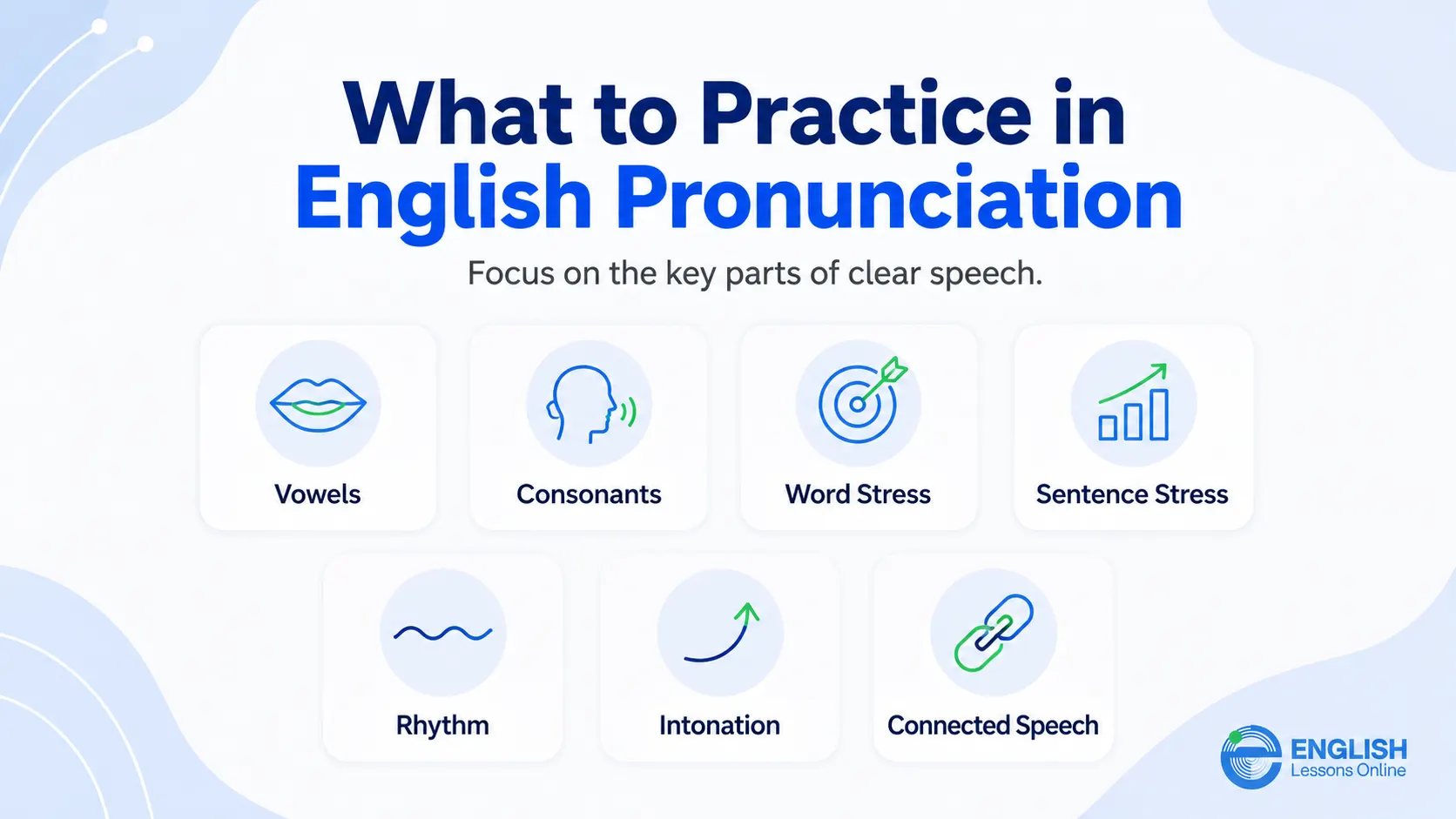
| Pronunciation part | What it means | Example | Why it matters |
| Vowel sounds | Sounds made with open airflow | ship / sheep | They can change word meaning |
| Consonant sounds | Sounds made with lips, teeth, tongue, or airflow | fan / van | They help words sound clear |
| Word stress | One syllable is stronger | TAble, aBOUT | It helps listeners recognize words |
| Sentence stress | Important words are stronger | I NEED help TODAY | It shows the main message |
| Rhythm | Strong and weak word pattern | I’d LIKE a CUP of TEA | It makes speech sound natural |
| Intonation | Voice rises and falls | Are you ready? ↗ | It shows questions, feelings, and meaning |
| Connected speech | Words join in natural speaking | an apple | It helps you understand real English |
Cambridge English organizes pronunciation activities around skills such as vowel sounds, word stress, intonation, and UK/US pronunciation. This supports a broad pronunciation practice plan, not only single-word repetition.
How can you pronounce English vowels and consonants more clearly?
You can pronounce English vowels and consonants more clearly by listening first, noticing mouth position, saying the sound slowly, and using it in words and sentences.
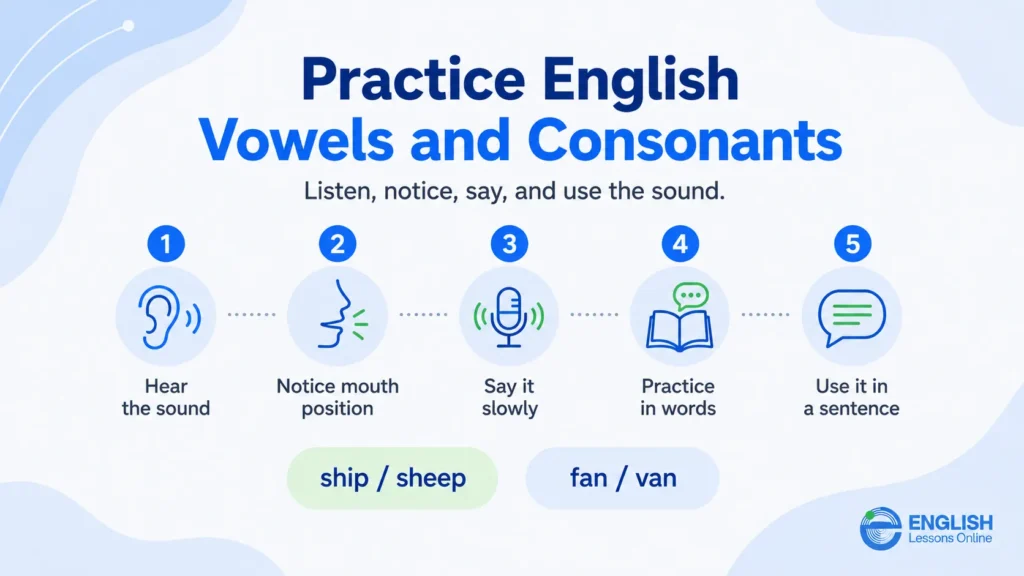
Use this simple method:
- Hear the sound.
- Notice the mouth position.
- Say the sound slowly.
- Practice the sound in words.
- Use the word in a sentence.
English vowel sound practice
Vowels can be difficult because small sound changes can create different words. Practice slowly first. Then use each word in a sentence.
| Sound focus | Practice words | Practice sentence |
| Short /ɪ/ | sit, live, ship | I live near the city. |
| Long /iː/ | seat, leave, sheep | Please leave the key with me. |
| /æ/ sound | bad, bag, map | I have a map in my bag. |
| /ɛ/ sound | bed, pen, send | Please send the email today. |
| /ʌ/ sound | cup, bus, lunch | I take the bus after lunch. |
| /ɑː/ sound | car, start, park | I start work near the park. |
| /ɔː/ sound | call, small, talk | I will call you after class. |
| /uː/ sound | food, school, move | We move to a new school soon. |
English consonant sound practice
Consonants often need clear lip, tongue, or teeth position. Pay attention to where the sound starts in your mouth.
| Sound focus | Practice words | Practice sentence |
| /v/ | van, visit, save | I will visit my friend tonight. |
| /b/ | bus, bring, job | I take the bus to my job. |
| /θ/ | think, three, month | I think the class starts at three. |
| /ð/ | this, they, mother | They are waiting in this room. |
| /ʃ/ | she, shop, finish | She will finish shopping soon. |
| /tʃ/ | chair, teacher, watch | The teacher is near the chair. |
| /r/ | red, ready, arrive | Are you ready to arrive early? |
| Final sounds | worked, asked, cold | I worked late and felt cold. |
Mouth and tongue position
Your mouth position changes the sound. Watch these parts:
- Lips: Are they open, rounded, or touching?
- Tongue: Is it high, low, forward, or behind the teeth?
- Teeth: Does the tongue touch or move near them?
- Jaw: Is your mouth wide or relaxed?
- Airflow: Does air move freely or stop?
- Voice: Do your vocal cords vibrate?
The University of Iowa Sounds of Speech resource uses animations, videos, and audio samples to show how consonants and vowels are made. It is useful when learners need to see mouth movement, not only hear the sound.
What are minimal pairs in English pronunciation?
Minimal pairs are two words that sound almost the same but differ by one sound and have different meanings.
Minimal-pair practice helps you hear and say small sound differences. This is useful when two English sounds are difficult for you.
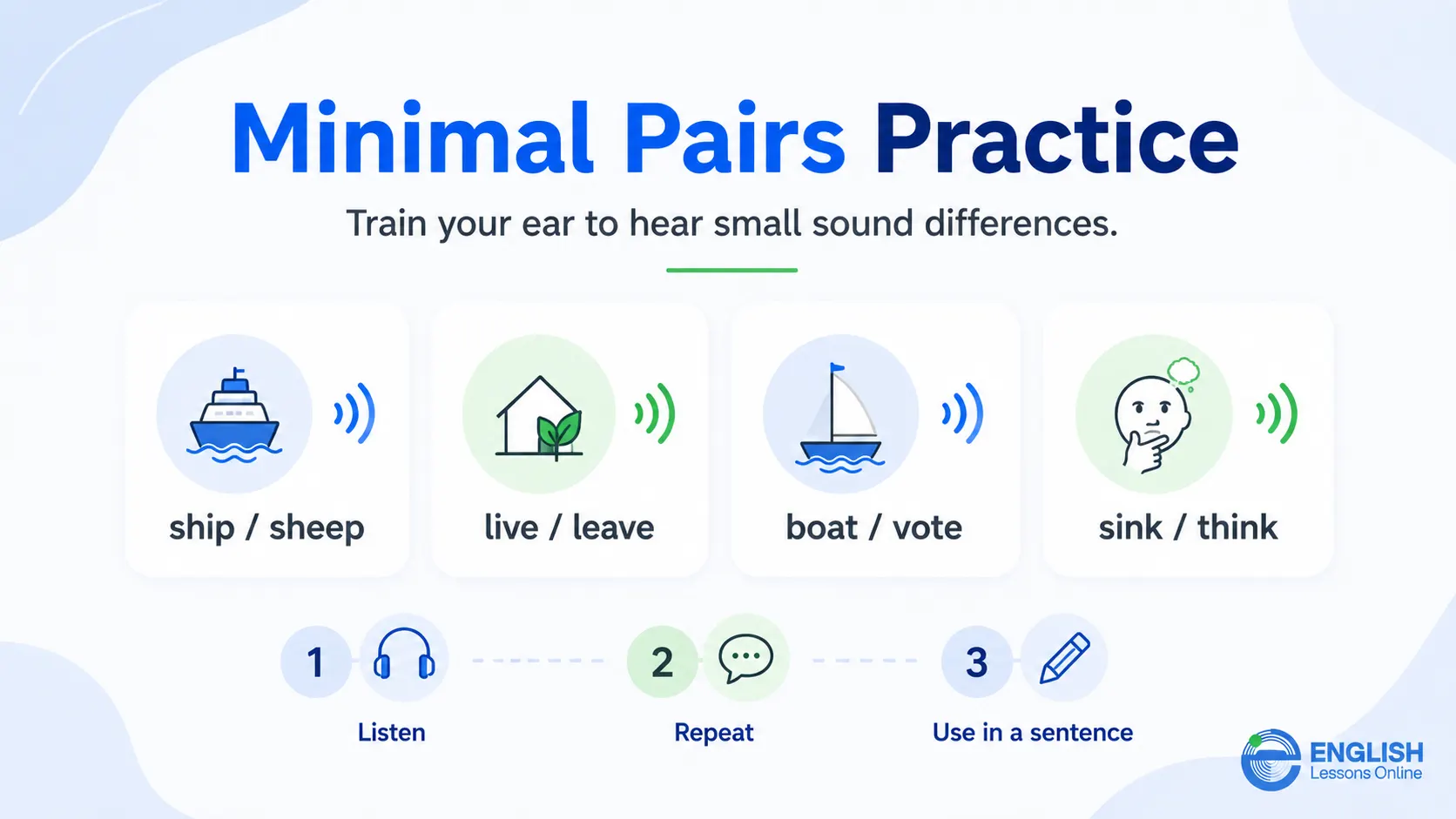
| Sound contrast | Word 1 | Word 2 | Practice sentence |
| /ɪ/ and /iː/ | ship | sheep | I saw a ship and a sheep. |
| /ɪ/ and /iː/ | live | leave | I live here, but I leave at six. |
| /b/ and /v/ | boat | vote | We vote before we get on the boat. |
| /s/ and /θ/ | sink | think | I think the key is near the sink. |
| /æ/ and /ɛ/ | bad | bed | The bad cat is on the bed. |
| /r/ and /l/ | rice | lice | I want rice, not lice. |
| /tʃ/ and /ʃ/ | cheap | sheep | The cheap sweater has a sheep on it. |
| /b/ and /v/ | bet | vet | I bet the vet can help. |
Start with five pairs. Listen first. Then repeat each word three times. After that, say the full sentence.
A full minimal-pairs article can go deeper with more sound groups, listening quizzes, and sentence drills.
How do word stress and sentence stress improve pronunciation?
Word stress and sentence stress improve pronunciation because they help listeners hear the most important parts of your speech.
Word stress means one syllable is stronger in a word.
Sentence stress means important words are stronger in a sentence.
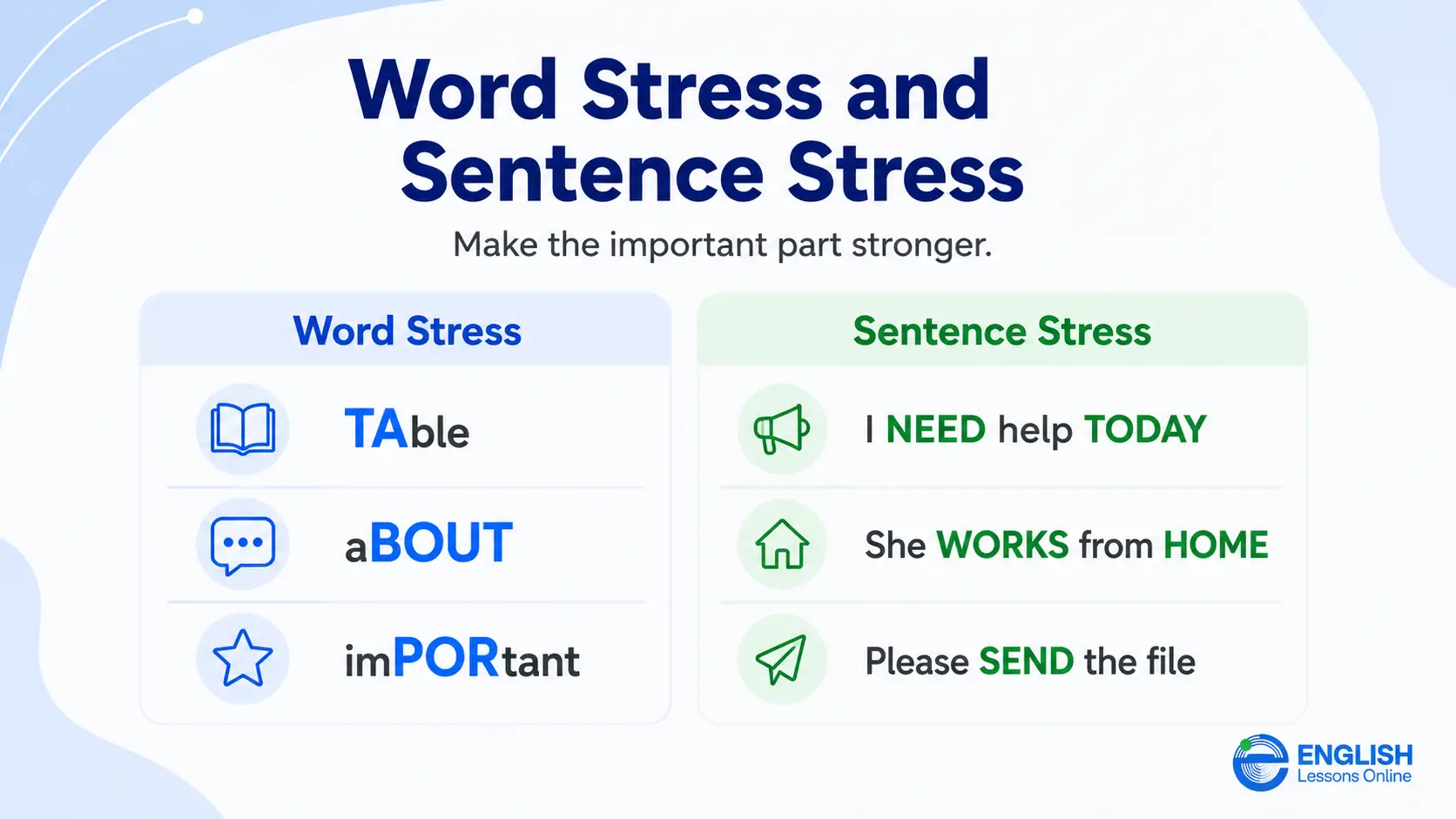
Word stress examples
Say the stressed part more clearly.
| Word | Stress pattern | Practice sentence |
| TAble | First syllable | The TAble is near the window. |
| TEAcher | First syllable | My TEAcher speaks clearly. |
| aBOUT | Second syllable | I want to talk aBOUT the schedule. |
| beGIN | Second syllable | We beGIN class at six. |
| imPORtant | Second syllable | This meeting is imPORtant. |
| proNUNciation | Fourth syllable | ProNUNciation takes regular practice. |
Sentence stress examples
In English, important words often sound stronger. Small grammar words are often weaker.
Practice these sentences:
- I NEED the report by FRIDAY.
- She WORKS from HOME.
- Can you CALL me TODAY?
- I LEFT my phone at WORK.
- We START class at SEVEN.
- Please SEND the file by EMAIL.
Do not stress every word equally. Choose the words that carry the main meaning.
How can you practice English rhythm and intonation?
You can practice English rhythm and intonation by stressing important words and using your voice to rise or fall at the right time.
Rhythm is the pattern of strong and weak words.
Intonation is the rise and fall of your voice.
Try these examples:
- Are you ready? ↗
- Where are you going? ↘
- Do you want tea ↗ or coffee? ↘
- I finished the report. ↘
- Can you help me today? ↗
- What time does class start? ↘
Use your hand to show the voice movement. Move your hand up for rising intonation. Move your hand down for falling intonation.
This helps your body feel the sentence pattern, not only read it.
What is connected speech in English?
Connected speech happens when English words join or change slightly in natural speaking.
English speakers do not always pronounce every word separately. Sounds connect between words. Some small words become weak. Some sounds become shorter.
Common connected speech patterns include:
- Linking sounds: an apple sounds connected.
- Weak forms: to, for, and can may sound shorter in fast speech.
- Contractions: I am → I’m, you are → you’re.
- Reduced sounds: going to may sound like gonna in informal speech.
- Schwa: a short, relaxed vowel sound in unstressed syllables.
Examples:
| Written form | Natural speech awareness | Practice sentence |
| an apple | sounds linked | I ate an apple. |
| next day | connected sounds | I will call you the next day. |
| want to | may sound like wanna in informal speech | I want to practice. |
| going to | may sound like gonna in informal speech | I am going to study tonight. |
You do not need to overuse informal reductions. But you should recognize them. This helps you understand real English conversations.
What are the best English pronunciation practice exercises?
The best English pronunciation practice exercises combine listening, speaking aloud, mouth control, sentence practice, recording, and feedback.
Here are 15 practical exercises you can use at home or in class.
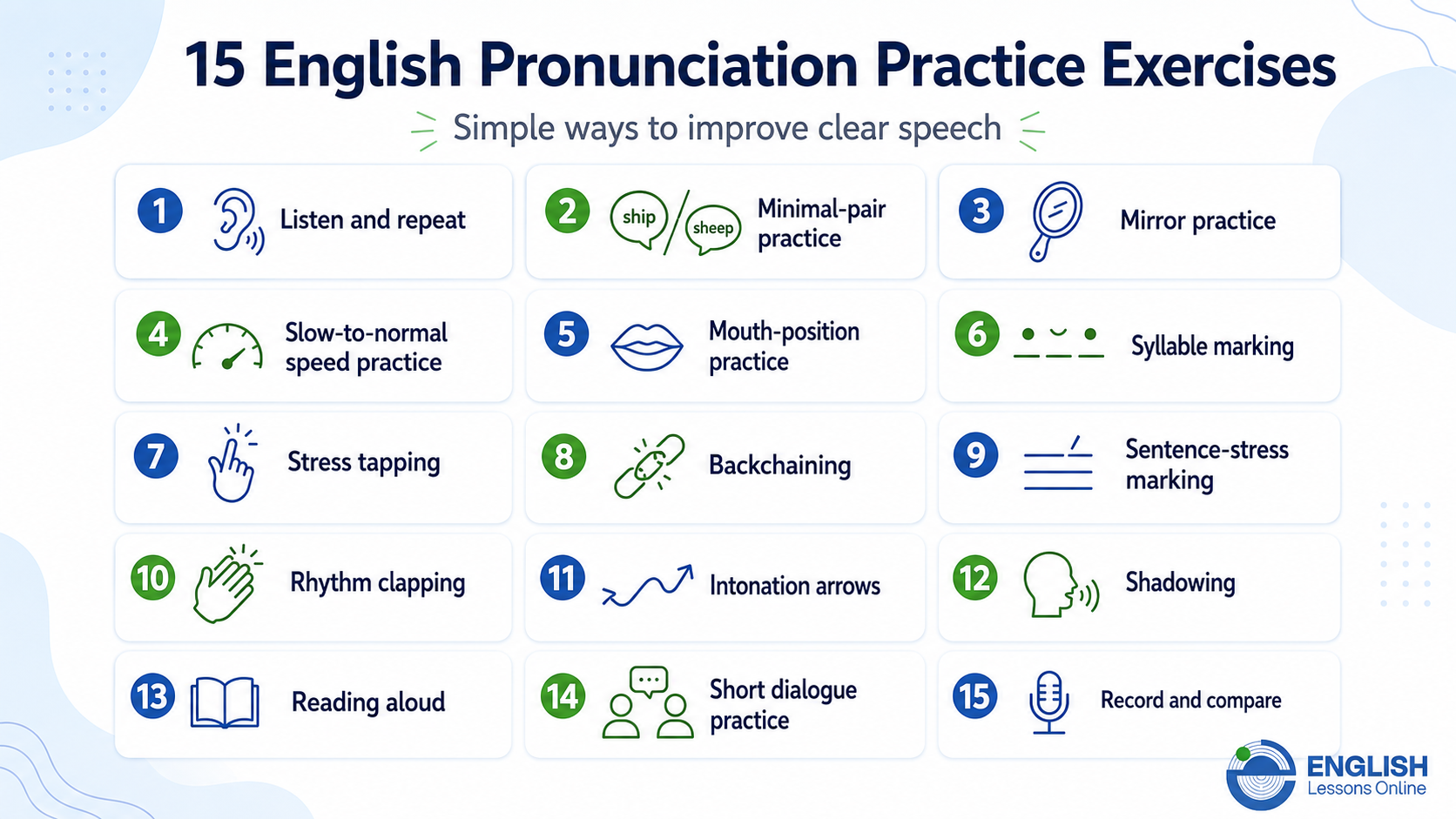
1. Listen and repeat
What it helps: Sound accuracy and listening.
How to do it: Listen to one word or sentence. Pause. Repeat it three times.
Example: “Please call me today.”
Beginner tip: Start with short sentences of 3–6 words.
2. Minimal-pair practice
What it helps: Similar sounds.
How to do it: Practice two words that differ by one sound.
Example: ship / sheep, live / leave.
Beginner tip: Listen before you speak. Do not guess from spelling.
3. Mirror practice
What it helps: Mouth position.
How to do it: Say a word while watching your mouth in a mirror.
Example: Practice /v/ in “very,” “visit,” and “save.”
Beginner tip: Notice if your lips, teeth, or tongue move correctly.
4. Slow-to-normal speed practice
What it helps: Control before speed.
How to do it: Say a word slowly. Then say it at natural speed.
Example: pro-nun-ci-a-tion → pronunciation.
Beginner tip: Clear speech first. Speed comes later.
5. Mouth-position practice
What it helps: Difficult consonants and vowels.
How to do it: Focus on one mouth movement.
Example: For /θ/ in “think,” place your tongue lightly between your teeth.
Beginner tip: Practice one sound for two minutes only.
6. Syllable marking
What it helps: Word stress.
How to do it: Divide a word into syllables and mark the strongest part.
Example: pro-NUN-ci-a-tion.
Beginner tip: Clap once for each syllable.
7. Stress tapping
What it helps: Strong and weak syllables.
How to do it: Tap the table when you say the stressed syllable.
Example: im-POR-tant.
Beginner tip: Make only one syllable clearly stronger.
8. Backchaining
What it helps: Long phrases.
How to do it: Start from the end and build backward.
Example: meeting → the meeting → for the meeting → ready for the meeting.
Beginner tip: Use this for difficult work phrases.
9. Sentence-stress marking
What it helps: Clear message meaning.
How to do it: Bold the important words before speaking.
Example: I NEED your HELP today.
Beginner tip: Do not stress every small word.
10. Rhythm clapping
What it helps: Natural English rhythm.
How to do it: Clap on the strongest words.
Example: I WANT to JOIN the CLASS.
Beginner tip: Clap slowly first.
11. Intonation arrows
What it helps: Questions and meaning.
How to do it: Add arrows to show voice movement.
Example: Are you free tonight? ↗
Beginner tip: Use rising intonation for many yes/no questions.
12. Shadowing
What it helps: Rhythm, stress, and natural speech.
How to do it: Listen to a short sentence and speak with the recording.
Example: “I’d like to make an appointment.”
Beginner tip: Use 5–10 second clips.
13. Reading aloud
What it helps: Speaking confidence and sentence flow.
How to do it: Read a short paragraph aloud after checking difficult words.
Example: Read a work email or short dialogue.
Beginner tip: Record one paragraph, not a full page.
14. Short dialogue practice
What it helps: Real conversation.
How to do it: Practice both sides of a short dialogue.
Example:
A: Can you help me with this form?
B: Yes, I can help you now.
Beginner tip: Use daily situations first.
15. Record and compare
What it helps: Self-correction.
How to do it: Record your voice and compare it with the model.
Example: Record “I need to leave at three.”
Beginner tip: Check one thing only, such as final sounds or stress.
How can you practice pronunciation with audio?
You can practice pronunciation with audio by listening, repeating, recording your voice, and reviewing one feature at a time.
Use this cycle:
- Listen without reading.
- Listen with the text.
- Repeat slowly.
- Repeat at natural speed.
- Record your voice.
- Compare one feature.
- Repeat with one correction.
Good audio practice should include a slow model and a natural-speed model. Use short clips. A long video can feel difficult, especially for beginners.
You can also use learner dictionaries to hear word pronunciation. Oxford Learner’s Dictionaries explains that its learner dictionary systems include British and American pronunciation support for learners. Merriam-Webster also provides written pronunciation information and audio for many dictionary entries.
Not sure which pronunciation exercises match your level? Take the free English placement test before you build your practice plan.
How does shadowing improve English pronunciation?
Shadowing improves pronunciation by helping you copy a speaker’s sounds, stress, rhythm, pauses, and intonation in real time.
Use this beginner-friendly method:
- Choose a 5–10 second audio clip.
- Listen two times.
- Read the sentence.
- Speak with the recording.
- Record your final version.
- Compare rhythm and stress.
Practice sentence:
I’d like to schedule a meeting for tomorrow morning.
First, say it slowly. Then listen to a natural model. Then say it again with the same rhythm.
Do not start shadowing with fast movies or long podcasts. Start with short, clear sentences.
Does reading aloud improve pronunciation?
Reading aloud can improve pronunciation when you check the words first and compare your speech with a reliable audio model.
Reading silently is not enough for pronunciation. Your mouth and voice need practice. Choose a short paragraph, check difficult words, mark stress, and record your voice.
Practice paragraph
Good morning, everyone. I am joining the meeting from home today. I can hear you clearly, but my camera is not working right now. I will listen to the discussion and share my update after Maria speaks. Please let me know if you need me to repeat anything.
After reading, ask yourself:
- Did I say the final sounds?
- Did I stress the important words?
- Was my speed comfortable?
- Did my voice go up or down naturally?
How should beginners practice English pronunciation?
Beginners should practice useful words, short phrases, and slow sentences before moving to longer speech.
Start small:
- help
- need help
- I need help
- Excuse me, I need help with this form.
This is better than practicing a long speech too early. You build confidence step by step.
Beginner tips:
- Practice one sound at a time.
- Speak slowly first.
- Record short sentences.
- Do not practice silently only.
- Use real daily words.
- Repeat useful phrases many times.
- Ask for feedback when you feel stuck.
Beginner pronunciation practice should feel simple and possible. You do not need perfect speech before you start speaking.
What pronunciation problems are common for Spanish speakers?
Spanish-speaking learners may need extra practice with English vowel contrasts, final consonants, TH sounds, V, English R, word stress, schwa, and sentence rhythm.
Common practice areas include:
| Practice area | Example | Practice sentence |
| B and V | boat / vote | We vote before we board the boat. |
| Short and long vowels | live / leave | I live here, but I leave soon. |
| TH sounds | think / this | I think this is correct. |
| SH and CH | ship / chip | The ship has a small chip. |
| English R | right / arrive | I will arrive at the right time. |
| Final consonants | work / worked | I worked late yesterday. |
| S + consonant | school, speak, start | I start school next week. |
| Schwa | about, support | I need support about this issue. |
| Sentence rhythm | I NEED help TODAY | Stress the main words clearly. |
Not every Spanish speaker has the same pronunciation pattern. Record your voice or ask a teacher to find your personal practice points.
For support, explore our English classes for Spanish speakers with bilingual support and live practice.
Should you practice American or British pronunciation?
You should choose one main pronunciation model for consistency, but you should learn to understand both American and British English.
One model helps your practice feel organized. Your choice can depend on your teacher, location, work, exams, or media. For example, learners in the United States may prefer American English pronunciation practice.
British and American pronunciation can differ in some vowel sounds, R sounds, word stress, and individual words. Cambridge English includes activities that compare UK and US pronunciation, which shows that this is a useful learning area.
Do not worry about choosing the “best” model. Choose the model that fits your real life.
What common English pronunciation mistakes should you avoid?
You should avoid relying only on spelling, speaking too quickly, ignoring final sounds, and practicing without feedback.
| Mistake | Why it causes problems | Better practice |
| Pronouncing every word exactly as spelled | English spelling and sounds do not always match | Check audio first |
| Speaking too quickly | Fast speech can hide unclear sounds | Slow down and repeat |
| Ignoring final consonants | Words may sound incomplete | Practice final sounds |
| Giving every syllable equal stress | Words sound harder to recognize | Mark the strongest syllable |
| Practicing words but not sentences | Real speech needs rhythm | Use full sentences |
| Fixing every sound at once | Practice becomes confusing | Choose one target |
| Practicing without recording | You may not hear your own patterns | Record and compare |
| Depending only on apps | Tools can miss context | Add human feedback |
| Avoiding real conversation | Practice stays isolated | Use short dialogues |
| Thinking accent means failure | Accent is normal | Focus on clarity |
Choose one mistake to fix this week. That is enough.
What is a good 15-minute English pronunciation routine?
A good 15-minute English pronunciation routine includes listening, focused sound practice, stress practice, shadowing, recording, and review.
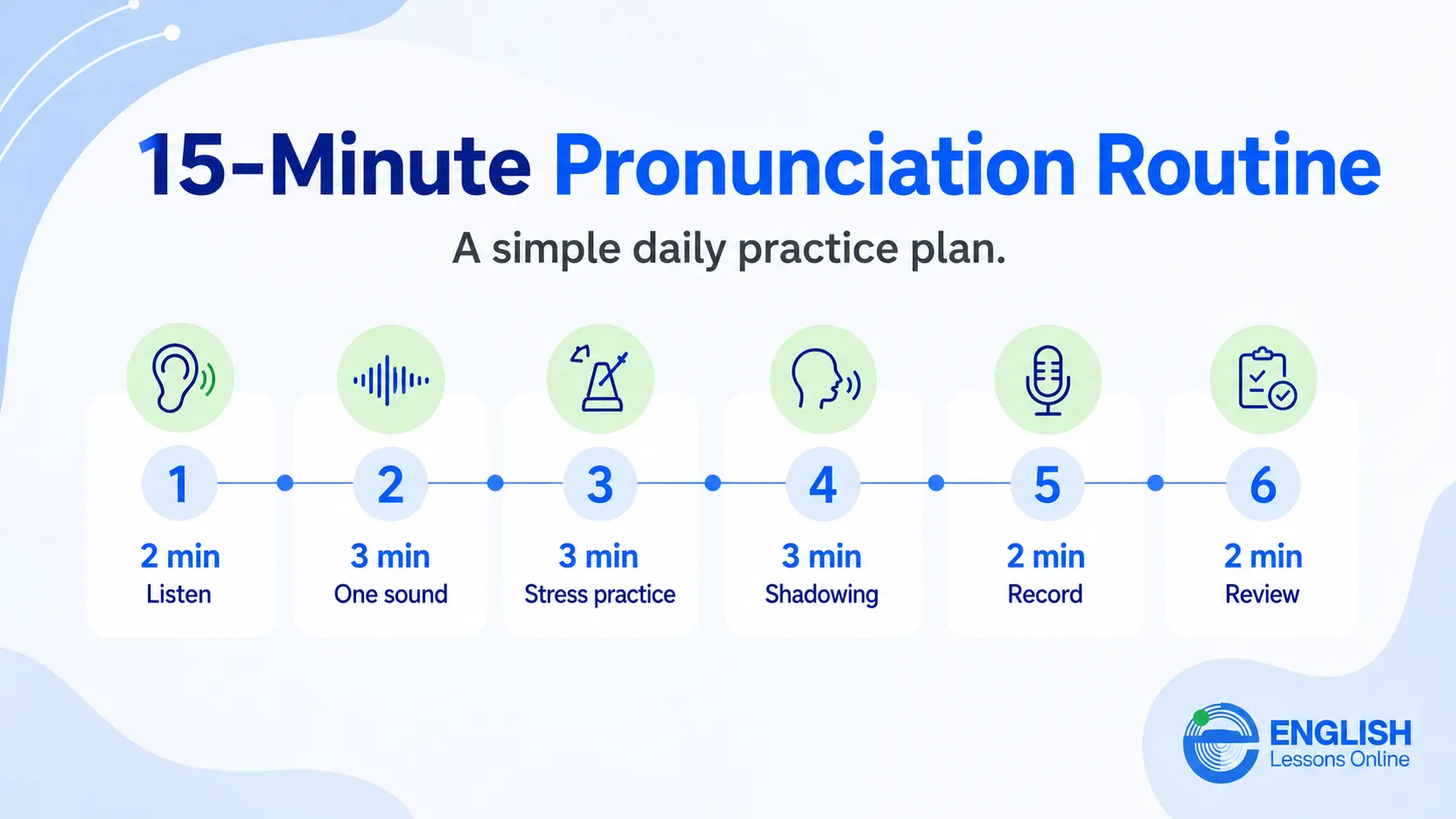
| Time | Activity | Goal |
| 2 minutes | Listen to the day’s audio | Hear the model |
| 3 minutes | Practice one sound or minimal pair | Improve sound control |
| 3 minutes | Practice word and sentence stress | Improve rhythm |
| 3 minutes | Shadow two short sentences | Copy natural speech |
| 2 minutes | Record one short response | Check clarity |
| 2 minutes | Review one correction | Plan the next practice |
This routine is short enough for busy adults. You can do it before work, after class, or during a quiet break.
Do not change everything every day. Use the same routine and change only the sound, sentence, or dialogue.
What can you practice in seven days?
A seven-day pronunciation plan helps you practice one skill at a time and check progress at the end of the week.
| Day | Main focus | Practice task | Progress check |
| Day 1 | Baseline recording | Record a 30-second introduction | Save the recording |
| Day 2 | Vowels | Practice 5 minimal pairs | Circle the hardest pair |
| Day 3 | Consonants | Practice one difficult consonant | Use it in 5 sentences |
| Day 4 | Word stress | Mark stress in 10 words | Record the word list |
| Day 5 | Rhythm and intonation | Practice 5 questions and statements | Add arrows and stress marks |
| Day 6 | Connected speech and shadowing | Shadow a short dialogue | Compare rhythm |
| Day 7 | Progress recording | Record the Day 1 introduction again | Compare both recordings |
Use the same speaking topic on Day 1 and Day 7. This makes progress easier to hear.
When should you ask an English teacher for feedback?
You should ask an English teacher for feedback when you cannot hear the problem, repeat the same mistake, or need clearer speech for work, study, or important conversations.
A teacher can help you with:
- Mouth and tongue position
- Difficult sounds
- Word stress
- Sentence rhythm
- Intonation
- Speaking speed
- First-language pronunciation patterns
- Real conversation practice
| Practice option | Best for |
| Self-study | Daily repetition and confidence |
| App or speech-to-text | Quick checks and extra practice |
| Group class | Conversation practice and regular speaking |
| Private lesson | Personal correction and specific pronunciation goals |
EnglishLessons.Online offers live online English classes through Zoom. Learners can choose group classes or private lessons based on their level, schedule, and goals. Group classes include up to 10 students, and private lessons can give more individual correction.
Want guided pronunciation and speaking feedback? Join a live online English class, practice with a certified instructor, and build clearer speech step by step.
Frequently asked questions
How can I practice English pronunciation?
You can practice English pronunciation by listening to a reliable audio model, repeating aloud, recording your voice, and comparing one feature at a time. Start with sounds, then words, then sentences. Practice daily with short, focused exercises.
Can I improve English pronunciation by myself?
Yes. You can improve pronunciation by yourself with audio practice, minimal pairs, shadowing, reading aloud, and regular recordings. Self-study works best when you focus on one clear target. Teacher feedback helps when you cannot identify the problem alone.
How many minutes should I practice pronunciation each day?
Practice for about 10–15 focused minutes each day. Short daily practice is easier to maintain than one long weekly session. Choose one sound, sentence pattern, or speaking feature, then repeat it carefully and record your voice.
Does reading aloud improve pronunciation?
Yes. Reading aloud can improve articulation, stress, rhythm, and speaking confidence. It works best when you check difficult words first and compare your recording with a reliable audio model. Do not read too fast at the beginning.
What is the shadowing technique?
Shadowing is a pronunciation practice method where you repeat spoken English immediately after or with a speaker. It helps you copy sounds, word stress, rhythm, pauses, and intonation. Beginners should use short, slow audio clips first.
How can I check whether my pronunciation is correct?
You can check your pronunciation by comparing your recording with a reliable audio model. You can also use speech-to-text, ask a teacher, or ask a fluent speaker if your message is clear. Check one feature at a time.
Should I learn American or British pronunciation?
Choose one main model for consistent practice, but learn to understand both. Your choice can depend on your location, teacher, workplace, exam plans, or the media you use. One model helps you stay organized while practicing.
Can adults improve English pronunciation?
Yes. Adults can improve English pronunciation with focused listening, repeated speaking, mouth-position practice, feedback, and regular review. Adult learners may need patience, but clear progress is possible when practice is specific and consistent.
What are minimal pairs in English?
Minimal pairs are two words that differ by one sound and have different meanings. Examples include ship and sheep, fan and van, and sink and think. They help you hear and practice small sound differences.
How long does pronunciation improvement take?
There is no fixed timeline for every learner. You may improve one sound after regular focused practice, but stress, rhythm, and natural conversation usually take longer. Track progress with recordings so you can hear small improvements.
Start practicing English pronunciation today
English pronunciation practice works best when it is simple and regular. Choose one target. Listen carefully. Say the word or sentence aloud. Record your voice. Then use the sound in real sentences.
You do not need to fix every sound this week. Start with one useful change. Maybe you practice final consonants. Maybe you practice word stress. Maybe you shadow two short sentences every day.
Clear pronunciation grows step by step. The more you practice with real words and real situations, the more confident you can feel when speaking.
Ready to practice with a teacher? Book a Free Trial Class or Take the Free English Placement Test to find your level.
Continue improving your English
- How to Practice English Speaking: Complete Guide
Learn practical methods for speaking aloud, recording yourself, building fluency, and practicing real conversations. - How to Speak English Fluently: 12 Daily Habits That Work
Use simple daily habits to improve pronunciation, sentence rhythm, vocabulary recall, and speaking confidence. - How to Learn English Step by Step: Beginner Roadmap
Follow a clear learning order for building vocabulary, grammar, listening, pronunciation, and speaking skills.