
Practicing spoken English means using English out loud every day so your mouth, ears, and brain get used to real communication. You do not need perfect grammar to start. You need simple sentences, regular practice, useful feedback, and real speaking time.
English speaking practice is not only a study activity. It prepares you for real communication. The EF English Proficiency Index 2025 is based on 2.2 million adult test takers across 123 countries and regions, showing that English ability remains a global education and workforce issue.
EF’s workplace analysis also reports that speaking and listening are often weaker than reading and writing, although they are the skills most needed in meetings, interviews, client calls, and daily communication. Regular speaking practice can help you improve fluency, pronunciation, response time, and confidence in real conversations.
This guide explains how to practice English speaking step by step. It is written for beginners, adults, and learners who want to speak more clearly in daily life, work, school, travel, or interviews.
You can practice English speaking every day by speaking out loud for a short time, using real-life sentences, repeating useful phrases, recording your voice, and speaking with another person when possible.
Short daily practice is usually more effective than one long weekly session. Speaking is a skill. It improves through repetition, correction, and confidence. Even 10 to 20 minutes a day can help you become more comfortable with English sounds, sentence patterns, and common conversations.
Short daily speaking sessions help you build a regular English speaking habit without feeling tired or overwhelmed.
Start with 5 minutes if you are a beginner. Then increase to 10, 15, or 20 minutes as you feel more comfortable. The goal is not to speak perfectly. The goal is to speak often.
You can use this simple daily structure:
This routine combines speaking, pronunciation, fluency, and self-correction in one short practice session. You may also find useful our guide on how to build your foundation of English step by step for beginners.
Speaking about your real life helps you use English for topics you actually need.
Do not only practice random textbook sentences. Talk about your job, family, food, routine, plans, problems, and goals. These topics are useful because they appear in real conversations.
For example, you can say:
Real-life speaking practice helps you remember words faster because the words are connected to your daily actions.
Repeating useful sentences helps your brain remember English patterns automatically.
Many learners study grammar rules but cannot speak quickly. This happens because they know the rule, but they have not practiced the sentence pattern enough.
Instead of memorizing only single words, repeat complete sentences. For example:
Repeat each sentence 5 to 10 times. Say it slowly first. Then say it more naturally. This builds fluency because you are training your mouth to use common English structures.
Recording your voice helps you hear your pronunciation, rhythm, grammar, and fluency more clearly.
Many learners do not notice their speaking mistakes while they are talking. Recording helps you listen from the outside. You can hear missing sounds, unclear words, long pauses, or sentences that need correction.
Use your phone and record 30 to 60 seconds. Then ask yourself:
Do not judge yourself too harshly. The goal is improvement, not perfection.
Practicing with another person gives you real conversation experience and helps you respond faster in English.
Self-practice is useful, but real conversations are also important. Real conversation teaches you how to listen, answer, ask questions, and continue a conversation.
You can practice with:
Ask the person to correct only 1 or 2 important mistakes at a time. Too many corrections can make you nervous. Simple correction helps you improve while still enjoying the conversation.
You can practice English speaking alone by talking to yourself, describing your actions, reading aloud, shadowing simple audio, answering common questions, and making a short voice diary.
Practicing alone is useful because you can speak anytime. You do not need a partner, a classroom, or a perfect schedule. It is also helpful for shy learners who feel nervous speaking in front of others.
Alone practice helps you prepare before real conversations. It builds vocabulary, pronunciation, sentence control, and confidence.
Talking to yourself in English helps you think in English and speak more naturally.
Choose one simple topic and speak out loud. You can talk about your day, your plans, your feelings, or what you need to do.
Examples:
This may feel strange at first. That is normal. After a few days, it becomes easier.
Describing your actions in English helps you connect vocabulary with daily life.
This is one of the easiest speaking exercises for beginners. You only need to say what you are doing at the moment.
Examples:
This exercise is useful because it teaches common verbs, present tense, and everyday nouns.
Reading short texts aloud helps you practice pronunciation, word stress, sentence rhythm, and clear speaking.
Choose a short paragraph from a beginner English article, class lesson, or simple story. Read it slowly. Focus on clear sounds and natural pauses.
Use this method:
Reading aloud is not the same as free speaking, but it prepares your mouth for English pronunciation.
Shadowing means listening to English audio and repeating it at almost the same time.
This method helps you copy pronunciation, rhythm, stress, and connected speech. It is useful because English does not always sound the same as it looks on the page.
Start with simple audio. Do not use fast movies or difficult podcasts in the beginning.
Use this shadowing method:
Example sentence:
“I’d like a cup of coffee, please.”
Repeat it until it feels smooth and natural.
Answering common questions out loud prepares you for real English conversations.
Many conversations use repeated question patterns. If you practice these questions, you will respond faster when someone asks you in real life.
Practice questions like:
Do not answer with one word only. Try to answer with 2 or 3 complete sentences.
Example:
“I am learning English because I want to speak better at work. I also want to feel more confident when I talk to new people.”
A 1-minute voice diary helps you practice fluency, self-expression, and daily speaking consistency.
A voice diary is simple. Record yourself speaking for 1 minute every day. Talk about what happened, what you learned, or what you will do tomorrow.
You can use these prompts:
After 7 days, listen to your first recording and your latest recording. You will usually notice better confidence, smoother sentences, and clearer pronunciation.
You can practice speaking English with other people by joining live classes, speaking with a conversation partner, using group classes, asking for simple correction, and practicing daily conversations.
Speaking with others is important because real communication includes listening, answering, asking, and reacting. You also learn how to continue when you forget a word or make a mistake.
This type of practice builds confidence faster because you use English in real time.
Live English classes give you regular speaking practice with a teacher and other learners.
A live class is different from watching recorded lessons. In a live class, you speak, listen, answer questions, and receive feedback. This helps you practice real communication.
Live online classes are useful for adult learners because they provide:
EnglishLessons.Online offers live English classes through Zoom for different levels, including beginner, intermediate, upper-intermediate, advanced, and TOEFL preparation. Learners can choose group classes or private lessons based on their goals.
A conversation partner helps you practice English in a relaxed and natural way.
Your partner does not need to be perfect. The goal is to speak regularly and stay active in the conversation.
You can practice:
Set a simple rule before you start. For example, speak only English for 10 minutes. Then use 2 minutes for correction or questions.
Group classes help you build confidence by speaking with different people in a supportive setting.
Many learners feel nervous when speaking English with strangers. Group classes help reduce this fear because everyone is learning. You hear different accents, answers, and speaking styles.
Group speaking practice helps you:
Small group classes are especially useful because you get both teacher support and peer speaking practice.
Simple correction helps you improve without stopping your speaking flow.
Do not ask someone to correct every mistake while you speak. This can make you afraid to talk. A better method is to speak first and correct after.
Ask your teacher or partner:
This keeps the conversation natural and still gives you useful feedback.
Common daily conversations help you use English for real situations, not only classroom exercises.
Start with situations you need often. Practice the same conversation several times until it becomes easier.
Useful daily conversations include:
Real-life speaking practice builds practical English. It also helps you feel prepared before the situation happens.
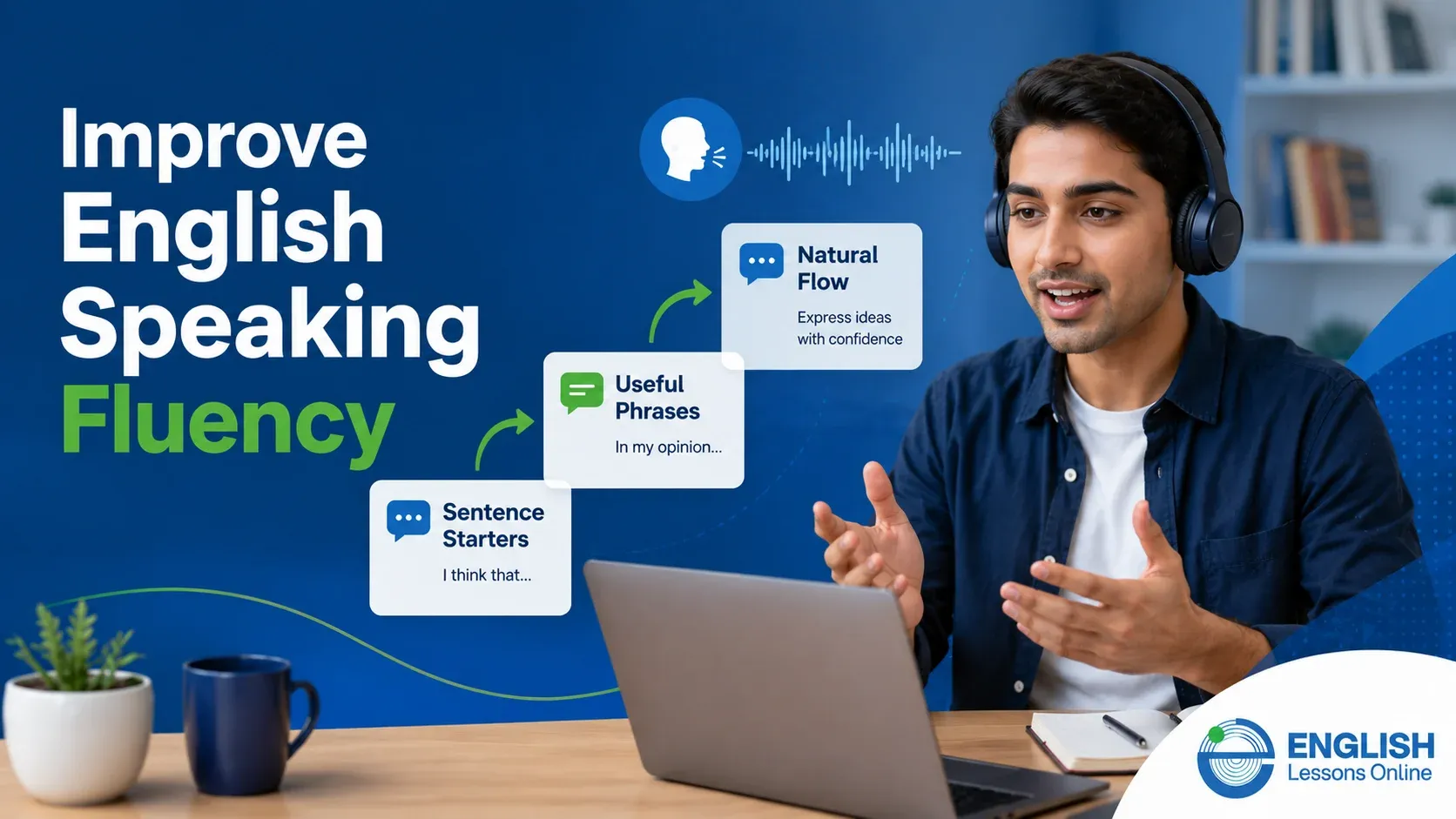
You can improve English speaking fluency by learning phrases, using sentence patterns, reducing translation, speaking slowly first, and repeating the same topic several times.
Fluency does not mean speaking very fast. Fluency means speaking smoothly enough for another person to understand you. A fluent speaker can continue speaking, even with small mistakes.
Learning phrases helps you speak faster because you do not build every sentence word by word.
Single words are useful, but phrases are more useful for speaking. A phrase gives you a ready-made structure.
For example, do not only learn the word “opinion.” Learn phrases like:
These phrases help you start speaking quickly and naturally.
Sentence patterns help you create many sentences from one structure.
A sentence pattern is a reusable grammar shape. You can change the words but keep the structure.
Example pattern:
“I usually ___ in the morning.”
You can say:
This method helps beginners and intermediate learners speak with less hesitation.
You can reduce translation by using simple English patterns and thinking in short English sentences.
Many learners translate from their first language before speaking. This slows down conversation. To improve, start with easy English thoughts.
Instead of thinking a long sentence in your language, use short English ideas:
Thinking in simple English helps your brain respond faster.
Speaking slowly helps you become clearer and more accurate before you increase speed.
Many learners try to speak fast because they think fast speech means fluent speech. This is not true. Clear speech is more important than fast speech.
Start slowly. Use short sentences. Pause between ideas. Then increase speed when the sentence feels natural.
A good speaking pattern is:
This builds fluency without losing clarity.
Repeating the same topic helps you speak with fewer pauses and better sentence control.
Choose one topic and speak about it 3 times. Each time, improve one part.
Example topic: “My daily routine”
First try: speak for 30 seconds.
Second try: add more details.
Third try: speak more smoothly.
This method works because your brain already knows the topic. You can focus on fluency, pronunciation, and better phrases.
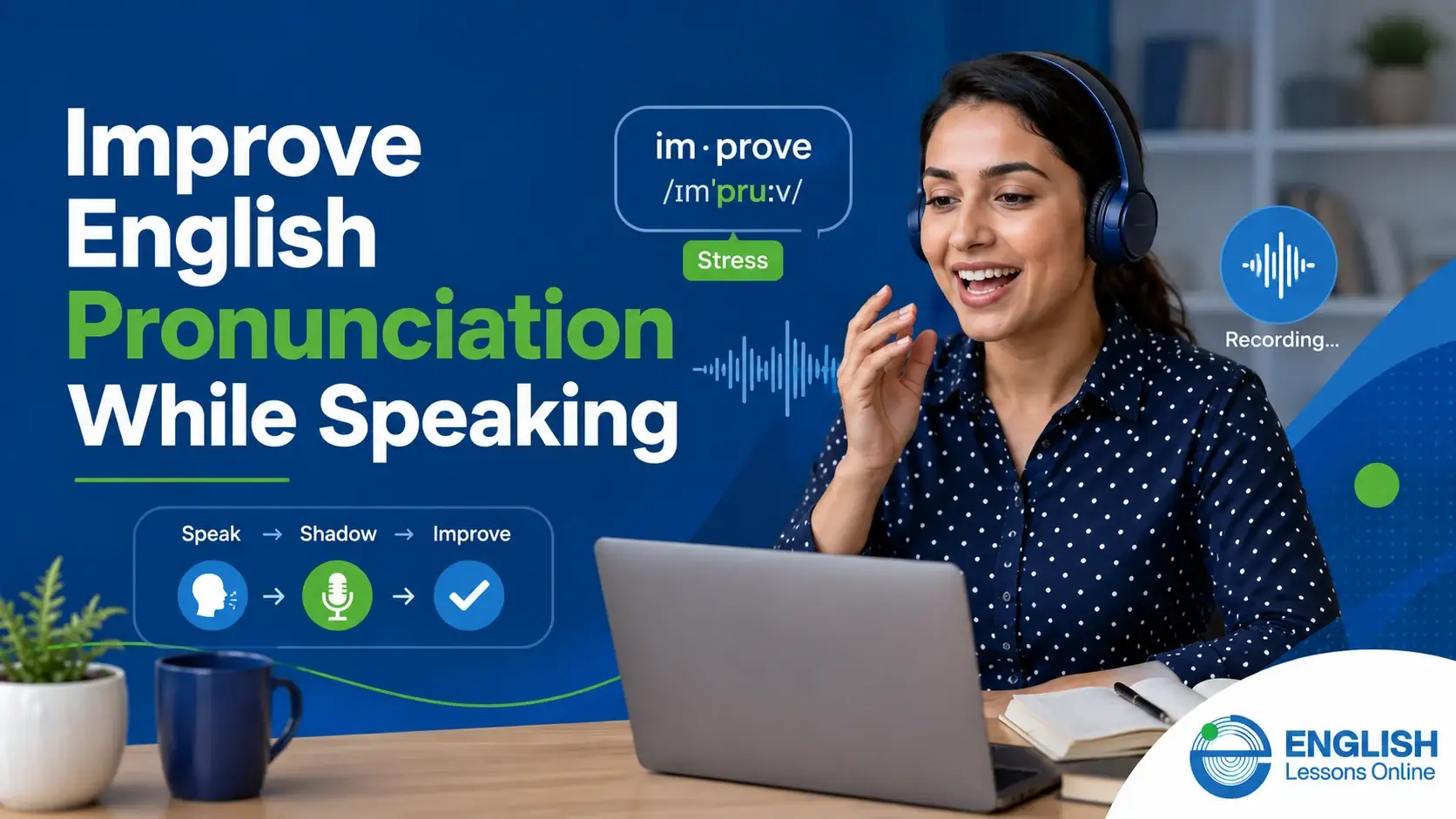
You can improve English pronunciation by listening before repeating, practicing word stress and sentence stress, recording difficult sounds, comparing your speech with clear audio, and focusing on being understood.
Pronunciation is not about removing your accent. It is about speaking clearly so people understand you. Many English learners can communicate well with an accent. The goal is clear speech, correct stress, and understandable rhythm.
Listening before repeating helps you hear the correct sound, stress, and rhythm of English.
Do not only read the word. Listen to how the word sounds. English spelling can be confusing, so audio is important.
Use this process:
For example, the word “comfortable” may not sound exactly how it looks. Listening helps you copy the real sound.
Word stress and sentence stress help your English sound clearer and more natural.
Word stress means one part of a word is stronger. Sentence stress means some words in a sentence are stronger than others.
Example:
“I need to PRACTICE speaking.”
The important words are “need,” “practice,” and “speaking.” These words carry the main meaning.
Practice stress with useful sentences:
Good stress helps listeners understand you more easily.
Recording difficult sounds helps you notice pronunciation problems and track your improvement.
Some English sounds may be hard because they do not exist in your first language. For example, learners may struggle with “th,” “v,” “r,” “l,” final consonants, or vowel sounds.
Choose 3 difficult words and record them every day.
Example:
Say each word alone. Then say it in a sentence.
Example:
“I think this is very important.”
This gives you pronunciation practice inside real speech.
Comparing your speech with clear audio helps you hear the difference between your pronunciation and the target pronunciation.
Use short audio from a teacher, class lesson, dictionary, or simple English recording. Listen to one sentence. Record yourself saying the same sentence. Then compare.
Check these points:
Do not compare your voice to become perfect. Compare it to become clearer.
Clear pronunciation is more important than perfect pronunciation.
You do not need to sound exactly like a native speaker to speak English well. You need to be understood in real situations.
Focus on:
Confidence grows when people understand you. Start with clarity. Accuracy will improve with practice, feedback, and repetition.
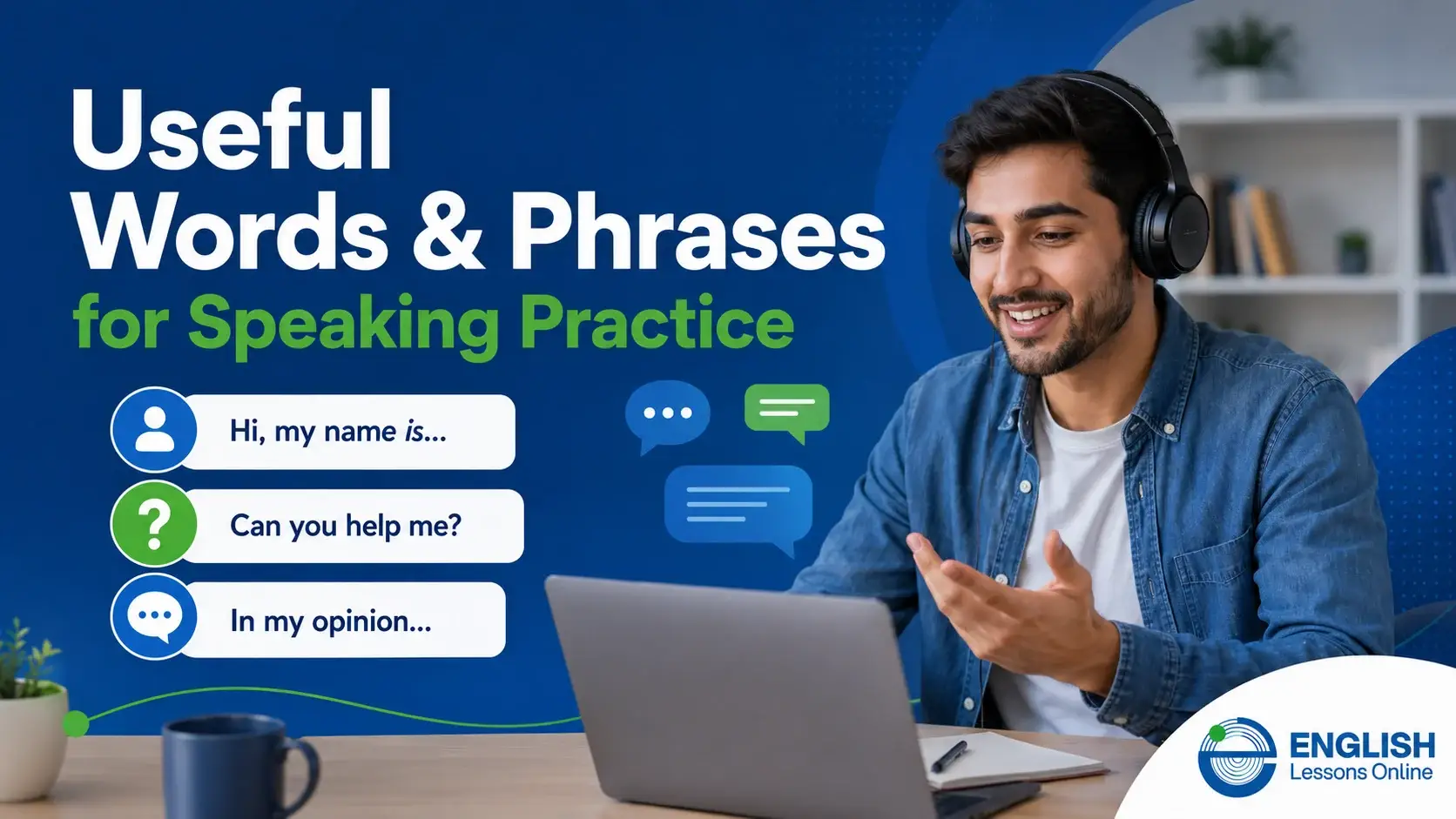
Beginners and adult learners should practice useful words and phrases for greetings, introductions, daily life, work, questions, opinions, and problem-solving first.
These phrases help you speak in real situations. You do not need thousands of words to begin speaking. You need the right words for the conversations you use most.
Start with simple phrases you can use every day. Repeat them until they feel easy. Then change small parts of the sentence to make new sentences.
For example:
“I need help with this.”
You can change it to:
This is how one useful sentence becomes many real speaking sentences.
Greetings and introductions are the first phrases you need for most English conversations.
These phrases help you start speaking politely and confidently. They are useful in class, at work, online meetings, interviews, and daily life.
Practice these sentences:
You can also practice a short introduction:
“Hi, my name is Maria. I’m from Mexico, and I live in New York. I work in customer service. I’m learning English because I want to speak more confidently at work.”
This type of practice helps you answer common first questions without feeling stuck.
Work and daily life phrases help you use English for practical communication.
Many learners need English for normal tasks, not only school. They need to talk to coworkers, ask for help, answer phone calls, book appointments, order food, and explain simple problems.
Useful daily life phrases include:
Useful work phrases include:
These phrases are short, but they are powerful. They help you speak when you need something.
Questions keep conversations moving and help you understand other people.
Many learners only practice answers. But questions are just as important. If you can ask questions, you can start conversations, continue conversations, and ask for help when you do not understand.
Practice these common questions:
You can practice question and answer pairs.
Example:
Question: “Why are you learning English?”
Answer: “I’m learning English because I want to speak better at work and feel more confident.”
Question: “What do you do?”
Answer: “I work in a restaurant. I talk to customers, take orders, and help my team.”
This builds conversation flow.
Opinion phrases help you speak in discussions, classes, meetings, and interviews.
You do not always need complex vocabulary to share your opinion. You can use simple phrases to explain what you think.
Useful opinion phrases include:
Example:
“In my opinion, speaking practice is more useful when I get correction. I can notice my mistakes and improve faster.”
This type of sentence is useful for English classes, job interviews, workplace meetings, and real conversations.
Problem-solving phrases help you explain issues and ask for solutions clearly.
These phrases are useful when something goes wrong. You may need them at work, at school, while traveling, or during daily tasks.
Practice these sentences:
Example:
“I have a problem with my schedule. I need to change my class time. Can you help me?”
These phrases help you stay calm and communicate clearly.
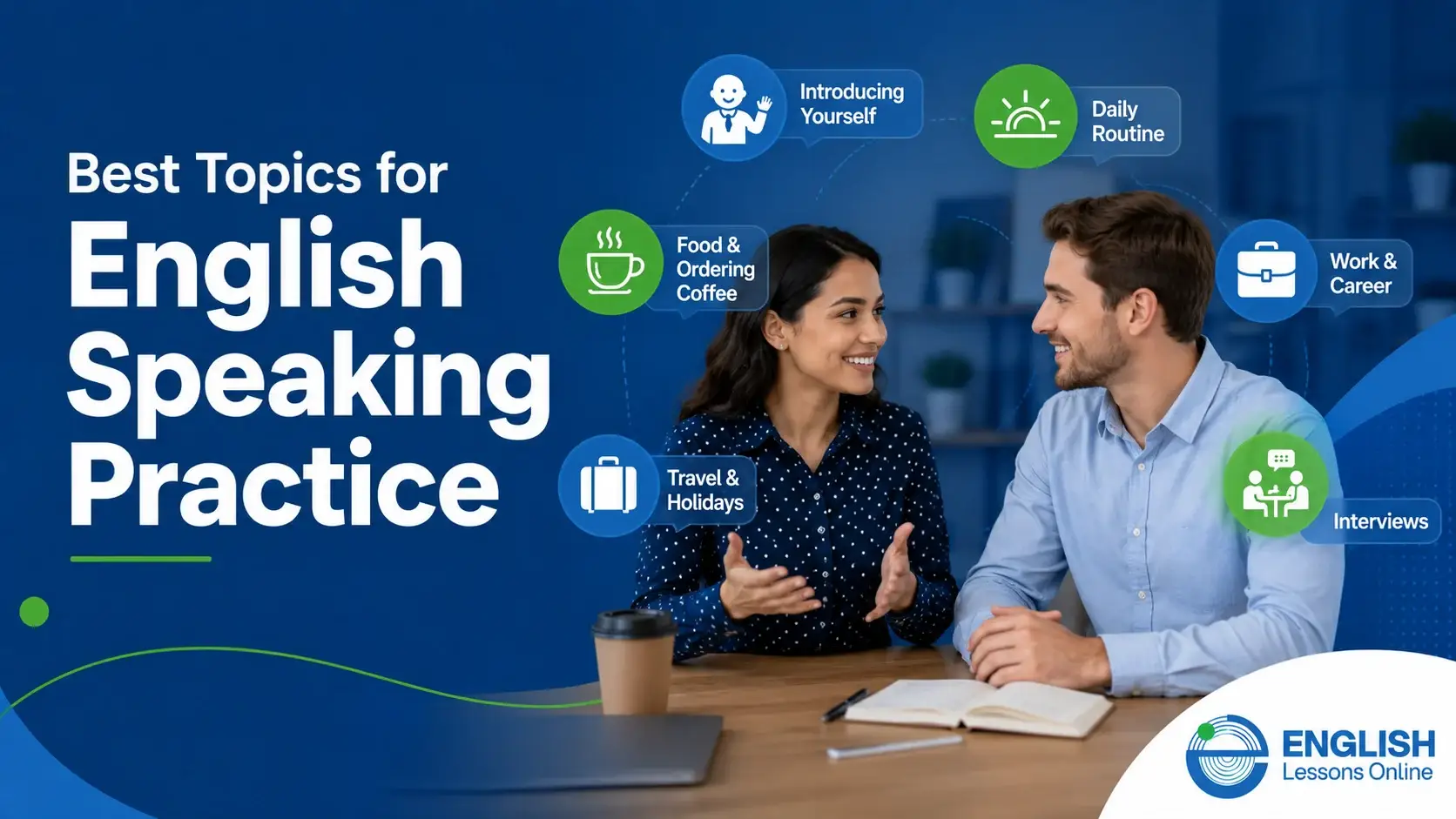
The best topics for English speaking practice are real-life topics you use in daily conversations, work, travel, appointments, family life, and interviews.
Choose topics that match your life. A beginner does not need to start with difficult debate topics. Start with simple situations. Then add more details as your English improves.
Good speaking topics include:
These topics are useful because they help you speak in situations that actually happen.
Talking about yourself is one of the most useful English speaking topics for beginners.
You often need to introduce yourself in classes, interviews, meetings, and social situations. Practice your basic personal information until it feels easy.
You can talk about:
Example:
“My name is Ahmed. I’m from Egypt, but I live in the United States now. I work in a store. I’m learning English because I want to talk to customers more confidently.”
This gives you a strong base for many conversations.
Ordering food or coffee helps you practice polite requests, numbers, prices, and common restaurant phrases.
This is a real situation many learners face. You can practice it alone, with a partner, or in class.
Useful phrases include:
Example conversation:
Customer: “Hi, can I have a medium coffee, please?”
Server: “Sure. Anything else?”
Customer: “Yes, I would like a chicken sandwich.”
Server: “For here or to go?”
Customer: “To go, please.”
This practice builds confidence for daily English.
Workplace speaking practice helps you communicate with coworkers, managers, customers, and clients.
Many adult learners need English for their job. They may need to ask questions, explain problems, give updates, answer customers, or join meetings.
Useful work topics include:
Example:
“I finished the first part of the task. I need more time for the second part because I have one problem with the file. Can you check it with me?”
This is clear, polite, and useful.
Appointment practice helps you speak with clinics, schools, offices, service providers, and businesses.
This topic is important for daily life. You may need to book, change, or cancel an appointment.
Useful phrases include:
Example:
“Hello, I would like to make an appointment for next week. Do you have anything available on Monday morning?”
This practice helps you speak more clearly on the phone and in person.
Asking for help is one of the most important speaking skills for English learners.
You should not stay silent when you do not understand. Asking for help is part of real communication.
Practice these phrases:
Example:
“I don’t understand this sentence. Can you explain it with a simple example?”
This helps you learn faster and feel less afraid.
Family, travel, and daily routines are easy topics because they connect to your real life.
These topics are good for beginners and intermediate learners. You already know the ideas. You only need English words and sentence patterns.
You can practice sentences like:
These topics help you practice present tense, past tense, future plans, and common verbs.
Interview speaking practice helps you answer common job, school, and visa-related questions with more confidence.
Interviews can feel stressful because you need to answer clearly and quickly. Practice common questions before the interview.
Common interview questions include:
Example answer:
“I have three years of customer service experience. I am friendly, patient, and organized. I want this job because I enjoy helping people and I want to grow in this company.”
Practice your answers out loud. Reading silently is not enough.
Beginners can start speaking English by using simple sentences, practicing present tense, answering common questions, speaking before their grammar is perfect, and building confidence step by step.
You do not need to know all English grammar before you speak. Speaking starts with small sentences. Then you add more words, better grammar, and clearer pronunciation over time.
The most important rule is start speaking with the English you already know.
Simple sentences help beginners speak clearly without feeling confused.
Start with subject + verb + object.
Examples:
Then add one detail.
This makes speaking easier and more natural.
Present tense is the best first tense for beginners because it helps you talk about daily life.
You can use present tense to talk about your routine, job, likes, needs, and habits.
Examples:
After present tense feels easy, add past and future sentences.
Past:
Future:
This step-by-step method keeps speaking simple.
Common question and answer practice helps beginners prepare for real conversations.
Start with questions people ask often. Practice short answers first. Then make your answers longer.
| Common question | Simple answer | Longer answer |
| What is your name? | My name is Ana. | My name is Ana, and I’m from Mexico. |
| Where do you live? | I live in New York. | I live in New York with my family. |
| What do you do? | I work in a restaurant. | I work in a restaurant, and I help customers. |
| Why are you learning English? | I want to speak better. | I want to speak better at work and feel more confident. |
| What do you do every day? | I go to work. | I go to work, study English, and spend time with my family. |
This table gives you ready speaking practice. Read the answers aloud. Then change the details to match your life.
You should not wait for perfect grammar before speaking English.
Many learners stay silent because they are afraid of mistakes. But speaking improves through mistakes, correction, and practice. If you wait until everything is perfect, you may never start speaking.
A simple sentence with a small mistake is still useful. For example, if you say, “Yesterday I go to work,” people may understand you. Then your teacher can help you correct it: “Yesterday I went to work.”
This is how speaking improves.
Speak first. Correct after. Repeat again.
Confidence grows when you practice small speaking tasks and repeat them often.
Do not begin with a long speech if you are nervous. Start with one sentence. Then speak for 30 seconds. Then speak for 1 minute. Then join a short conversation.
Use this confidence ladder:
Small wins build speaking confidence.
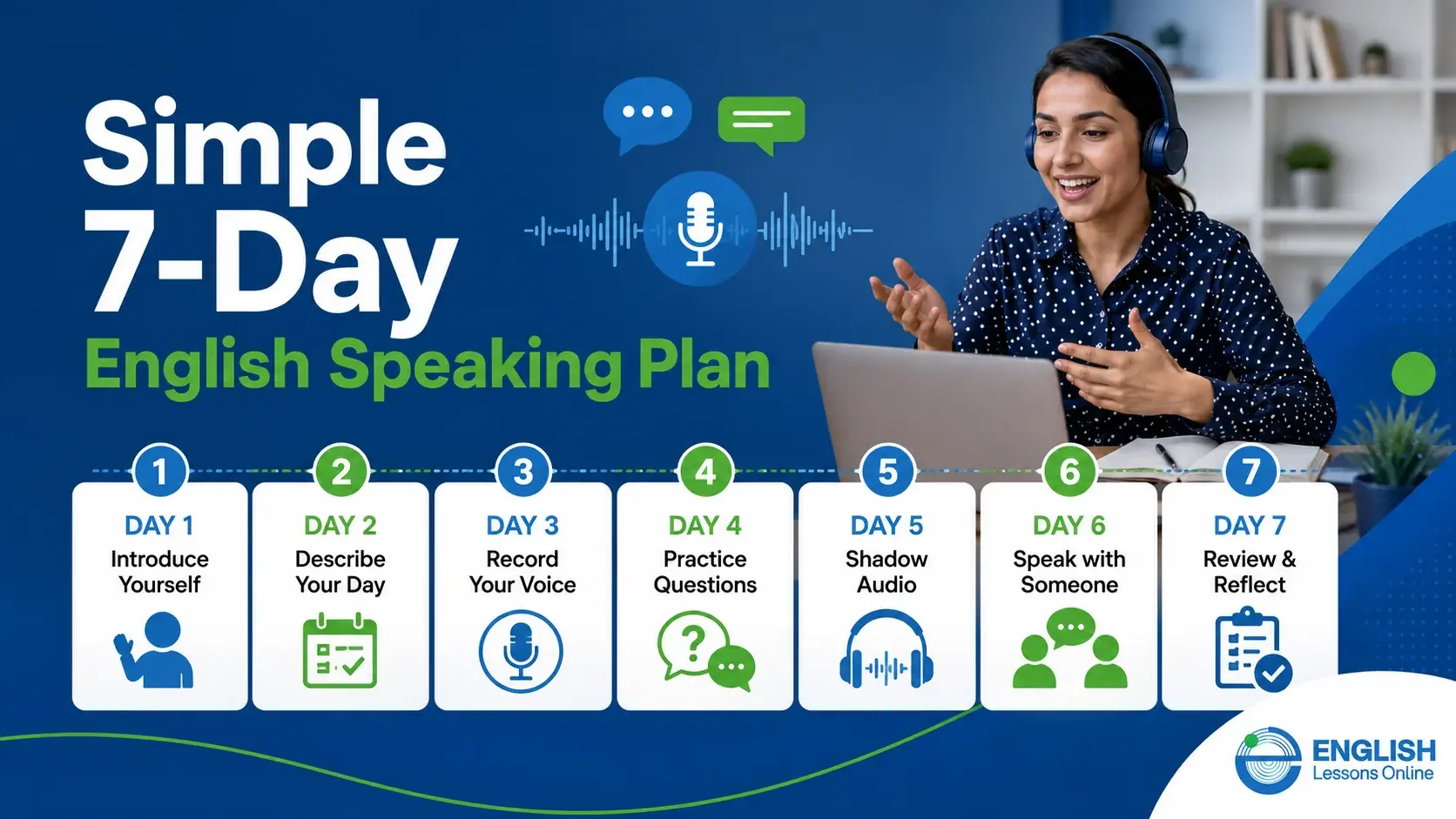
A simple 7-day English speaking practice plan gives you one speaking task each day so you can build confidence, fluency, pronunciation, and conversation skills step by step.
This plan is useful for beginners and busy adults. You only need 10 to 20 minutes a day. Repeat the plan every week with new topics and phrases.
| Day | Speaking task | Goal |
| Day 1 | Introduce yourself | Build basic confidence |
| Day 2 | Describe your day | Practice daily verbs |
| Day 3 | Record your voice | Notice pronunciation |
| Day 4 | Practice questions | Improve conversation flow |
| Day 5 | Shadow short audio | Improve rhythm |
| Day 6 | Speak with someone | Use English in real time |
| Day 7 | Review and repeat | Build fluency |
Introduce yourself to practice basic personal information and first conversation phrases.
Say your name, country, job, city, and English goal.
Example:
“My name is Carlos. I’m from Mexico. I live in Queens, New York. I work in construction. I’m learning English because I want to speak better at work.”
Repeat this 5 times. Try to sound more natural each time.
Describe your day to practice daily verbs and simple sentence order.
Talk about what you do in the morning, afternoon, and evening.
Example:
“I wake up at 7 a.m. I drink coffee. I go to work. After work, I study English for 20 minutes. At night, I eat dinner with my family.”
This helps you use common verbs like wake up, go, work, study, eat, and sleep.
Record your voice to notice pronunciation, pauses, and sentence clarity.
Speak for 1 minute about your routine. Then listen to the recording.
Check:
Record again after correction. The second recording will usually sound better.
Practice questions to improve conversation flow and real-time answers.
Choose 5 common questions and answer each one out loud.
Use these questions:
Answer each question with 2 or 3 sentences. This helps you avoid very short answers.
Shadow short audio to improve pronunciation, rhythm, and listening-to-speaking connection.
Choose simple audio from a teacher, class lesson, or beginner English video. Use only 3 to 5 sentences.
Practice like this:
Do not use difficult audio. Simple audio gives better results for beginners.
Speaking with someone helps you use English in real time.
Practice with a teacher, classmate, friend, or conversation partner. Speak for 10 minutes if possible.
Use simple topics:
Ask for one correction at the end. This keeps the conversation comfortable.
Reviewing and repeating helps you turn short practice into long-term fluency.
Listen to your recordings from the week. Notice what improved. Choose 3 phrases you want to keep practicing.
Ask yourself:
Then repeat the same 7-day plan with new topics. Repetition builds fluency.
Group classes are better for real conversation practice, while private classes are better for personal correction and focused speaking goals.
The best choice depends on your level, confidence, schedule, and reason for learning English. Some learners need more conversation. Some need direct help from a teacher. Some need both.
| Practice type | Best for | Main benefit |
| Group classes | Learners who want real conversation | Peer speaking practice |
| Private classes | Learners who need personal help | Direct teacher feedback |
| Self-practice | Learners with limited time | Daily habit building |
Small-group English classes help you practice English with other learners in a live, social setting.
This is useful if you feel nervous speaking with different people. You can listen to classmates, answer questions, join discussions, and practice real conversation.
Group classes help you build:
Group classes are also helpful because you hear different accents and speaking styles. This prepares you for real English outside the classroom.
Private English lessons help you improve faster in specific areas because the teacher focuses only on you.
A private class is useful if you need help with pronunciation, grammar, job interviews, business English, TOEFL speaking, or personal speaking problems.
Private classes help you get:
Private lessons are a good choice if you feel shy in groups or if you need English for a specific goal.
Self-practice helps you build a daily English speaking habit even when you do not have a teacher or partner.
You can practice alone by reading aloud, recording your voice, shadowing audio, answering questions, and describing your day.
Self-practice is useful, but it should not be your only method forever. To speak well with real people, you also need real conversation. Use self-practice to prepare. Then use classes or partners to communicate.
Choose group classes if you want more conversation, private classes if you need personal correction, and self-practice if you need a daily routine.
For many learners, the best plan is a mix of all 3:
Not sure whether a group or private class fits your goals? Book a free trial class and speak with an instructor.
Online English classes help you practice speaking by giving you live conversation time, teacher correction, structured lessons, level-based support, and regular practice from home.
Online classes are useful for adults because they are flexible. You can learn from home, join through Zoom, and practice with teachers and classmates without traveling to a school.
A good online English class should not only teach grammar. It should also give you time to speak, ask questions, make mistakes, receive correction, and try again.
Live classes help you speak in real time with teachers and classmates.
This is important because speaking is not only about knowing words. You need to listen, think, answer, and continue the conversation.
In a live class, you can practice:
Recorded videos can help you learn vocabulary and grammar. But live speaking helps you use English actively.
Certified teachers help you understand your mistakes and show you how to say things more clearly.
Correction is important because many learners repeat the same mistakes without noticing them. A teacher can help you fix grammar, pronunciation, sentence order, word choice, and speaking habits.
Good correction should be simple and supportive.
For example:
Learner: “Yesterday I go to work.”
Teacher: “Good idea. Say: Yesterday I went to work.”
This type of correction helps you improve without feeling embarrassed.
Group and private classes support different speaking goals because learners need different types of practice.
Group classes are useful for conversation confidence. You speak with classmates, listen to different people, and practice communication in a friendly class environment.
Private classes are useful for personal goals. You can focus on job interviews, business English, pronunciation, grammar problems, TOEFL speaking, or any topic you need.
At EnglishLessons.Online, students can choose group classes or private 1-on-1 classes based on their level, schedule, and learning goals. The classes are live on Zoom and designed for learners from beginner to advanced levels.
A placement test helps you join the right English level before you begin classes.
This matters because a class that is too easy may feel slow. A class that is too difficult may feel stressful. The right level helps you practice speaking with better confidence.
A placement test can check your:
EnglishLessons.Online offers a free online placement test so learners can start at a level that matches their current English ability.
The best way to practice English speaking is to speak out loud every day, use real-life phrases, repeat useful sentence patterns, record your voice, and practice with other people.
You do not need perfect grammar to begin. You need a simple plan and regular practice. Start with short speaking sessions. Talk about your real life. Practice common questions. Repeat phrases until they feel natural. Then speak with a teacher, classmate, or conversation partner.
If you are a beginner, start small. Say one sentence. Then speak for 30 seconds. Then speak for 1 minute. Confidence grows step by step.
If you want more structure, live online English classes can help you practice speaking in a supportive way. You can get teacher correction, real conversation time, and lessons that match your level.
EnglishLessons.Online offers live group and private English classes for adult learners who want to speak more clearly and confidently. You can also take a free placement test to find your level before starting.
Start with one sentence today. Then repeat tomorrow. That is how speaking confidence grows.
You should practice English speaking for 10 to 20 minutes every day if you want steady improvement.
Beginners can start with 5 minutes a day. The most important thing is consistency. Short daily practice is better than one long session once a week.
Yes, you can improve English speaking alone by talking to yourself, reading aloud, shadowing audio, answering questions, and recording your voice.
Alone practice helps you build fluency and pronunciation. But you should also speak with real people when possible because conversation requires listening and quick answers.
The fastest way to improve spoken English is to practice speaking every day, learn useful phrases, get correction, and repeat real-life conversations.
Do not only study grammar or vocabulary. Use English out loud. Speak about your day, work, goals, problems, and common situations.
You can speak English without fear by starting with simple sentences, practicing in a safe environment, and accepting small mistakes as part of learning.
Fear becomes smaller when you speak more often. Start alone, then practice with a partner, teacher, or small group class.
You can practice English speaking without a partner by recording your voice, describing your actions, reading aloud, shadowing audio, and answering common questions out loud.
You can also join online English classes or conversation groups when you are ready for real speaking practice.
You should focus on speaking first while learning basic grammar at the same time.
Grammar helps you make correct sentences, but speaking helps you use English in real life. Do not wait for perfect grammar before you start speaking.
There is no fixed timeline. Your progress depends on your starting level, practice routine, feedback, and speaking opportunities. Daily practice and live conversation usually help learners improve faster.
Yes, online English speaking classes can be effective when they are live, interactive, level-based, and taught by qualified teachers.
Live online classes give you real speaking time, correction, listening practice, and conversation support. They are useful for adults who want flexible English practice from home.