
English remains one of the most used languages for work, study, travel, technology, and online communication. The British Council reports that nearly one-third of the world speaks English, around 2.3 billion people, and about 60% of internet content is in English.
Recent EF English Proficiency Index data also shows that speaking is still the weakest English skill in more than half of the measured countries.
This makes fast English learning less about memorizing rare words and more about building practical skills through level-based input, daily exposure, repeated use, and guided correction.
Learning English supports better communication, study access, career growth, and confidence in real conversations.
The 15 methods below focus on the core actions that help learners improve English faster:
- Start with English you can understand
- Learn the most common English words first
- Build vocabulary with full sentences
- Read English every day at the right level
- Listen to English conversations daily
- Repeat native speakers out loud
- Speak English before you feel ready
- Learn grammar through real examples
- Use flashcards to review new words
- Write short English sentences every day
- Think in English for daily actions
- Change your phone and social media to English
- Watch English videos with subtitles correctly
- Join a class, tutor session, or speaking group
- Follow a simple weekly English study plan
1. Start With English You Can Understand
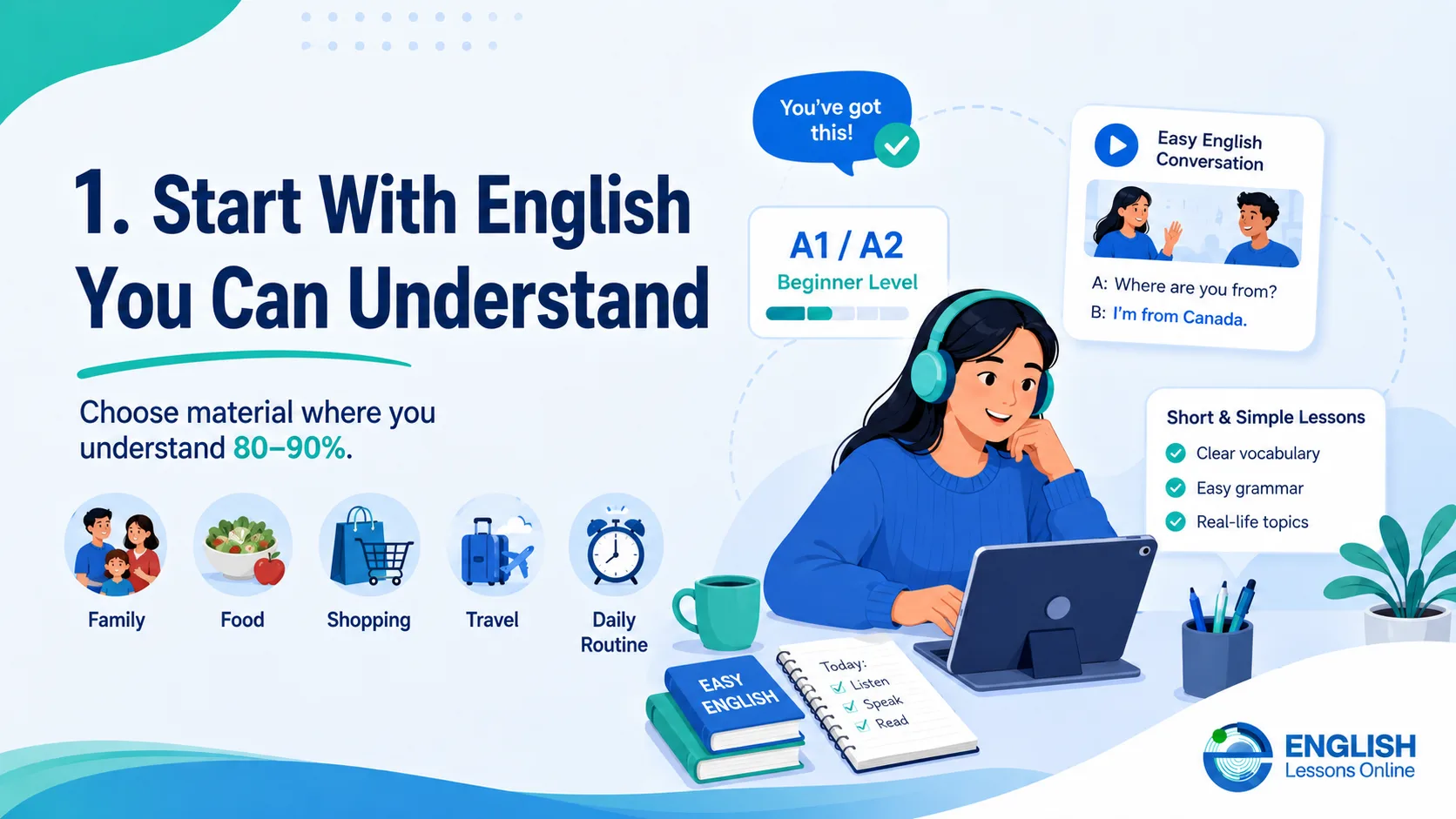
You learn English faster when you study English that is easy enough to follow but still gives you a few new words or phrases. This helps you understand the meaning first, then slowly learn new vocabulary, grammar, and sentence patterns.
Many learners make English harder than it needs to be. They start with fast podcasts, difficult movies, advanced books, or long grammar lessons. Then they feel lost because too many words are new at the same time.
A better way is to start with simple English that matches your level.
For example, if you are a beginner, do not start with a business podcast or a full English movie without support. Start with short conversations, slow audio lessons, simple stories, or beginner videos about daily life.
Good beginner topics include:
- Introducing yourself
- Ordering food
- Talking about family
- Asking for directions
- Shopping
- Daily routines
- Work and study
- Hobbies
- Travel basics
These topics are useful because you can use them in real life. You also hear common words again and again, such as name, live, work, study, want, need, like, go, eat, buy, and help.
A simple rule is this: choose English material where you understand around 80% to 90% of the content. If you understand most of it, your brain can guess the new words from the sentence. If you understand only 30% or 40%, the material is probably too difficult right now.
You can check your level like this:
- If you understand almost everything, the material may be too easy.
- If you understand most of it but find some new words, it is a good level.
- If you stop every few seconds to translate, it is too hard.
- If you feel tired after two minutes, choose something simpler.
- If you can explain the main idea after listening or reading, you are using the right material.
The Common European Framework of Reference for Languages, or CEFR, divides English levels into A1, A2, B1, B2, C1, and C2. Beginners usually start at A1 or A2. At these levels, learners should focus on simple sentences, common words, slow listening, and everyday situations.
For example, a good A1 sentence is:
- I live in the USA.
- I work in an office.
- I want to learn English.
A good A2 sentence is:
- I am learning English because I want to speak with more people.
- I watched a short English video yesterday.
- I usually study English for 30 minutes in the evening.
These sentences are simple, but they build real speaking ability. Fast learning does not start with difficult English. It starts with English you can understand, repeat, and use.
When your study material matches your level, English feels easier. You stay motivated, learn faster, and build confidence step by step.
2. Learn the Most Common English Words First
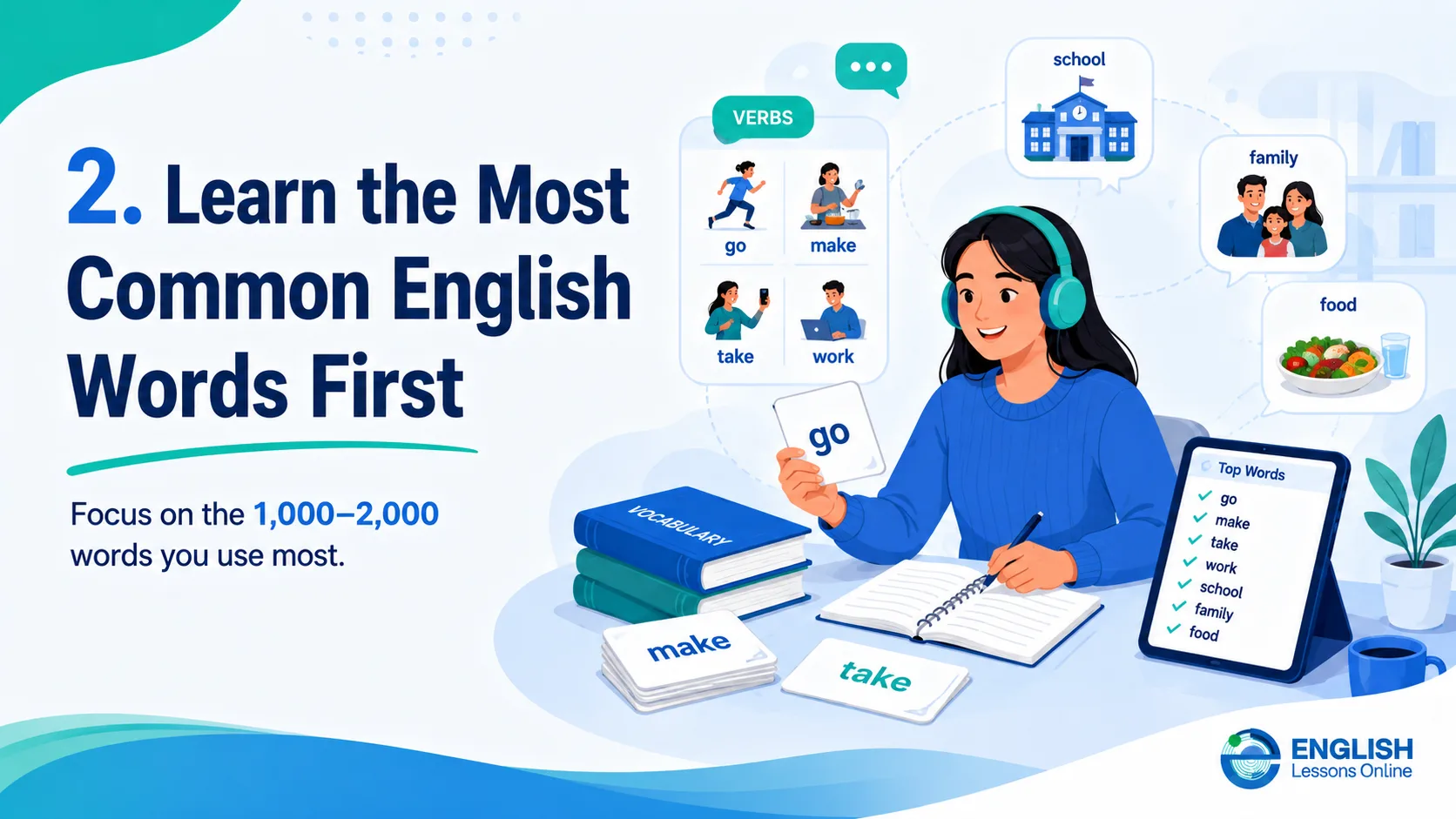
You can understand English faster by learning the most common English words before rare or advanced words. High-frequency words appear again and again in conversations, books, videos, emails, and everyday speech.
English has hundreds of thousands of words, but learners do not need all of them at the beginning. A smaller group of common words gives the biggest result. Cambridge English learning resources often focus on words and phrases that learners need at each level because these words appear more often in real communication.
Common words include verbs like go, make, take, get, want, need, know, think, and use. They also include nouns like time, day, work, school, family, food, money, and place. These words may look simple, but they build thousands of useful sentences.
For example, the verb “get” appears in many daily expressions:
- You can get a job.
- You can get home.
- You can get better.
- You can get a message.
- You can get ready.
One common word can create many meanings when it is used with different words. That is why learning common words is more useful than memorizing rare words like “magnificent,” “complicated,” or “unbelievable” too early.
Start with the first 1,000 to 2,000 most useful words. Then learn how they work in real sentences. This helps you understand more English with less study time.
3. Build Vocabulary With Full Sentences, Not Single Words
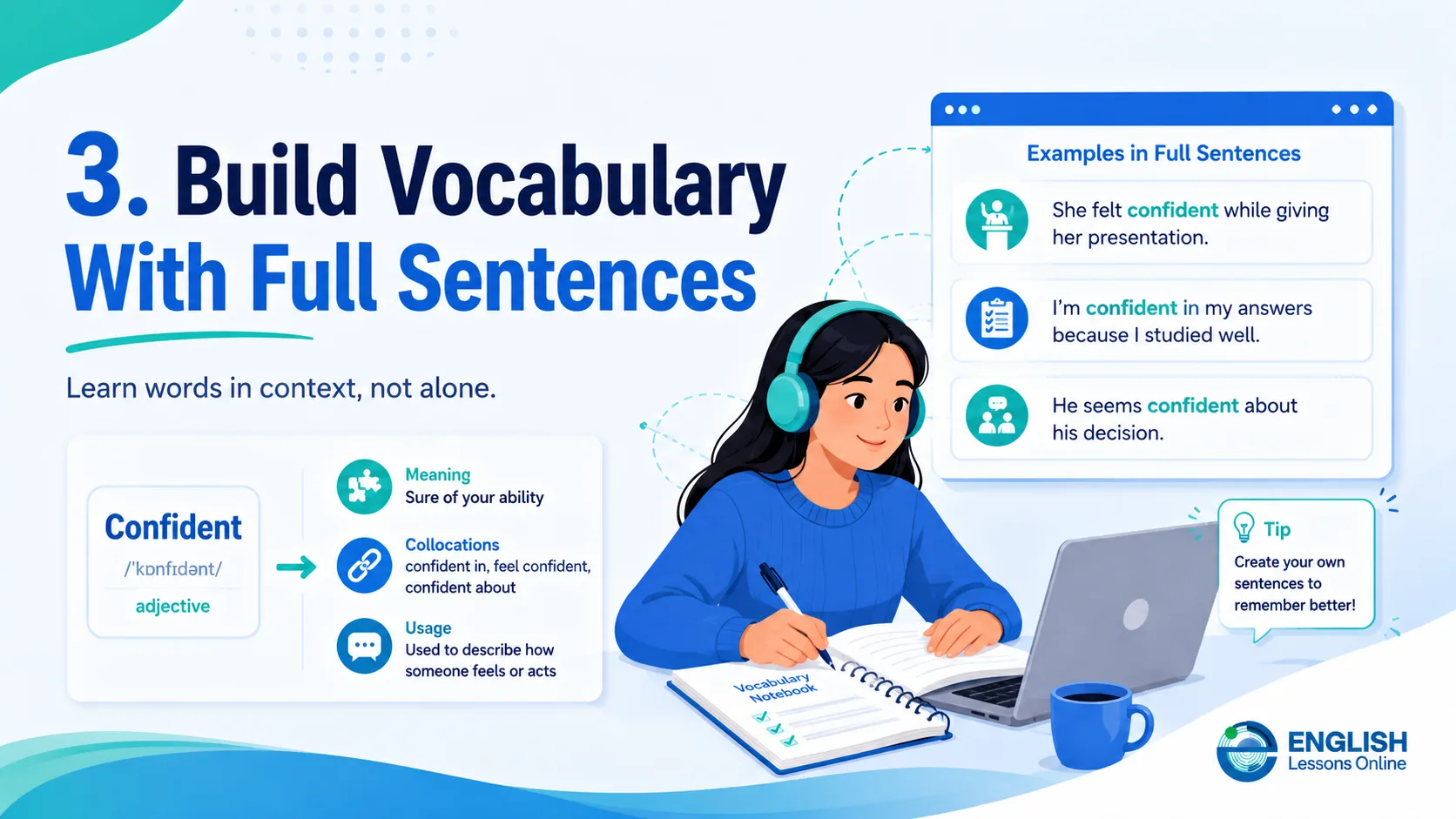
Vocabulary becomes easier to remember when you learn words inside full sentences. A single word gives meaning, but a sentence shows grammar, usage, word order, and context.
Many learners write vocabulary like this:
- important means necessary
- improve means become better
- borrow means take and return later
This is useful, but it is not enough. You may know the meaning of “borrow,” but still say the sentence incorrectly.
For example, some learners say “Can you borrow me your pen?” The correct sentence is “Can you lend me your pen?” or “Can I borrow your pen?”
Full sentences prevent this mistake because they show how the word works.
Instead of learning only the word “improve,” learn sentences like:
- I want to improve my English speaking.
- Reading every day can improve your vocabulary.
- My listening skills improved after three months of practice.
These examples show the word form, sentence pattern, and natural usage. They also help your brain remember the word through meaning.
This method is especially important for verbs, prepositions, phrasal verbs, and collocations. Collocations are words that often go together, such as make a mistake, take a break, strong coffee, heavy rain, and improve your skills.
If you learn the word “mistake” alone, you may not know which verb to use. If you learn “make a mistake,” you can use it correctly in speaking and writing.
Better vocabulary learning means learning words with their partners.
4. Read English Every Day at the Right Level
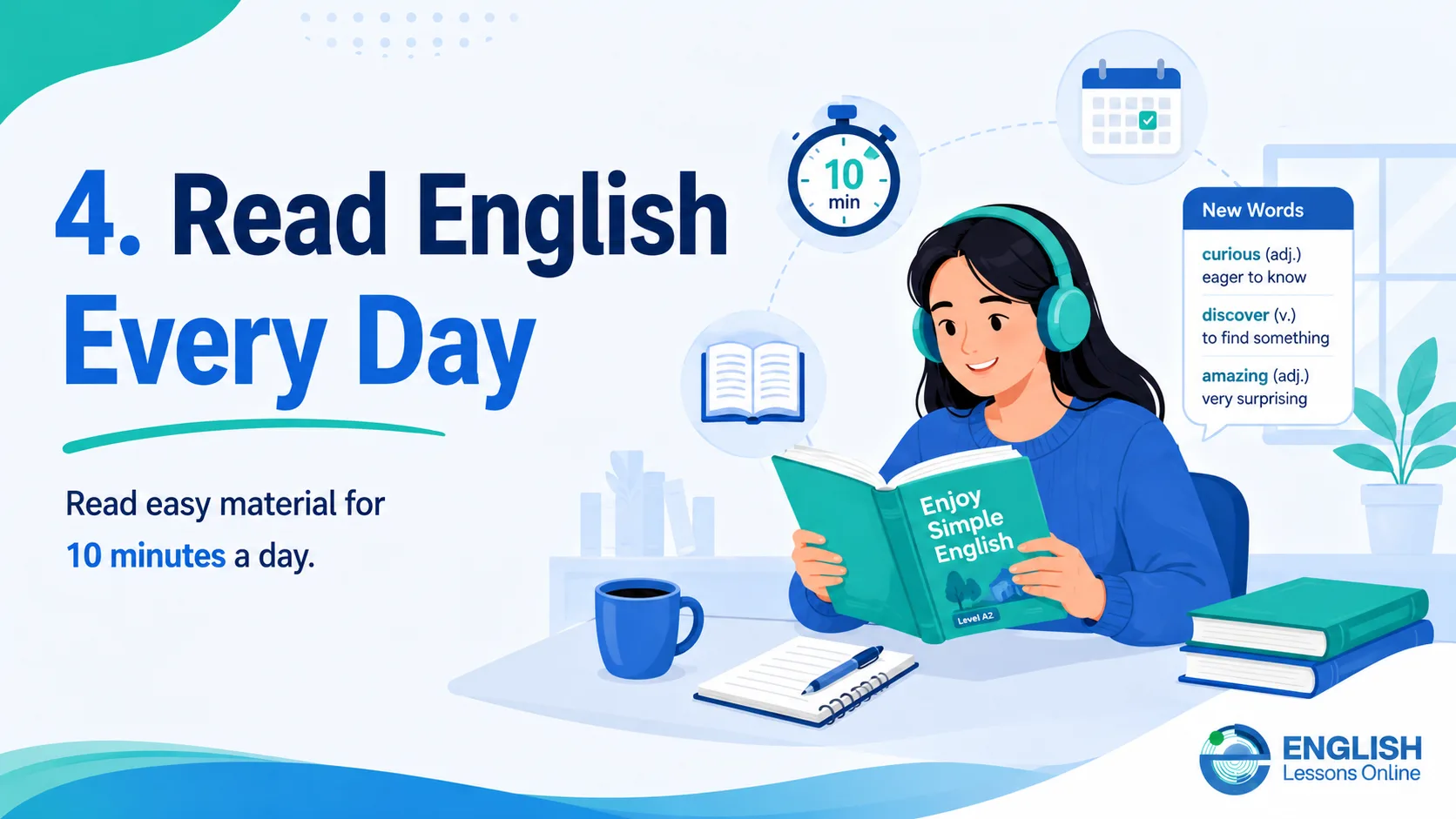
Daily reading improves English vocabulary, grammar, spelling, sentence structure, and comprehension. Reading works best when the text is easy enough to understand without translating every word.
The National Reading Panel found that reading is strongly connected with vocabulary growth, fluency, and comprehension. For English learners, reading gives repeated exposure to words and sentence patterns. This repeated exposure helps the brain recognize English faster.
You do not need to read difficult books at the beginning. You can start with graded readers, short stories, beginner blogs, simple news, children’s books, or English learning articles.
The best reading material should meet three conditions:
- You understand most of the text.
- The topic is useful or interesting.
- The sentences are not too long.
If you stop every few seconds to check a dictionary, the text is too hard. Choose something easier. Reading should build confidence, not frustration.
A beginner can read 100 to 300 words per day. An intermediate learner can read 500 to 1,000 words per day. The number is less important than the habit. Ten minutes of reading every day is better than two hours once a week.
When you read, do not translate every sentence into your native language. First, try to understand the general meaning. Then mark only the most useful new words. After reading, write 3 to 5 sentences using those words.
This turns reading into active learning.
5. Listen to English Conversations Daily
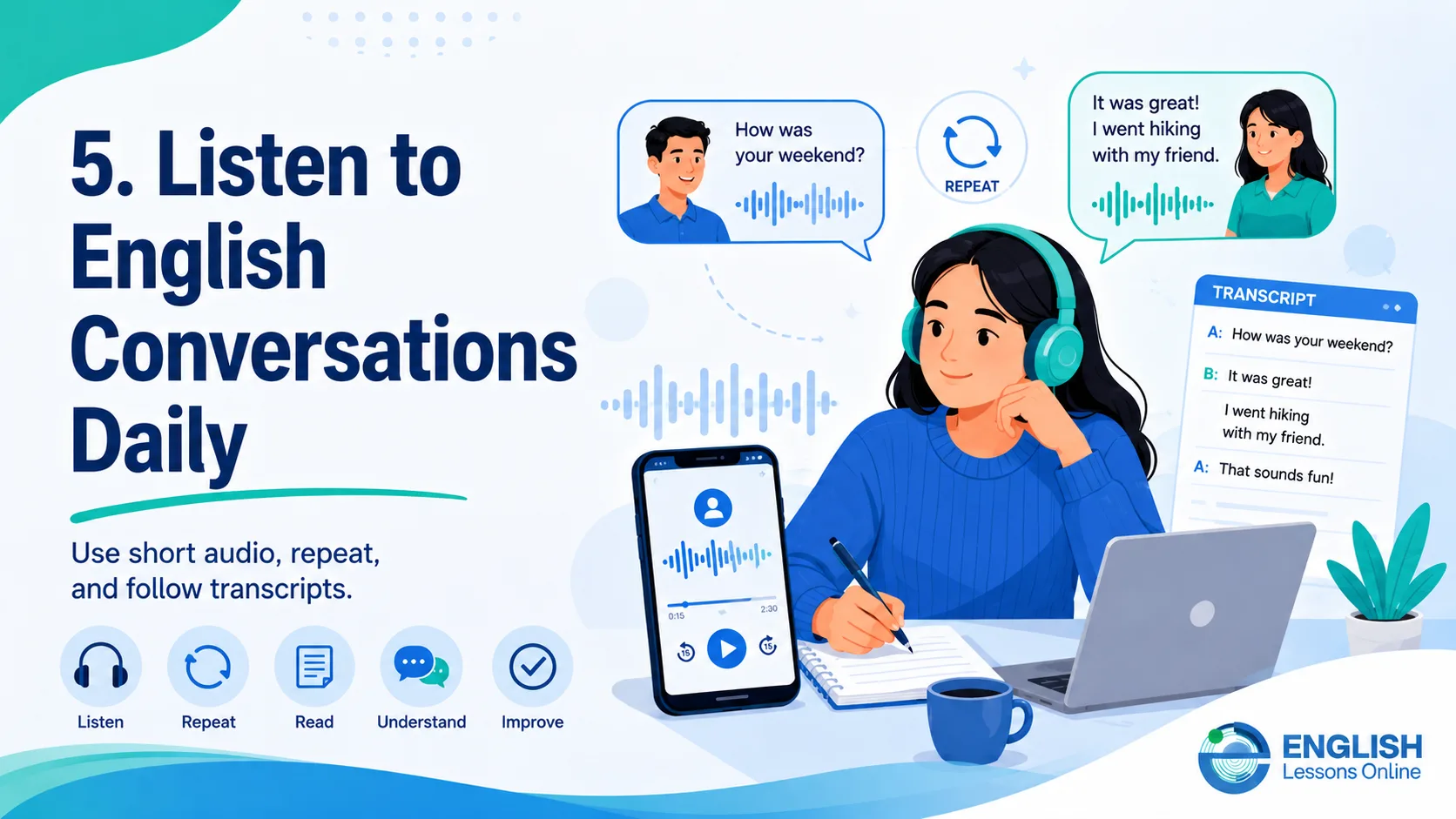
Listening to English every day trains your ear to understand pronunciation, rhythm, stress, connected speech, and natural sentence flow. You improve faster when you listen to real conversations at the right speed and level.
Many learners can read English but cannot understand spoken English. This happens because written English and spoken English are different. In speech, native speakers connect words, reduce sounds, and speak in chunks.
For example,
“What do you want to do?” may sound like “Whaddaya wanna do?” in natural speech. A learner who only studies written English may not recognise this sentence when hearing it.
Daily listening helps solve this problem.
Start with slow and clear English if you are a beginner. Use short dialogues, beginner podcasts, English course audio, or videos made for learners. Listen to the same audio more than once. Repetition helps your brain catch words you missed the first time.
A simple listening routine can look like this:
- First listening: understand the main idea.
- Second listening: catch keywords.
- Third listening: read the transcript while listening.
- Fourth listening: repeat useful sentences out loud.
This method improves both listening and speaking because you are not only hearing English. You are also noticing how English sounds in real use.
For faster progress, listen for 15 to 30 minutes every day. Short daily listening is more effective than long, irregular practice.
6. Repeat What Native Speakers Say Out Loud
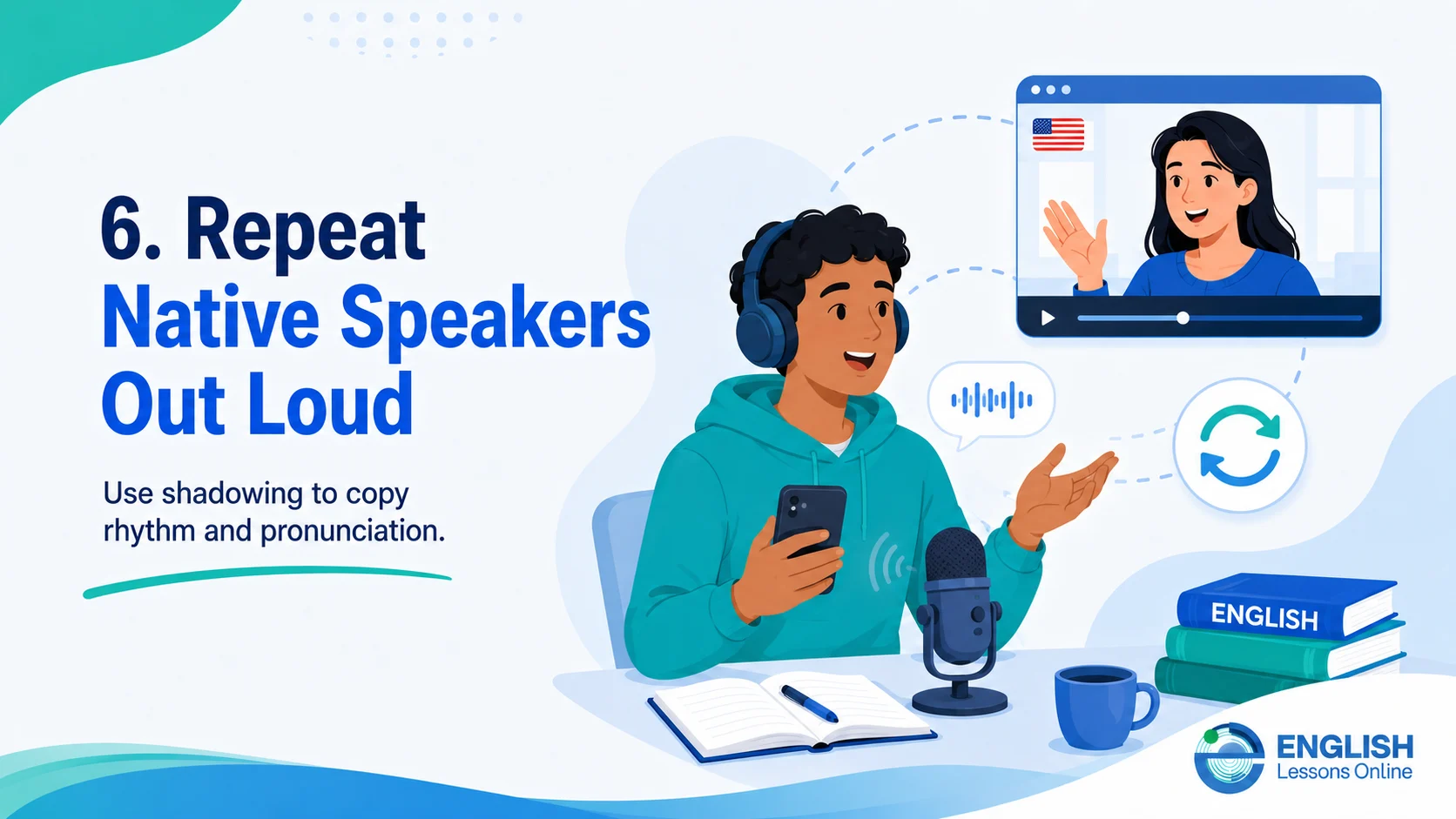
Repeating native speakers out loud improves pronunciation, fluency, rhythm, and speaking confidence. This method is often called shadowing when you listen and speak shortly after the speaker.
Many English learners understand words in their mind but struggle to say them smoothly. This happens because speaking is a physical skill. Your mouth, tongue, lips, breath, and voice need practice.
Reading grammar rules cannot train these muscles. Speaking out loud can.
Choose a short audio or video that is 30 seconds to 2 minutes long. Listen to one sentence. Pause. Repeat the sentence. Try to copy the speaker’s pronunciation, stress, and rhythm. Do not worry about sounding perfect. Focus on clear and steady practice.
For example, listen to this sentence:
I’m looking for a place to study English online.
Then repeat it several times until it feels easier.
This method works because it trains common sentence patterns. You are not creating English from zero. You are borrowing natural English and making it part of your own speaking.
Shadowing is also useful for connected speech. You hear how words join together, such as “going to” becoming “gonna” in casual speech, or “want to” becoming “wanna.” You do not need to use all casual forms yourself, but you need to understand them when others speak.
Practice 5 to 10 minutes per day. Over time, your speech becomes faster, clearer, and more natural.
7. Speak English Before You Feel Ready
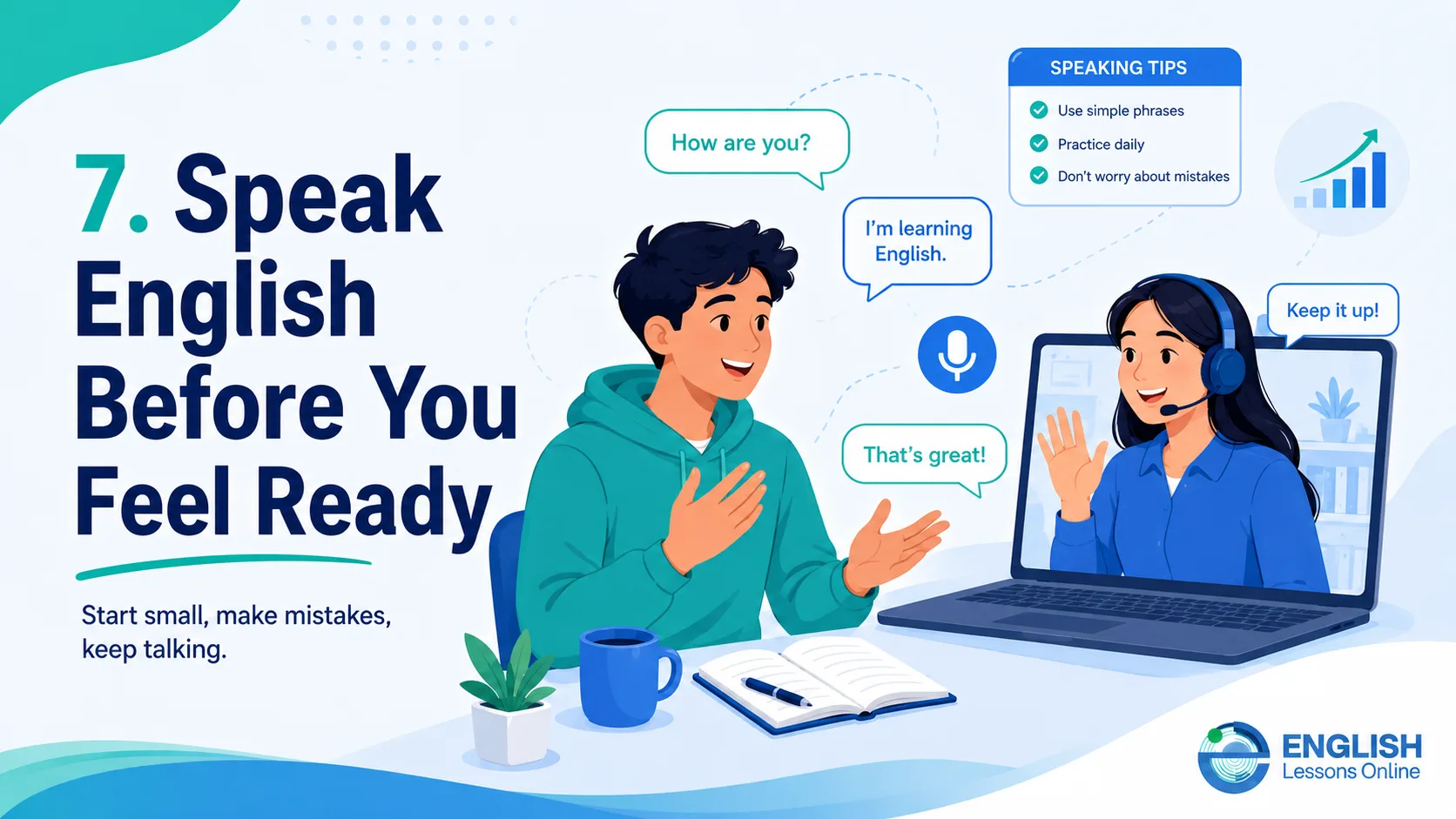
Improve your English speaking faster when you start speaking before you feel fully ready. Speaking builds fluency through use, correction, repetition, and confidence.
Many learners wait too long. They think they must learn more grammar, more vocabulary, or better pronunciation before speaking. This delay creates a problem. They know English in their head, but they cannot use it in real conversation.
Speaking is not the reward after learning English. Speaking is part of learning English.
At the beginning, your sentences can be simple. You can say:
- I want to practice English.
- I work in an office.
- I watched a video yesterday.
- I don’t understand this word.
- Can you say that again?
These sentences are not advanced, but they are useful. Real speaking starts with useful sentences, not perfect sentences.
Mistakes are normal. A mistake shows what you need to practice next. If you say “I am agree,” and someone corrects you to “I agree,” you learn a real grammar point from a real communication situation.
You can practice speaking with a teacher, tutor, language partner, friend, online speaking group, or voice recording app. If you have no speaking partner, record yourself answering simple questions. Listen again. Notice where you stop, repeat, or search for words.
Start with 5 minutes of speaking per day. Then increase to 10 or 15 minutes. The goal is to make English leave your mouth regularly.
8. Learn Grammar Through Real Examples
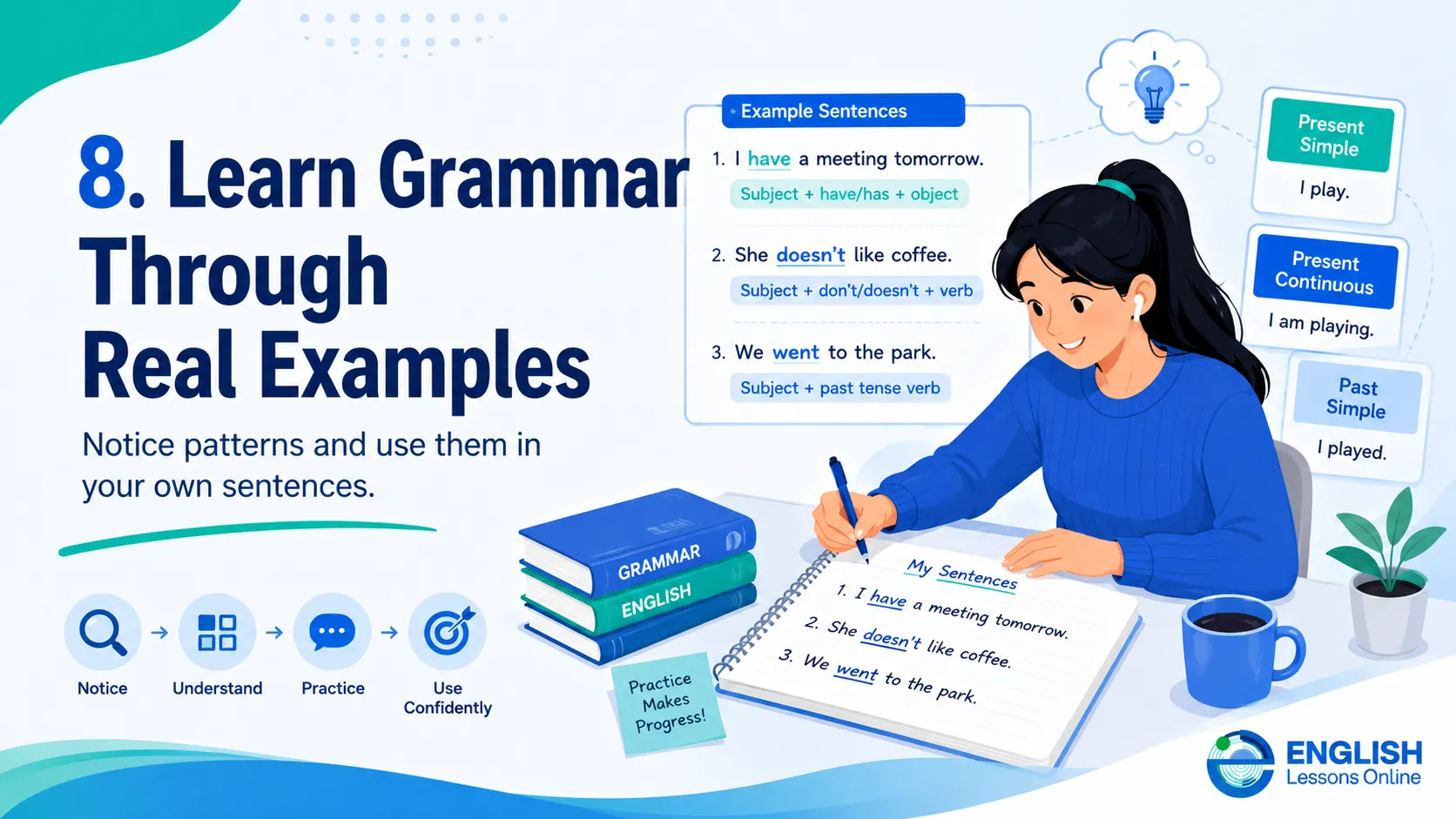
Grammar becomes easier when you learn it through real examples instead of memorizing rules alone. Rules explain grammar, but examples show how grammar works in actual communication.
Many learners study grammar in isolation. They read rules about tenses, prepositions, articles, and conditionals, but they cannot use them when speaking. This happens because grammar needs context.
For example, the present perfect tense is often confusing. A rule may say it connects the past with the present. But examples make the meaning clearer:
- I have finished my homework.
- She has lived here for five years.
- Have you ever visited London?
These sentences show how the tense works in different situations. The first sentence shows a completed action with present result. The second sentence shows duration. The third sentence asks about life experience.
Grammar should answer a communication need. Learn the grammar that helps you say what you want to say.
If you want to talk about daily habits, learn the present simple.
- I work from Monday to Friday.
- She studies English every evening.
If you want to talk about actions happening now, learn the present continuous.
- I am watching an English lesson.
- They are practicing speaking.
If you want to talk about past events, learn the past simple.
- I joined an English class last month.
- We watched a movie in English yesterday.
This method keeps grammar practical. You learn the structure, then use it in your own sentences.
A good grammar routine is simple. Read 5 examples, notice the pattern, write 5 personal sentences, then say them out loud. This moves grammar from the page into real use.
9. Use Flashcards to Review New Words
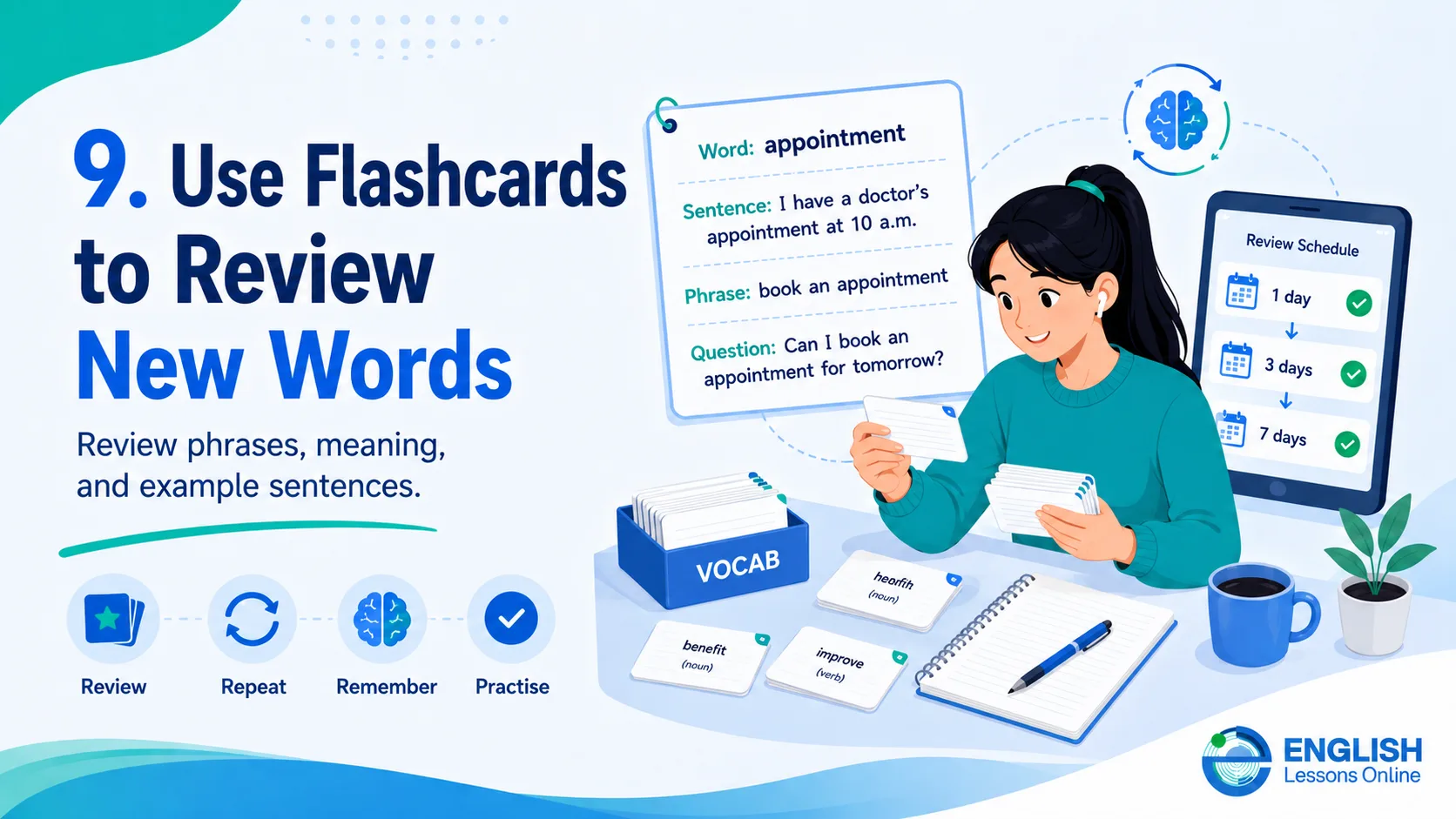
Flashcards help you remember English words by showing them again before you forget them. They work best when you review full phrases, example sentences, pronunciation, and meaning together.
Many learners forget vocabulary because they only see a word once. The brain needs repeated contact with new words. This is why review is as important as learning.
A good flashcard should not only show one word and one meaning. It should show how the word works in real English.
For example, a weak flashcard looks like this:
Word: appointment
Meaning: a meeting arranged for a specific time
A stronger flashcard looks like this:
Word: appointment
Sentence: I have a doctor’s appointment at 10 a.m.
Common phrase: book an appointment
Question: Can I book an appointment for tomorrow?
This gives you the meaning, grammar, and real usage together.
Spaced repetition is useful here. It means you review a word after 1 day, then after 3 days, then after 7 days, then after a longer gap. This method helps move words from short-term memory into long-term memory.
Apps like Anki, Quizlet, Memrise, and Brainscape can help you review words automatically. You can also use paper cards if you prefer writing by hand.
Do not add too many new words each day. Ten useful words with example sentences are better than 50 random words you cannot use.
10. Write Short English Sentences Every Day
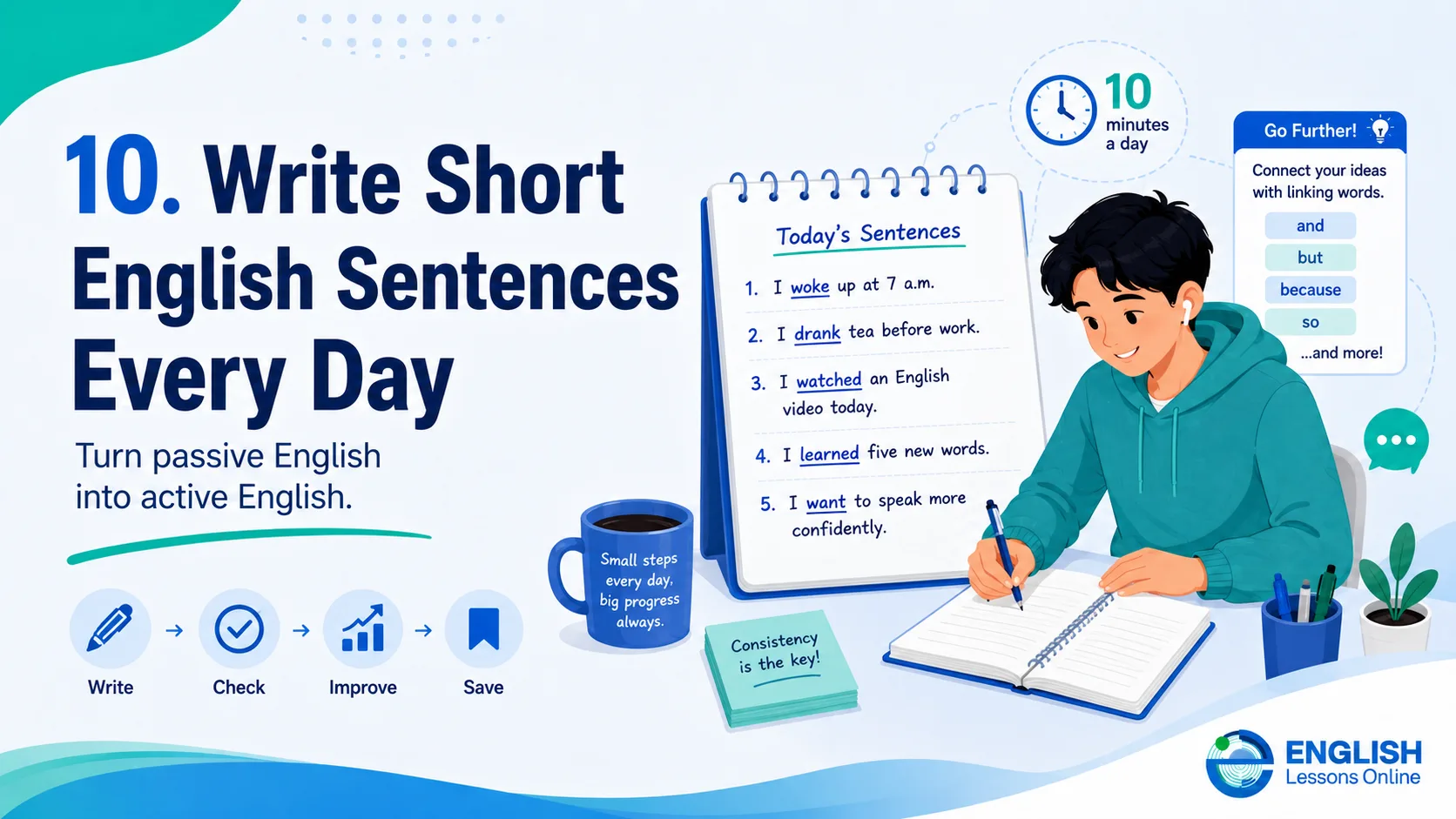
Writing short English sentences every day improves grammar, vocabulary, spelling, and sentence control. It helps you turn passive knowledge into active English.
Many learners can understand English but cannot create sentences quickly. Writing fixes this problem because it makes you choose words, organize ideas, and check grammar.
You do not need to write long essays. Start with simple sentences about your real life.
For example:
- I woke up at 7 a.m.
- I drank tea before work.
- I watched an English video today.
- I learned five new words.
- I want to speak more confidently.
These sentences look basic, but they build control. When you write daily, you notice repeated mistakes. You also learn which words you need for your own life.
After a few weeks, make your sentences longer.
- I watched an English video today, and I wrote down five useful phrases.
- I want to speak more confidently, so I practice with a tutor twice a week.
- This helps you connect ideas with words like and, but, because, so, when, before, and after.
A simple writing habit can take only 10 minutes per day. Write 5 to 8 sentences. Read them out loud. Correct one or two mistakes. Then save them in a notebook.
Over time, this creates a personal English record. You can see how your grammar, vocabulary, and confidence improve.
11. Think in English for Simple Daily Actions
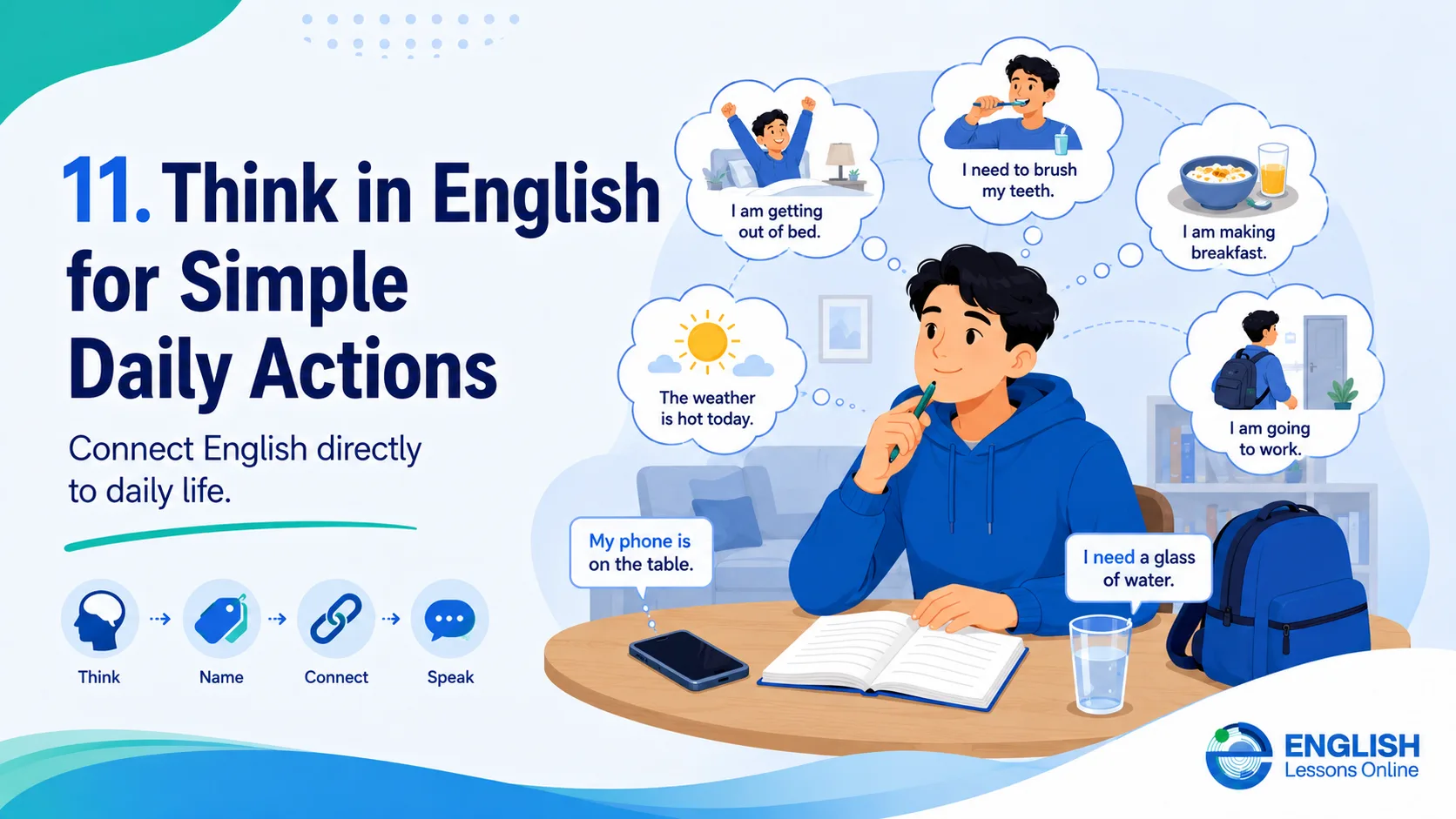
Thinking in English helps you stop translating every sentence from your native language. It trains your brain to connect English words directly with actions, objects, and ideas.
Many learners translate before speaking. They think in their first language, change the sentence into English, check grammar, and then speak. This process is slow. It also makes conversation feel stressful.
You can reduce translation by thinking in English during simple daily actions.
When you wake up, think:
- I am getting out of bed.
- I need to brush my teeth.
- I am making breakfast.
When you go outside, think:
- The weather is hot today.
- I am going to work.
- There are many people on the road.
This method works because the sentences are connected to real actions. You are not studying English as a separate subject. You are connecting English to daily life.
Start with nouns and short sentences. Name things around you: phone, table, chair, window, door, bag, shirt, water, food, road, bus, office. Then make simple sentences with them.
- My phone is on the table.
- The door is open.
- I need a glass of water.
This habit may feel strange at first. After some time, English words start coming faster because your brain does not wait for translation.
12. Change Your Phone and Social Media to English
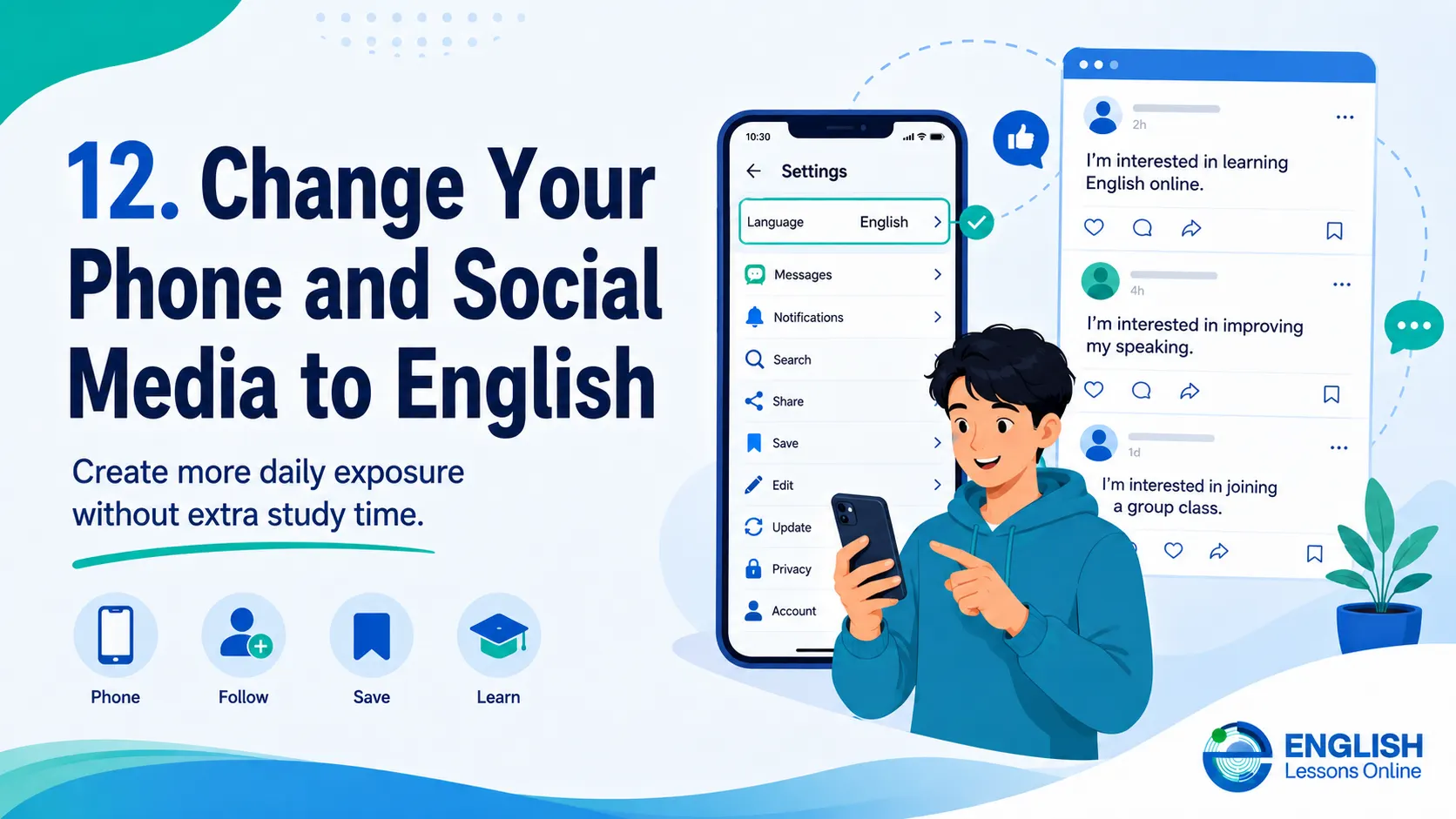
Changing your phone and social media to English gives you daily English exposure without extra study time. It helps you learn common digital words, instructions, buttons, settings, and short phrases.
Most people use their phone many times a day. This makes the phone a simple learning tool. When your device language is English, you repeatedly see words like settings, messages, notifications, search, share, save, edit, update, privacy, password, and account.
These words are useful because they appear in real life. You see them again and again, so they become familiar.
Social media can also support English learning if you use it carefully. Follow English learning pages, simple news pages, teachers, pronunciation channels, and accounts that explain daily English phrases.
Do not only scroll for entertainment. Save useful posts. Write down 3 phrases. Use one phrase in your own sentence.
For example, if you see the phrase “I’m interested in,” write your own sentence:
- I’m interested in learning English online.
- I’m interested in improving my speaking.
- I’m interested in joining a group class.
- This turns social media into active learning.
You do not need to change everything at once. Start with your phone language. Then follow 5 to 10 useful English accounts. After that, watch short English videos with captions for a few minutes each day.
Small changes create more daily contact with English.
13. Watch English Videos With Subtitles the Right Way
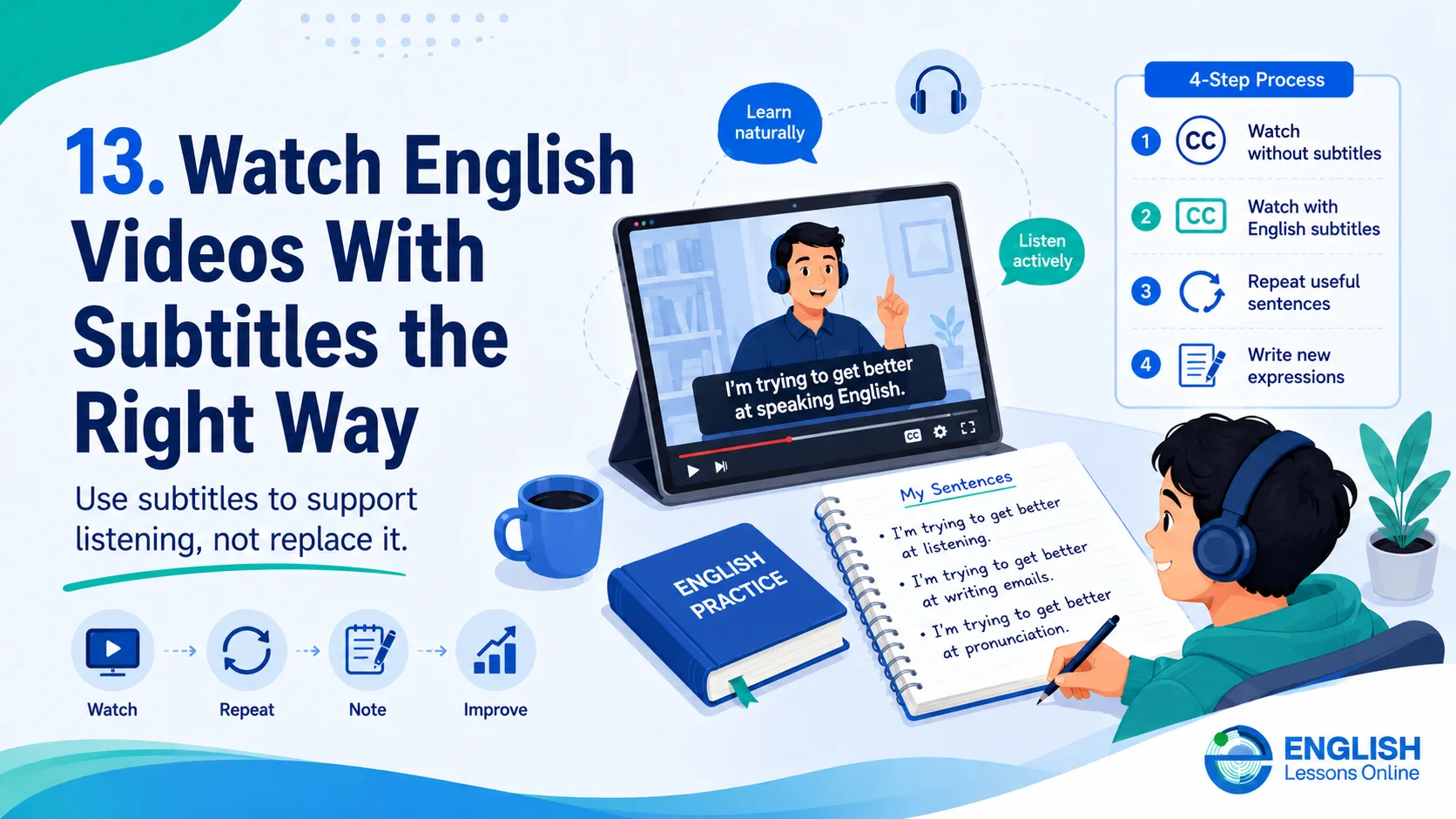
English videos improve listening, vocabulary, pronunciation, and real-life understanding when you use subtitles correctly. Subtitles should support listening, not replace it completely.
Many learners watch videos with subtitles in their native language. This helps them understand the story, but it often does not improve English listening much. Their eyes follow the translation while their ears ignore the English.
A better method is to use English subtitles first. Choose videos that match your level. Beginner learners can watch short lessons, slow conversations, children’s stories, or simple daily-life videos. Intermediate learners can watch interviews, vlogs, news explainers, and course videos.
Use this simple process:
- First, watch without subtitles and understand the main idea.
- Second, watch with English subtitles and notice useful phrases.
- Third, pause and repeat important sentences out loud.
- Fourth, write 3 to 5 new expressions in your notebook.
This method trains listening, reading, speaking, and vocabulary at the same time.
For example, you may hear this sentence in a video:
- I’m trying to get better at speaking English.
- You can repeat it and then make your own sentences:
- I’m trying to get better at listening.
- I’m trying to get better at writing emails.
- I’m trying to get better at pronunciation.
This is how one video becomes a full English practice session.
Short videos are better than long videos for active learning. A 5-minute video studied properly can teach more than a 1-hour video watched passively.
14. Join a Class, Tutor Session, or Speaking Group
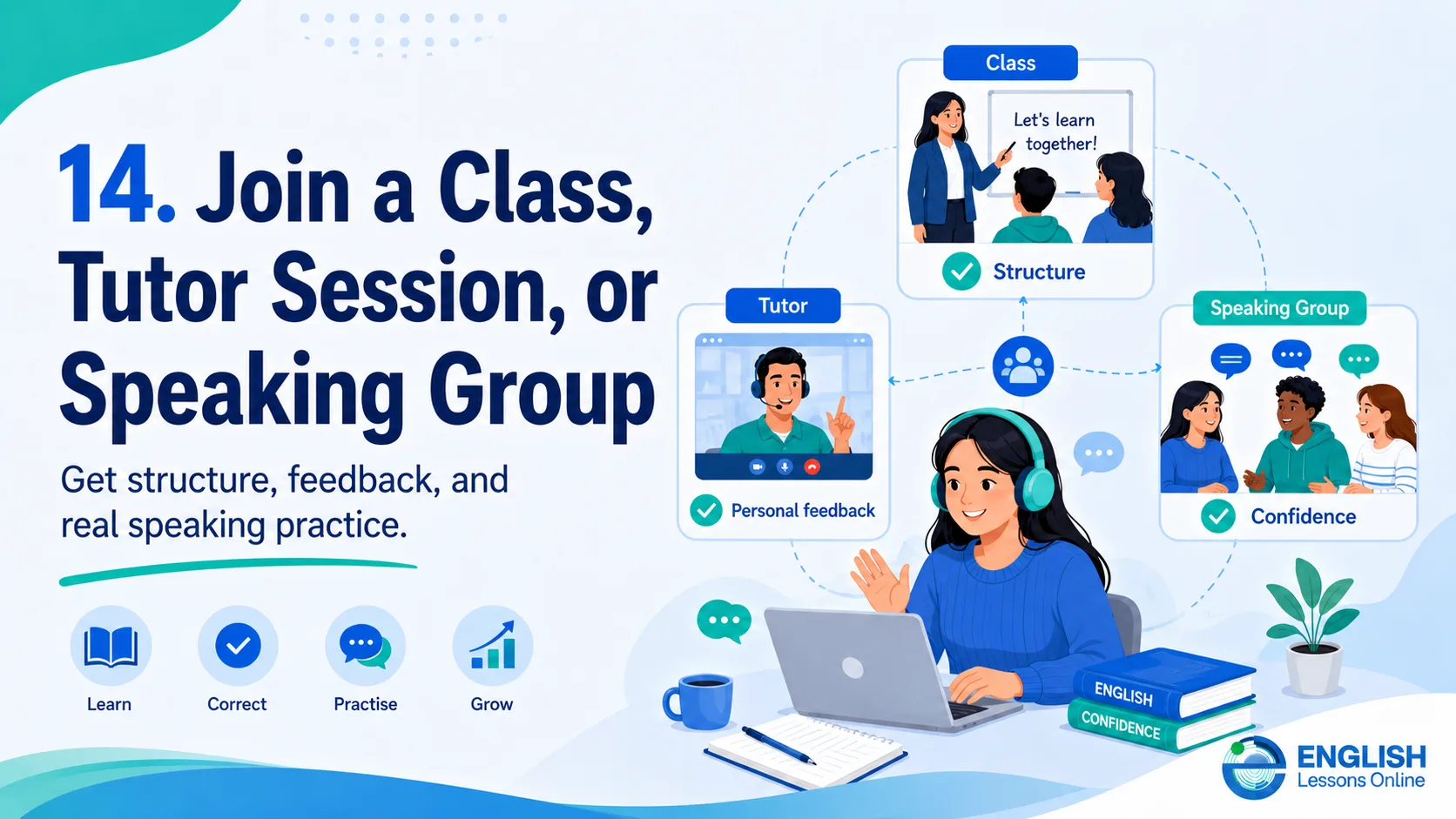
A class, tutor session, or speaking group helps you learn English faster by giving structure, correction, feedback, and real speaking practice. Guided learning is useful when you do not know what to study next.
Self-study is powerful, but many learners need direction. A teacher or tutor can find your weak areas faster. They can correct pronunciation, explain grammar, give speaking tasks, and help you build a clear plan.
Cambridge English notes that moving from one CEFR level to the next often takes around 200 guided learning hours. This does not mean every learner needs the same time. Motivation, practice, exposure, and learning method can change the speed. But it shows one important point: English improvement takes regular guided practice, not random study.
Classes are useful for learners who need a fixed routine. You know when to study, what to practice, and how to move from one lesson to the next.
Tutors are useful when you need personal correction. A tutor can focus on your speaking mistakes, pronunciation problems, grammar gaps, or job-related English.
Speaking groups are useful when you need confidence. You can practice real conversation with other learners. You can discuss simple topics like hobbies, food, travel, work, study, daily life, and future plans.
The best choice depends on your goal.
- Choose a class if you need structure.
- Choose a tutor if you need personal feedback.
- Choose a speaking group if you need fluency and confidence.
Many learners improve faster when they combine all three. For example, they study grammar in a class, practice speaking with a group, and take one tutor session per week for correction.
15. Follow a Simple Weekly English Study Plan
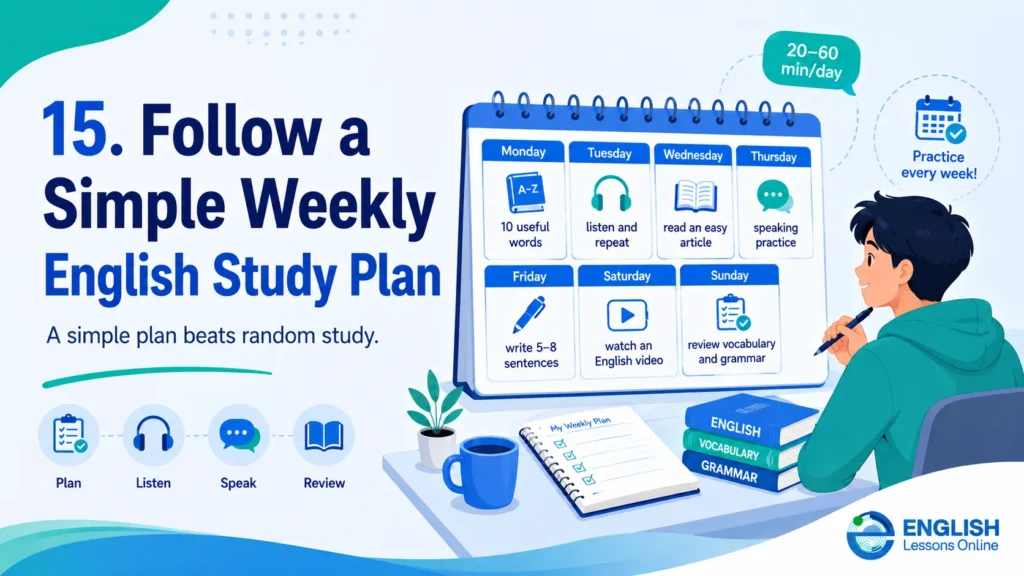
A weekly English study plan helps you improve faster because it gives each skill enough attention. Speaking, listening, reading, writing, vocabulary, and grammar all need regular practice.
Many learners fail because their study plan is unclear. One day they watch a video. Another day they memorise grammar. Then they stop for a week. This makes progress slow.
A simple plan works better than a perfect plan.
For beginners, 30 to 60 minutes per day is enough if the practice is focused. For busy learners, even 20 minutes per day can help if done consistently. The most important point is to practice every week, not only when you feel motivated.
Here is a simple weekly English study plan:
- Monday: Learn 10 useful words with example sentences.
- Tuesday: Listen to a short English conversation and repeat it.
- Wednesday: Read one easy English article or story.
- Thursday: Practice speaking for 10 to 15 minutes.
- Friday: Write 5 to 8 sentences about your day.
- Saturday: Watch one English video with subtitles.
- Sunday: Review vocabulary, grammar, and speaking mistakes.
This plan is simple, but it covers all major skills. It also gives your brain repeated exposure to English in different ways.
You can change the plan based on your goal. If your goal is speaking, give more time to speaking, listening, and pronunciation. If your goal is exams, add reading tasks, writing practice, grammar review, and mock tests.
Fast English learning does not come from doing everything once. It comes from repeating the right activities every week.
How Can You Improve English Speaking Faster?
You can improve English speaking faster by speaking daily, repeating natural sentences, learning useful phrases, recording your voice, and getting correction from a teacher, tutor, or fluent speaker.
Speaking improves when you use English in real situations. It does not improve only by reading grammar books. You need to train your mouth to produce English and your brain to find words quickly.
Start with common speaking topics. Talk about yourself, your work, your family, your hobbies, your daily routine, your goals, and your problems. These topics appear in most beginner and intermediate conversations.
For example, practice answers to simple questions:
- What do you do?
- Why are you learning English?
- What did you do yesterday?
- What kind of videos do you like?
- What are your plans for this week?
Do not memorize long answers. Learn sentence patterns and change them with your own details.
For example:
I’m learning English because I want to work with international clients.
I’m learning English because I want to study abroad.
I’m learning English because I want to speak more confidently.
Recording your voice is also useful. Speak for one minute about a simple topic. Then listen again. Notice your pauses, unclear words, and repeated mistakes. Next time, answer the same question again with better sentences.
This method helps you measure progress.
How Can You Improve English Listening Faster?
You can improve English listening faster by listening to level-appropriate English every day, using transcripts, repeating short audio clips, and training your ear to understand connected speech.
Listening is difficult because spoken English is fast. Words often connect together. Some sounds become weak. Native speakers do not always pronounce every word separately.
For example, “I want to go” may sound like “I wanna go” in casual speech. “Did you” may sound like “didja.” These sound changes are normal in spoken English.
To improve faster, do not only listen once. Repeat the same audio several times.
- First, understand the topic.
- Second, catch the main words.
- Third, read the transcript.
- Fourth, listen again without the transcript.
This process helps you connect written words with spoken sounds.
Choose short audio clips at first. A 1-minute conversation can teach pronunciation, vocabulary, grammar, and speaking rhythm. Long podcasts are useful later, but they can be too difficult for beginners. Listening should be active. Do not only play English in the background all day. Background listening can help you become familiar with the sound of English, but focused listening improves understanding faster.
How Can You Learn English Vocabulary Without Forgetting It?
You can learn English vocabulary without forgetting it by reviewing words regularly, using them in sentences, connecting them to real topics, and practicing them through reading, listening, speaking, and writing.
Forgetting is normal. The problem is not your memory. The problem is often the method. If you learn words once and never use them again, they disappear quickly.
Use each new word in at least three ways.
- Read it in a sentence.
- Write your own sentence.
- Say it out loud.
For example, take the word “improve.”
- Reading sentence: I want to improve my English.
- Writing sentence: I practice speaking every day to improve my fluency.
- Speaking sentence: I’m trying to improve my listening skills.
This gives your brain more contact with the word. It also teaches you how to use the word naturally.
Group words by topic. Learn food words together, travel words together, work words together, and study words together. Topic groups make vocabulary easier to remember because the words are connected.
For example, work vocabulary can include meeting, deadline, report, client, manager, task, schedule, project, and email. These words appear together in real workplace English.
Vocabulary becomes stronger when it belongs to a situation.
Best Resources to Learn English Faster
The best resources to learn English faster are tools that match your level and help you practice real English every day. Choose resources that improve listening, speaking, reading, writing, vocabulary, and grammar without making learning confusing.
Use 2 to 4 resources at first. Too many apps, channels, books, and websites can make your study plan messy. A small set of good resources is easier to follow and gives better results.
- BBC Learning English: Good for short grammar lessons, pronunciation practice, daily English phrases, and listening exercises. It is useful for beginner and intermediate learners.
- British Council LearnEnglish: Good for level-based reading, listening, grammar, and vocabulary practice. It also includes exercises that help you check your understanding.
- Duolingo: Good for building a daily English habit. It is useful for beginners, but it should be used with speaking and listening practice.
- Anki or Quizlet: Good for remembering new words with flashcards. Add full sentences, not only single words, so you can learn how each word is used.
- YouTube English Lessons: Good for learning pronunciation, grammar, common phrases, and real speaking examples. Choose simple channels and repeat useful sentences out loud.
- English Podcasts for Learners: Good for improving listening skills. Start with slow podcasts that include transcripts, such as BBC 6 Minute English or British Council podcasts.
- Online English Classes: Good for learners who need structure, correction, and a clear study plan. A teacher can help you fix mistakes faster.
- Speaking Practice Websites: Good for real conversation practice. Websites like italki, Preply, Cambly, Tandem, and HelloTalk can help you speak with tutors or language partners.
- Graded English Books: Good for reading practice at the right level. Choose A1, A2, or B1 graded readers instead of difficult novels if you are still learning.
- English Subtitled Videos: Good for listening and vocabulary. Watch short videos with English subtitles, repeat useful lines, and write down 3 to 5 new phrases.
The best resource is not always the most popular one. The best resource is the one you can understand, use regularly, and connect with your English goal.
Is Online English Learning Better With a Teacher?
Online English learning works best when you combine flexible study with teacher guidance. You can practice from home, follow a clear lesson plan, speak with a real teacher, and get correction when you make mistakes.
Many learners try to learn English alone with apps, videos, and free resources. These tools are useful, but they often do not give enough speaking practice or personal feedback. You may learn new words, but still feel nervous when you need to speak.
This is where online English lessons can help.
A structured online lesson gives you a clear path. You do not need to guess what to study next. Your teacher can check your level, explain grammar in a simple way, correct your pronunciation, and help you practice real conversations.
Online English lessons are also easier to fit into daily life. You can study from home, join a class from your laptop or phone, and learn at a time that suits your routine. This is helpful for students, job seekers, busy professionals, and anyone who wants to improve English without traveling to a physical classroom.
Here is a simple comparison:
| Learning Method | Best For | Main Benefit | Main Limitation |
| Apps and videos | Daily practice | Easy and flexible | Little or no correction |
| Self-study online | Independent learners | Low cost and simple access | Can become random |
| Speaking groups | Confidence building | More speaking practice | Mistakes may not be corrected |
| Online English lessons | Serious learners | Teacher guidance, speaking practice, and correction | Needs regular attendance |
| Private online tutor | Personal improvement | One-to-one feedback | Usually costs more than group classes |
For most learners, the fastest progress comes from a balanced method. Use free resources for extra practice, but take guided online English lessons for structure, speaking, and correction.
A good online English lesson should include:
- Speaking practice for real situations
- Listening tasks at your level
- Simple grammar explanations
- New vocabulary with example sentences
- Pronunciation correction
- Regular feedback from a teacher
- Homework or review tasks after class
This gives you more than passive learning. You are not only watching English. You are using English.
At EnglishLessons.Online, learners can study English from home with guided lessons that focus on real communication. This makes online learning more practical because you get flexibility, structure, and teacher support in one place.
If your goal is to speak English faster, online lessons with a teacher are usually better than studying alone. They help you stay consistent, fix mistakes early, and practice the English you need for study, work, travel, or daily conversation.
FAQs About Learning English Fast
Can I learn English fast at home?
Yes, you can learn English fast at home if you follow a daily plan and practice listening, speaking, reading, writing, grammar, and vocabulary.
Start with 20 to 30 minutes per day. Use simple English videos, short reading texts, flashcards, and speaking practice. Record your voice and describe your daily actions in English.
Online English lessons can also help you learn from home with teacher support and regular correction.
How many hours should I study English every day?
Most learners should study English for 30 to 60 minutes every day. If you are preparing for IELTS, TOEFL, study abroad, or work, 1 to 2 hours per day is better.
Daily practice works better than studying for many hours only once a week. Focus on one skill at a time and review what you learned before adding too much new information.
What is the best method to learn English quickly?
The best method to learn English quickly is to combine easy English input, daily speaking, useful vocabulary, grammar examples, listening practice, and regular review.
A simple routine works well:
- Listen to English every day
- Read at your level
- Learn words in full sentences
- Speak before you feel perfect
- Write short sentences
- Review with flashcards
- Get correction from a teacher when possible
This method improves real English, not only memory.
Is speaking more important than grammar?
Speaking is important for fluency, but grammar is important for clear communication. You should practice both together.
Do not wait until your grammar is perfect before speaking. Learn simple grammar, then use it in real sentences. For example, after learning past tense, talk about what you did yesterday.
Grammar should help you speak better, not stop you from speaking.
Can I learn English without a teacher?
Yes, you can learn English without a teacher using apps, videos, books, podcasts, and online resources. But a teacher can help you improve faster by correcting mistakes and giving you a clear plan.
Self-study is good for vocabulary, reading, and listening. Teacher-led lessons are better for speaking, pronunciation, grammar correction, and confidence.
For faster progress, combine self-study with online English lessons.
What should I do if I understand English but cannot speak?
If you understand English but cannot speak, you need more speaking practice, not only more study. Start with short sentences and speak every day.
Try this simple method:
- Repeat useful sentences out loud
- Record yourself for 1 minute
- Answer simple questions in English
- Speak with a teacher or language partner
- Use new words in your own sentences
This problem is common. Your passive English is stronger than your active English. Speaking improves when you turn what you understand into real spoken practice.
Conclusion
Learning English quickly becomes easier when you follow a simple plan and practice every day. You do not need to learn every grammar rule or memorize difficult words at the beginning. Start with English you can understand, learn common words, listen daily, speak often, and review what you learn.
The fastest progress comes from regular practice. Read short texts, listen to simple conversations, write small sentences, and speak before you feel perfect. These small actions build real confidence over time.
If you want a clear path, online English lessons can help you learn with structure, teacher support, and speaking practice. With the right guidance and daily effort, English can move from study into real conversation.