
Daily English speaking practice topics are structured around subjects like your job, travel, or daily routine, which give you something clear to talk about. Using them every day builds vocabulary, reduces hesitation, and prepares you for real conversations.
Many learners can read English well and understand most of what they hear. But the moment someone asks, “So, tell me about yourself,” your mind goes blank. Sound familiar?
The problem usually isn’t vocabulary. Most learners already know enough words to have a basic conversation. The real challenge is having no clear topic to focus on. Without a starting point, your brain tries to do too much at once: choose words, build a sentence, check grammar, and think of something to say all at the same time.
Daily English speaking practice topics solve that problem. They give you a clear subject before you start speaking, so you can focus on how you say something rather than what to say.
This guide gives you everything you need: a definition, practical benefits, 30 organized topics by level, a 30-day practice plan, tips for practicing alone or with a partner, and ways to measure your progress. You do not need perfect grammar to get started. You just need a topic and a few minutes.
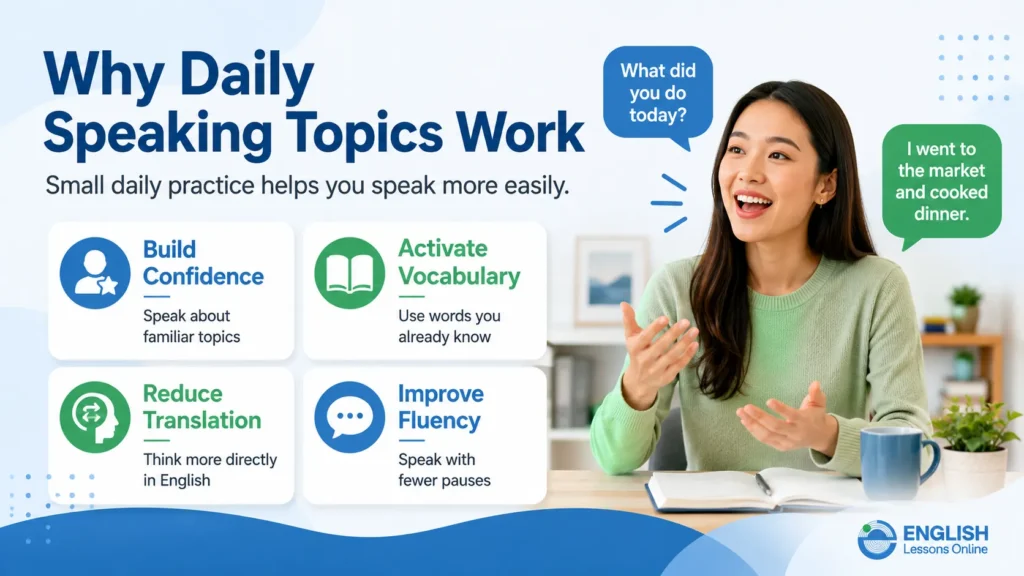
Using structured topics every day produces several practical benefits. These improvements happen gradually, not overnight, but they are real and measurable.
Familiar topics can make practice feel more manageable. You already understand the subject, so you can focus on expressing the idea in English.
For example, describing your daily routine may feel easier than discussing international economics. Begin with personal topics. Move to longer experiences, comparisons, and opinions as speaking becomes easier.
Many learners have passive vocabulary—words they recognize when reading or listening but cannot use when speaking. Speaking about a specific topic forces you to retrieve and use those words actively. Over time, passive vocabulary becomes active vocabulary.
One of the biggest barriers for beginner and intermediate learners is translating from their first language before speaking. Topic-based practice builds direct connections between English words and the situations they describe. The more you speak about familiar subjects in English, the less you need to translate first.
Other benefits include:
The table below shows which topic types, goals, and practice times work best at each level.
| English Level | Best Topic Type | Recommended Speaking Time | Main Practice Goal | Example Topic |
| Beginner (A1) | Personal and familiar topics | 1–2 minutes | Use basic sentences and simple vocabulary | “My daily routine” |
| Elementary (A2) | Everyday life and preferences | 2–3 minutes | Connect ideas with and, but, because | “Food I like and dislike” |
| Intermediate (B1) | Opinions and experiences | 3–5 minutes | Give reasons, use past and future tenses | “A travel experience” |
| Upper-Intermediate (B2) | Abstract and professional topics | 5–7 minutes | Argue a point, use complex sentences | “Working from home” |
Use this table to choose topics that match your current level. Starting too difficult makes practice frustrating. Starting at the right level builds momentum.
These topics are suitable for A1–A2 learners. Each one includes questions, useful vocabulary, and a speaking task.
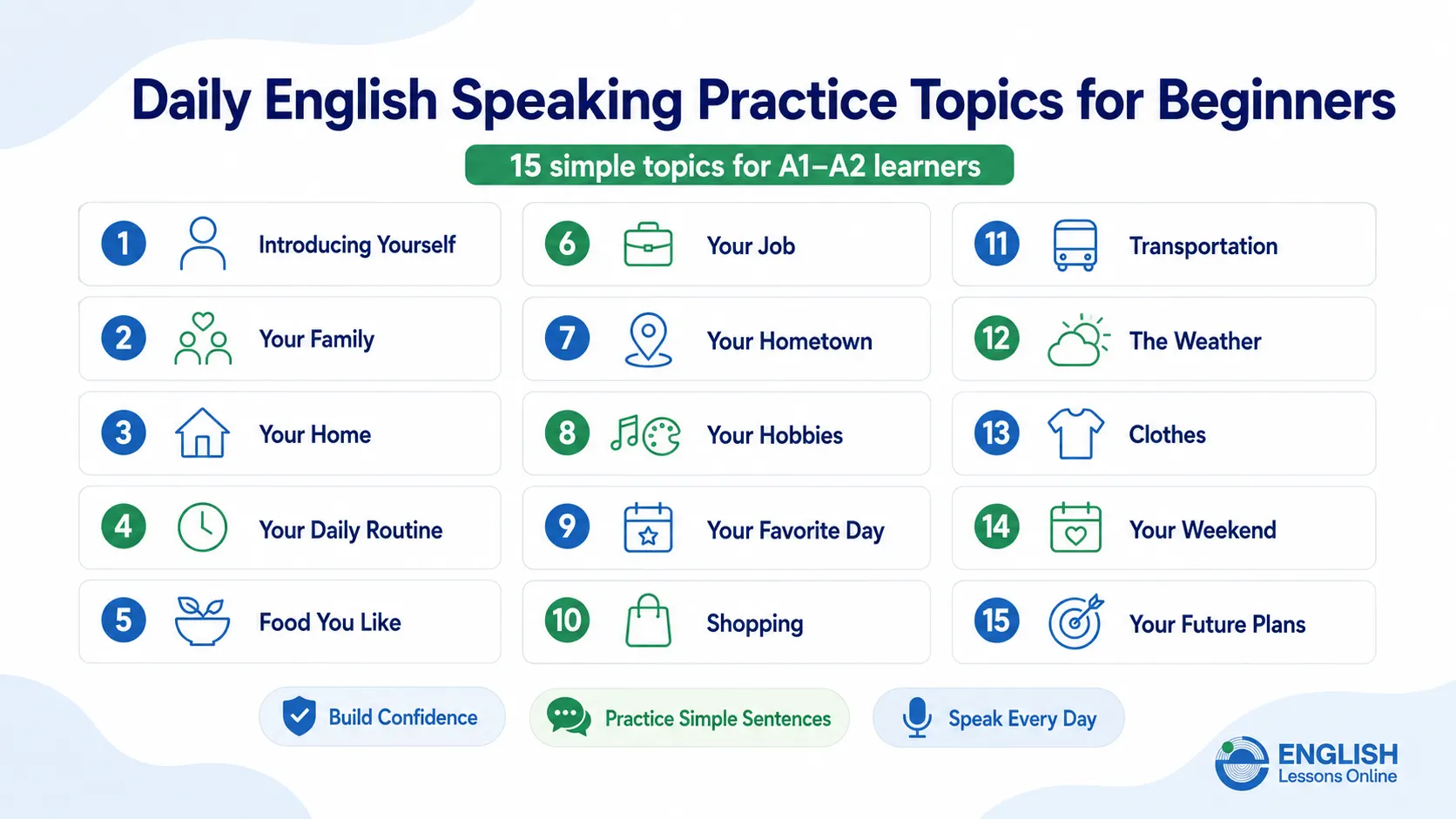
Not sure which level matches your English? Take the free online English placement test at EnglishLessons.Online before building your practice plan. It covers grammar, vocabulary, and comprehension, and helps you identify the right starting point.
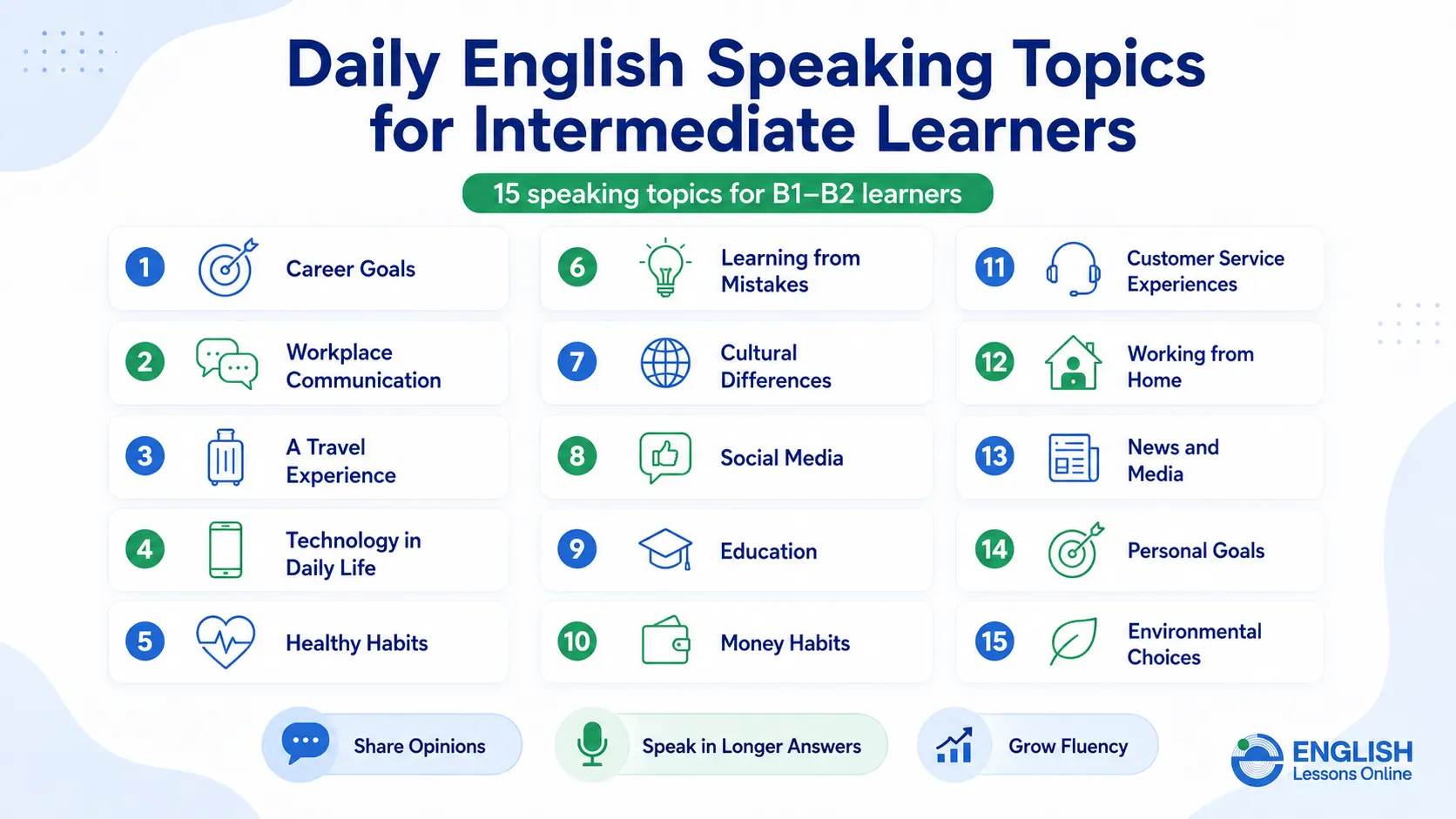
These topics are suitable for B1–B2 learners. They require longer answers, opinions, and more complex sentences.
Use this 30-day plan to practice one topic per day. Topics move from simple and personal at the start to more detailed and opinion-based by day 30.
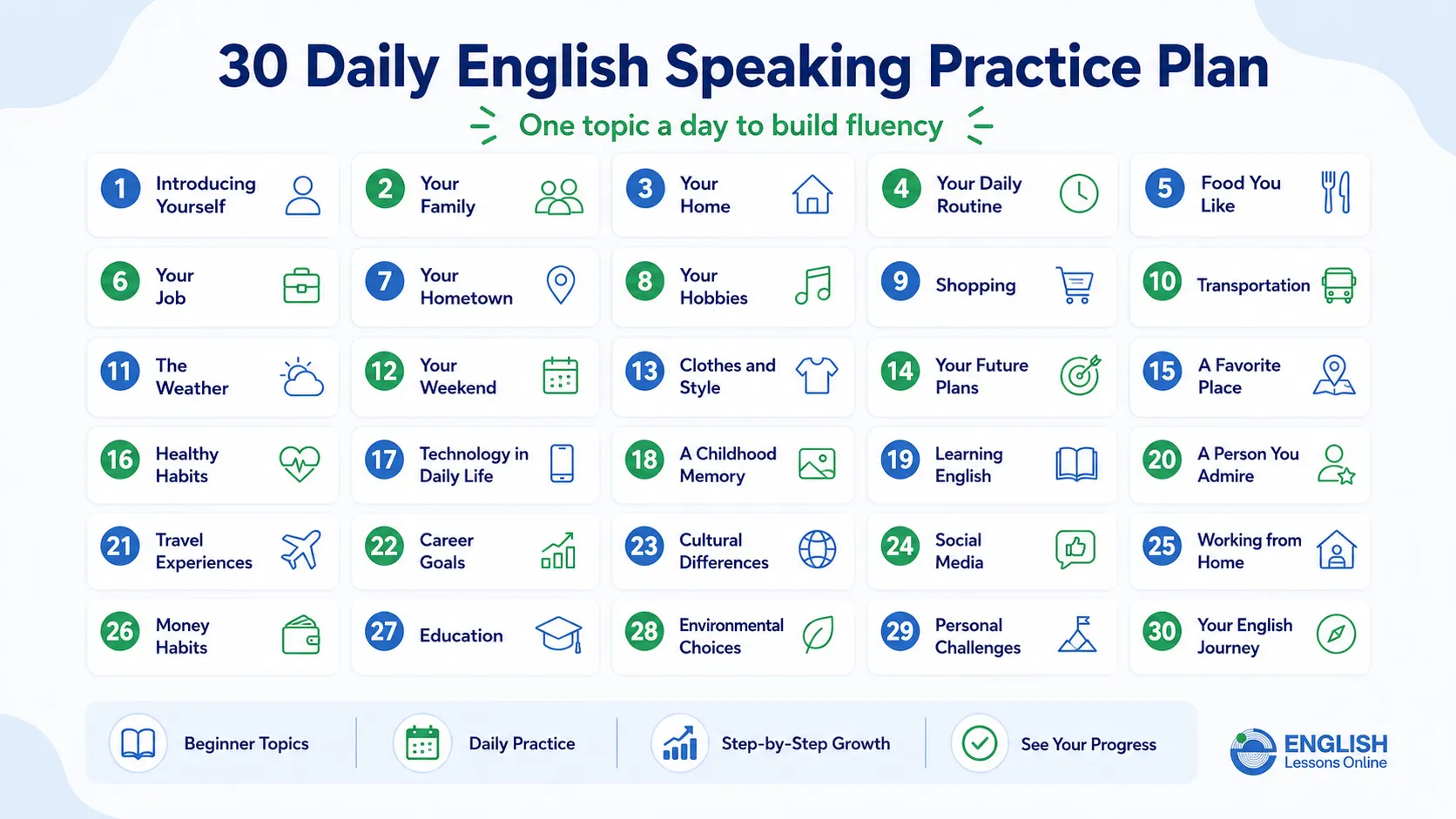
| Day | Topic | Speaking Prompt | Suggested Time | Goal |
| 1 | Introducing yourself | Tell me about yourself. Who are you? | 1 min | Use basic present tense sentences |
| 2 | Your family | Describe two people in your family. | 2 min | Use names, relationships, and jobs |
| 3 | Your home | What does your home look like? | 2 min | Use location words: next to, in front of |
| 4 | Your daily routine | What do you do from morning to night? | 2 min | Use sequence words: first, then, after |
| 5 | Food you like | What are your three favorite foods and why? | 2 min | Use because to give reasons |
| 6 | Your job | What do you do at work? | 2 min | Use simple present and work vocabulary |
| 7 | Your hometown | Describe where you grew up. | 2 min | Use adjectives: big, quiet, crowded |
| 8 | Your hobbies | What do you enjoy doing in your free time? | 2 min | Use I enjoy, I like to, I usually |
| 9 | Shopping | Describe your last shopping trip. | 2 min | Use simple past tense |
| 10 | Transportation | How do you travel to work or school? | 2 min | Use time expressions: it takes, every day |
| 11 | The weather | Describe today’s weather and your favorite season. | 2 min | Use weather vocabulary and comparisons |
| 12 | Your weekend | What did you do last weekend? | 2 min | Practice simple past tense freely |
| 13 | Clothes and style | What do you usually wear? Why? | 2 min | Describe with adjectives and preferences |
| 14 | Your future plans | What do you want to do in the next year? | 2 min | Use I want to, I plan to, I hope to |
| 15 | A favorite place | Describe a place you love and why. | 3 min | Use descriptive language |
| 16 | Healthy habits | What do you do to stay healthy? | 3 min | Use frequency words: always, sometimes, never |
| 17 | Technology in daily life | How do you use technology every day? | 3 min | Give examples and opinions |
| 18 | A childhood memory | Describe something you remember from when you were a child. | 3 min | Use past tense narrative |
| 19 | Learning English | Why are you learning English? What is your goal? | 3 min | Practice personal motivation language |
| 20 | A person you admire | Who do you admire and why? | 3 min | Describe character and reasons |
| 21 | Travel experiences | Talk about a place you have visited or want to visit. | 3 min | Use present perfect or conditional |
| 22 | Career goals | What are your professional goals for the next five years? | 4 min | Structure a longer answer with reasons |
| 23 | Cultural differences | How is your culture different from US culture? | 4 min | Use comparison language: while, whereas |
| 24 | Social media | Do you think social media is more helpful or harmful? | 4 min | Give an opinion with supporting reasons |
| 25 | Working from home | What are the advantages and disadvantages? | 4 min | Practice balancing two viewpoints |
| 26 | Money habits | How do you manage your finances? What advice would you give? | 4 min | Use conditional: If I were…, I would… |
| 27 | Education | What is the best way to learn a new skill? | 5 min | Support opinion with one personal example |
| 28 | Environmental choices | What changes do you make to protect the environment? | 5 min | Use linking words: therefore, as a result |
| 29 | Personal challenges | What is one challenge you are currently facing and how are you handling it? | 5 min | Practice honest, fluent, extended speaking |
| 30 | Your English journey | What have you learned in the last 30 days? What will you do next? | 5 min | Reflect and plan using full sentences |
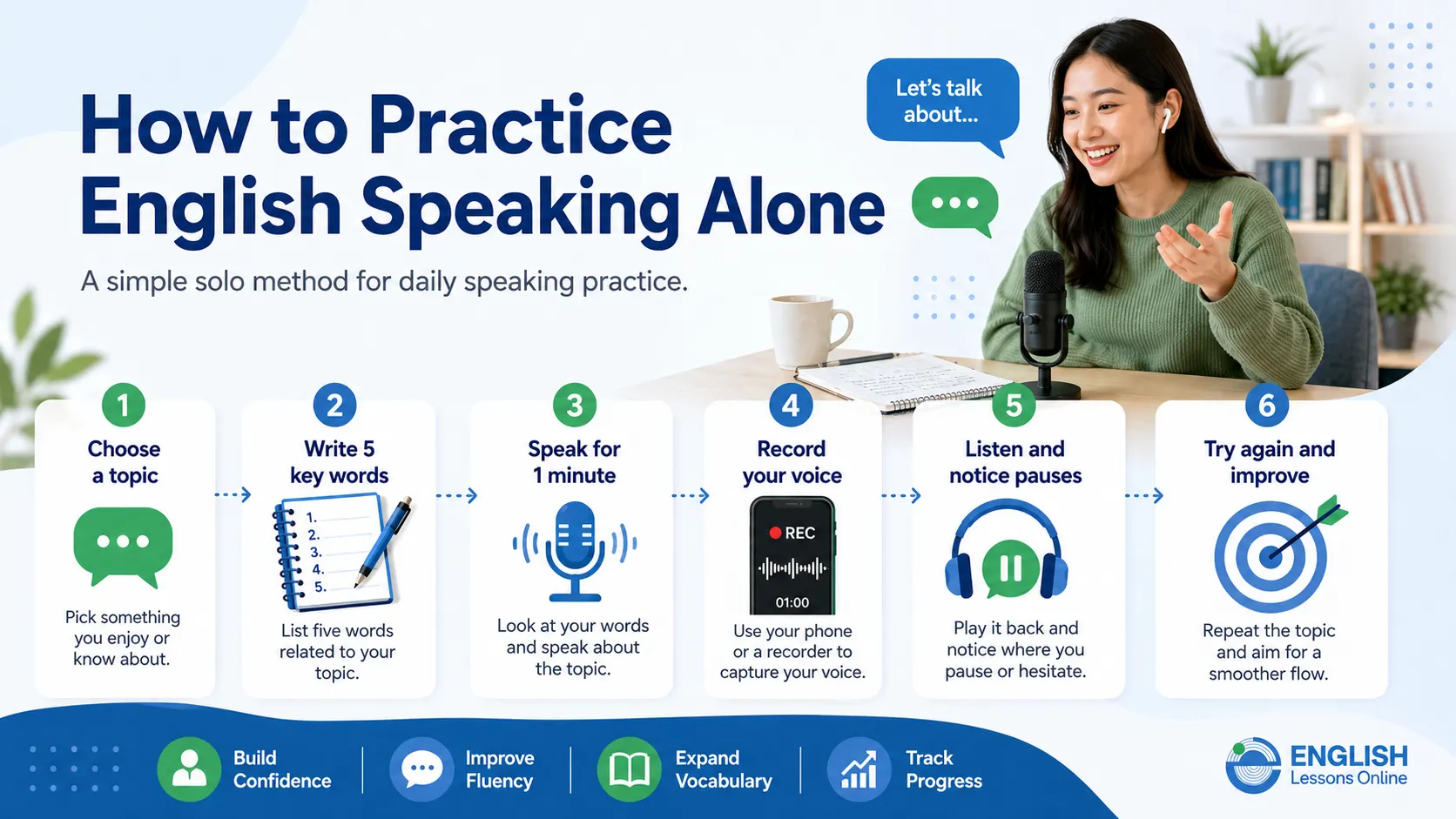
You can practice English speaking alone by choosing one topic, preparing a few key words, speaking aloud, recording your voice, and reviewing what you said.
Solo practice is effective because it removes social pressure. You speak at your own pace, without fear of judgment. Research from Cambridge Assessment English suggests that learner-generated output, speaking without a prompt or correction, strengthens memory for new vocabulary and grammar structures.
Shadowing means listening to a native English speaker and repeating exactly what they say, at the same speed and with the same rhythm. It trains your mouth to produce natural English sounds. Choose a short podcast clip or YouTube video on a topic from this list, then pause and repeat each sentence. Shadowing improves pronunciation and natural sentence flow over time.
Other useful solo techniques include:
Two learners can use speaking topics effectively by taking turns, asking follow-up questions, and avoiding one-word answers.

Follow these steps with a practice partner:
Topic: Your daily routine
Partner A: I usually wake up at 6 a.m. I make coffee and check my messages. Then I take a shower and leave for work at 7:30. My commute is about 40 minutes by bus.
Partner B: That sounds like a busy morning. Do you eat breakfast before you leave?
Partner A: Yes, I have toast and coffee at home. Sometimes I eat at the office if I am late.
Partner B: I understand. My morning is similar, but I work from home, so I don’t have a commute.
Notice how both speakers use complete sentences and ask follow-up questions. This is what a productive partner practice session looks like.
Use thinking-time expressions to keep the conversation going while you organize your thoughts.
These phrases are natural and common in real English conversations. They signal to your listener that you are thinking, not that you do not know.
Practice these phrases until they feel automatic. When you stop panicking about silence, you give your brain the space it needs to find the right words.
Short daily practice is more effective than occasional long sessions. Language learning research consistently supports the principle of spaced repetition, frequent, brief exposures produce stronger retention than rare, lengthy study sessions (ACTFL, 2012).
Here is a realistic guide:
| Practice Time | What to Do | Best For |
| 5 minutes | Choose one topic, speak for two minutes, review one sentence | Very busy schedules, beginners building a habit |
| 10 minutes | Speak for three minutes, record and listen, review vocabulary | Most learners; sustainable daily routine |
| 20 minutes | Full topic practice, partner conversation, or shadowing exercise | Learners preparing for an interview, exam, or job |
| 30+ minutes | Class session, structured lesson, or extended partner practice | Learners in a formal program |
The most important factor is regularity. Ten minutes every day produces better results than one hour once a week.
Most learners make the same set of mistakes. Recognizing them helps you avoid them.
| Mistake | Simple Fix |
| Waiting until your grammar is perfect before speaking | Start speaking now. Grammar improves through practice, not preparation. |
| Memorizing full answers | Use key words as prompts instead. Memorized answers sound unnatural. |
| Choosing topics that are too difficult | Start with personal topics. Move to opinion topics after a few weeks. |
| Speaking without reviewing vocabulary first | Write 5 words before you start. This primes your brain. |
| Never listening to your recordings | Listening back is how you notice real problems. Do it every session. |
| Correcting every mistake while speaking | Speak first, review after. Self-interruption breaks your fluency. |
| Using only one-word answers | Always add because, so, or for example to extend your answer. |
| Practicing irregularly | Set a specific daily time. Treat it like an appointment. |
| Repeating the same easy topics | Challenge yourself weekly. Use the 30-day plan to stay on track. |
| Avoiding real conversations | Speaking practice prepares you for real life—use it there too. |
Solo practice and partner conversations are powerful tools. But there are situations where working with a qualified English teacher makes a significant difference.
Consider getting professional support if you:
EnglishLessons.Online offers both group English classes and private English lessons online via Zoom. Lead instructor Antonio Franco is a certified English teacher and psycholinguist with more than 20 years of experience. The school serves learners from beginner to advanced levels and has students from over 25 countries.
Talk about familiar subjects such as your routine, family, work, food, hometown, hobbies, and future plans. Familiar topics let you focus on building sentences. As your confidence grows, add experiences, comparisons, problems, and opinions.
Yes. Talking to yourself helps you practice sentence building, vocabulary recall, and pronunciation. Ask yourself questions, describe your actions, explain a picture, or retell a short story. Add partner or teacher practice when you need interaction and feedback.
Record yourself answering questions, describe photos, shadow short audio clips, retell videos, or explain your daily activities aloud. You can also exchange voice messages with another learner or join a live online class for regular interaction.
Recording gives you a way to review your speech. You can listen for unclear pronunciation, long pauses, missing words, or repeated grammar errors. Record the same answer twice and compare the second version with the first.
Practice common sentence patterns instead of translating complete ideas. Learn phrases such as “In my opinion,” “The main reason is,” and “One example is.” Reuse these patterns across different topics until you can begin answers more quickly.
Add four parts to your answer: a direct response, a reason, an example, and a final comment. You can also ask yourself follow-up questions such as “Why?”, “When?”, “Where?”, “Who with?”, and “What happened next?”
Daily practice supports speaking development, but most learners also need listening, vocabulary, grammar, interaction, and useful feedback. Combine independent practice with real conversations. A teacher can help identify problems you may not notice by yourself.
Choose one topic today. Prepare three to five useful words and speak aloud for a few minutes. Record your answer, identify one improvement, and try the task again.
Do not wait for perfect grammar. Your first goal is to express a clear idea. You can improve accuracy as you continue practicing.
Continue with these related guides:
Not sure where to begin? Take the free English placement test to find your level. When you are ready for live conversation and teacher feedback, book a free group trial class.