
English speaking practice exercises help you build fluency, improve pronunciation, and feel more confident using English in real life. You do not need a classroom or a partner for every practice session. At home, you can speak out loud, record your voice, copy short audio clips, describe your day, and prepare for common conversations.
The most useful home exercises make you produce full sentences. They should help you recall words quickly, organize your ideas, and continue speaking even when you make a small mistake. Start with simple topics you know well, then add more challenging situations as your confidence grows.
Can you improve English speaking at home?
Yes. You can improve English speaking at home by practicing aloud every day and reviewing one clear area at a time. Solo practice is especially useful for building vocabulary recall, pronunciation awareness, and speaking speed.
However, practicing with another person is still valuable. A teacher or conversation partner can give feedback, ask follow-up questions, and help you respond naturally. The strongest routine combines independent home practice with regular real conversations.
How do you choose the right speaking exercise?
Choose an exercise based on the skill you want to improve. You do not need to do every exercise in one session.
| Your speaking goal | Best exercise | What it helps you practice |
| Speak without long pauses | Timed speaking and self-talk | Fluency and faster word recall |
| Improve pronunciation | Reading aloud and shadowing | Sounds, stress, rhythm, and intonation |
| Feel less nervous | Mirror practice and voice recordings | Confidence and self-awareness |
| Prepare for daily conversations | Role-plays and question prompts | Useful phrases and natural responses |
| Stop translating every word | Daily narration and story retelling | Thinking in simple English sentences |
| Speak more accurately | Recording and self-correction | Repeated grammar and pronunciation errors |
Start with one fluency exercise and one accuracy exercise. For example, you could do a one-minute talk, then record yourself and review one pronunciation point.
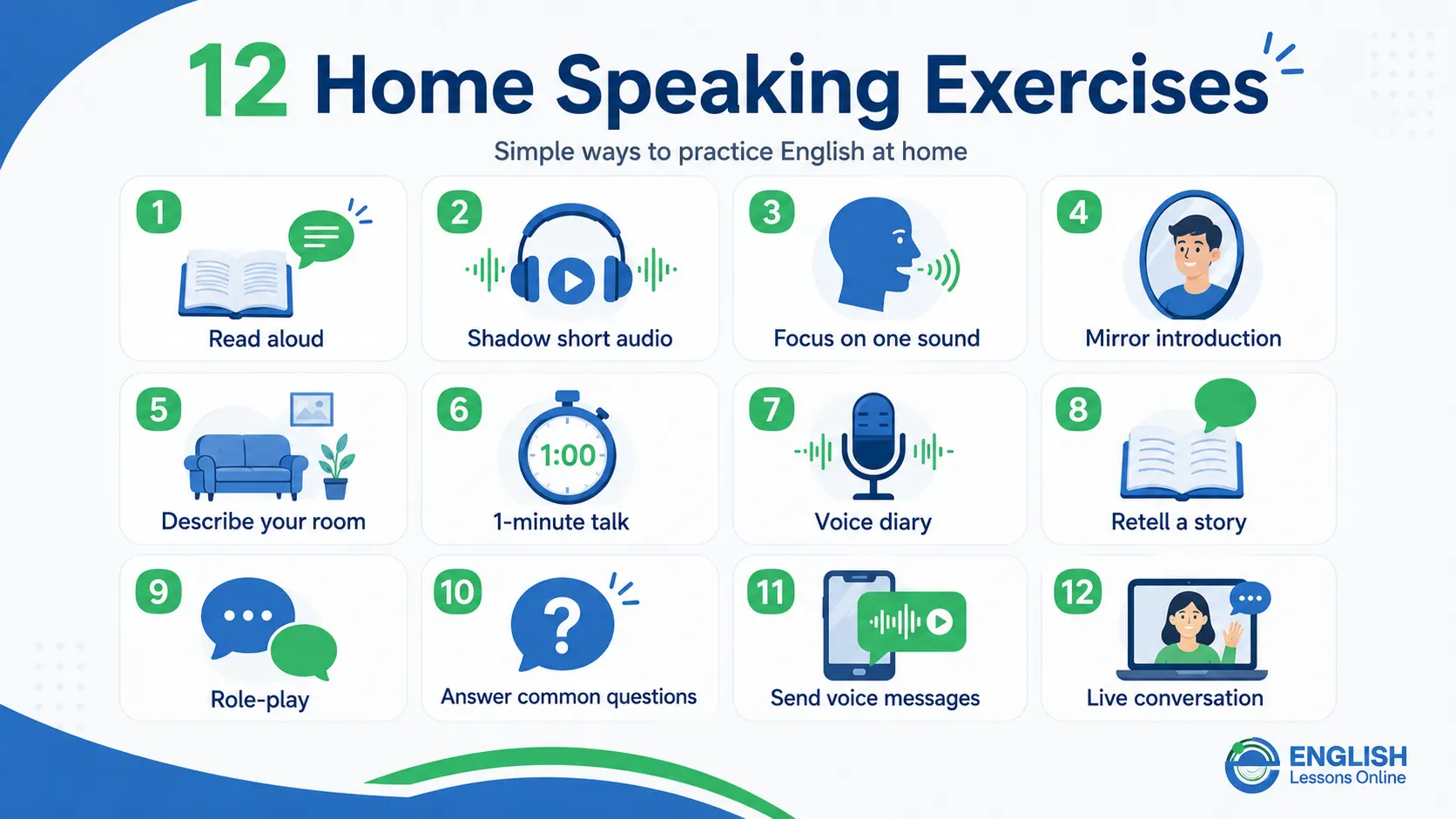
12 English speaking practice exercises to do at home
1. Read a short text aloud
Reading aloud improves the connection between written English and spoken English. It helps you practice sentence rhythm, word stress, and common phrases without needing to create every sentence from zero.
Choose a short paragraph from a level-appropriate article, story, or lesson. Read it silently first so you understand the meaning. Then read it aloud three times:
- Read slowly and clearly.
- Mark natural pauses between ideas.
- Read again at a more natural speed.
Do not focus only on individual words. Notice how words connect in a sentence. For example, instead of stopping after every word, practice the full phrase: “I’m looking for a job near my home.”
2. Use shadowing to copy natural English
Shadowing means listening to a short English audio clip and repeating it immediately. It is useful for improving rhythm, stress, connected speech, and natural intonation.
Use an audio clip that is 20 to 45 seconds long. A short conversation, lesson recording, or video with clear speech works well.
Follow these steps:
- Listen once without speaking.
- Listen again and repeat with the speaker.
- Pause after each sentence if the speed is difficult.
- Record your final attempt.
- Compare your rhythm and pronunciation with the original.
Choose material you can mostly understand. If the audio is too advanced, you may copy sounds without understanding how to use the language yourself.
3. Practice one pronunciation point at a time
Pronunciation improves faster when you focus on one sound, stress pattern, or sentence feature during each practice session. Trying to fix everything at once can make speaking feel difficult.
You can practice:
- Long and short vowel sounds, such as ship and sheep
- Final consonant sounds, such as the t in want or worked
- Word stress, such as PREsent and preSENT
- Sentence stress, such as “I need help” and “I need HELP.”
- Rising and falling intonation in questions and statements
Use an online dictionary with audio pronunciation. Listen, repeat, and record your voice. Then say the word in a full sentence. This helps you move from isolated pronunciation practice to real communication.
4. Introduce yourself in front of a mirror
Mirror practice helps you become more comfortable speaking English while looking at someone. It can reduce nervousness before job interviews, meetings, classes, or social conversations.
Prepare a short introduction that includes:
- Your name
- Where you live
- What you do
- Your interests
- Why you are learning English
For example:
“Hi, my name is Maria. I live in New York, and I work in a restaurant. I am learning English because I want to speak more confidently with customers and apply for better jobs.”
Practice the same introduction until it feels natural. Then change one detail each time so you do not only memorize it.
5. Describe what you can see around you
Describing your surroundings helps you form simple English sentences without translating from your first language. You can do this anywhere at home.
Look at a room, a photo, or an object. Describe what you see for one minute. Use basic details first, then add more information.
For example:
“There is a small table next to the window. On the table, there is a laptop and a cup of coffee. The room is quiet, but I can hear cars outside.”
This exercise builds useful vocabulary for colors, size, location, actions, and daily objects. It is also suitable for beginners because you control the topic.
6. Speak for one minute about a familiar topic
Timed speaking trains you to continue talking instead of stopping when you cannot find the perfect word. It is one of the most practical exercises for building fluency.
Set a timer for one minute. Choose a familiar topic, such as:
- Your daily routine
- Your family
- Your favorite food
- Your workday
- A recent weekend
- A place you want to visit
Speak until the timer ends. Do not stop to correct every grammar mistake. After one minute, repeat the same topic for another minute. Your second attempt will usually sound clearer because your ideas are already organized.
7. Keep an English voice diary
A voice diary gives you regular speaking practice and a record of your progress. You only need your phone or computer.
Record one to three minutes each day. Talk about what happened, what you plan to do, or how you feel about a simple event. Use complete sentences.
You could begin with prompts like:
- “Today I had to…”
- “The best part of my day was…”
- “Tomorrow I need to…”
- “This week I am trying to…”
Listen to one recording at the end of the week. Notice one improvement and one repeated problem. For example, you may hear that you pause less often, but still need to practice past tense verbs.
8. Retell a short story or video
Retelling helps you organize information in English instead of repeating exact sentences. It improves speaking fluency, sequence words, and grammar for past events.
Watch a short video or read a short story. Then explain it in your own words without looking at the original.
Use sequence phrases such as:
- First
- Then
- After that
- Because of this
- Finally
For example:
“First, the woman missed her bus. Then she called her manager and explained that she would be late. Finally, she found a taxi and arrived at work.”
Start with a 30-second video. As you improve, retell longer stories and include your own opinion.
9. Practice real-life role-plays
Role-plays prepare you for English situations you may face at work, in shops, during travel, or in appointments. They help you learn useful phrases before you need them.
Practice common situations such as:
| Situation | Useful speaking task |
| Ordering food | Ask about the menu, price, and ingredients |
| Calling a doctor’s office | Explain a health concern and request an appointment |
| Job interview | Describe your experience and answer common questions |
| Talking to a customer | Greet the person, offer help, and solve a simple problem |
| Traveling | Ask for directions, check in, or explain a booking issue |
Write a short dialogue first. Then practice both sides of the conversation. Later, change the answers so your speech stays flexible.
10. Answer common conversation questions
Question practice helps you respond more naturally when someone starts a conversation. Many adult learners understand questions but need extra time to answer them.
Practice questions such as:
- What do you usually do on weekends?
- What kind of work do you do?
- How long have you lived here?
- What are you learning English for?
- What is something you enjoyed recently?
- What would you like to improve this year?
Give a short answer first. Then add one reason, example, or detail. This creates a more natural response.
For example:
“I usually spend weekends with my family. We cook together on Saturday, and on Sunday I prepare for the week.”
11. Send voice messages in English
Voice messages let you practice real communication without the pressure of an immediate response. You have time to think, speak, listen again, and improve your message.
You can send a short message to a classmate, language partner, friend, or tutor. Start with simple topics:
- Ask how their day is going.
- Explain what you did today.
- Recommend a movie or restaurant.
- Share a plan for the weekend.
- Ask one follow-up question.
Keep the message short at first. One clear minute is more useful than a long message that you do not understand when you listen back.
12. Practice a live conversation from home
Live conversation gives you practice responding to real people in real time. It helps you use the vocabulary and speaking habits you build during solo practice.
If you want structured guidance, explore live English language classes online. EnglishLessons.Online offers live Zoom classes where adult learners can practice speaking with certified instructors and other students.
Group classes can help you build confidence through regular discussion. Private lessons can give you focused support for interviews, workplace communication, pronunciation, or a specific speaking goal.
What is a simple 20-minute English speaking routine?
A 20-minute daily routine is enough to create regular speaking practice when you use it consistently. The goal is to speak aloud, review one issue, and return the next day.
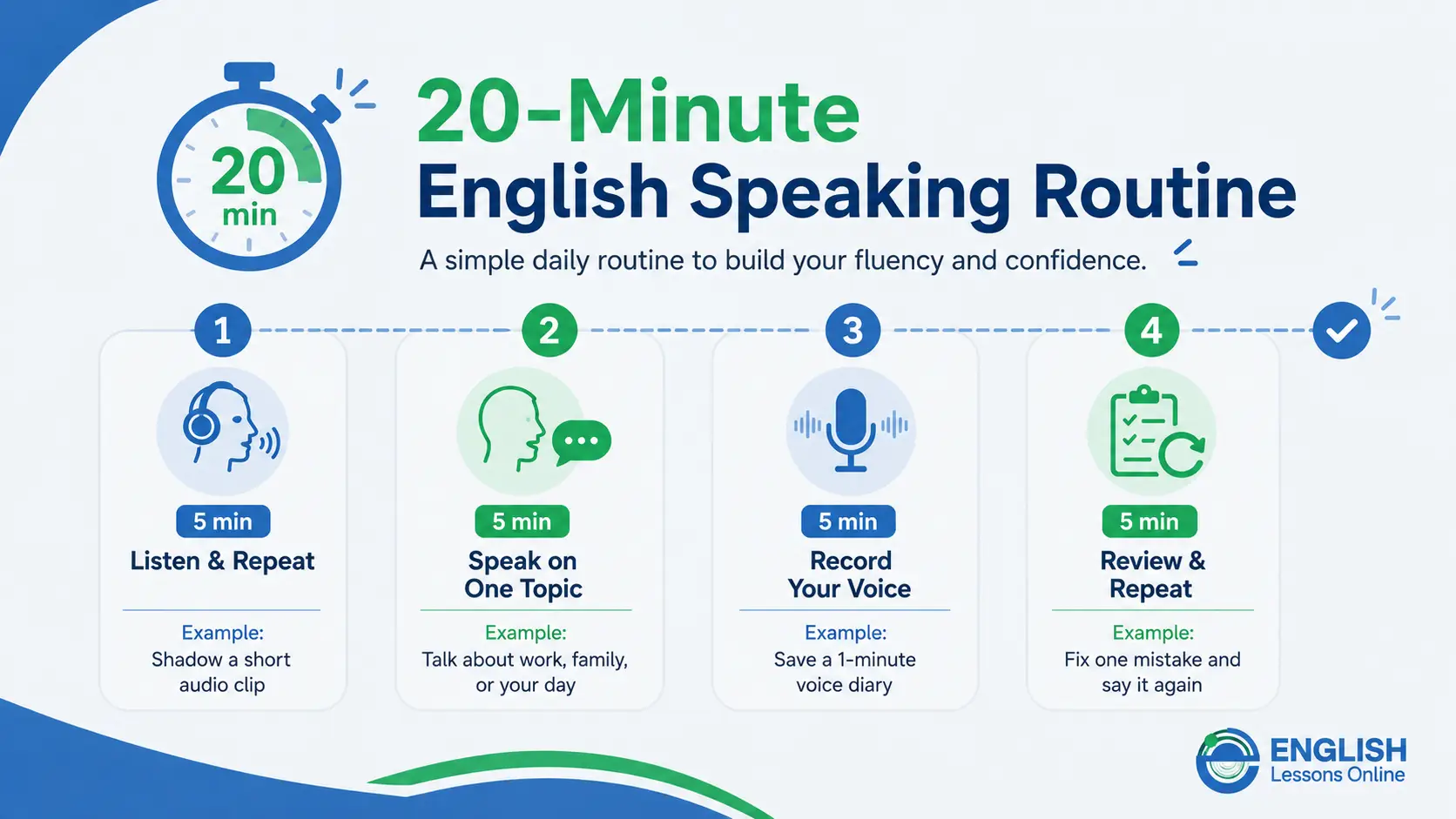
| Time | Activity | Example |
| 5 minutes | Listen and repeat | Shadow a short audio clip |
| 5 minutes | Speak about one topic | Talk about your workday or family |
| 5 minutes | Record your voice | Save a one-minute voice diary |
| 5 minutes | Review and repeat | Correct one mistake, then say it again |
Do not spend all 20 minutes studying grammar rules silently. The main purpose of this routine is to use English with your voice.
Try this 7-day home speaking plan
A weekly plan helps you practice different speaking skills without feeling overwhelmed.
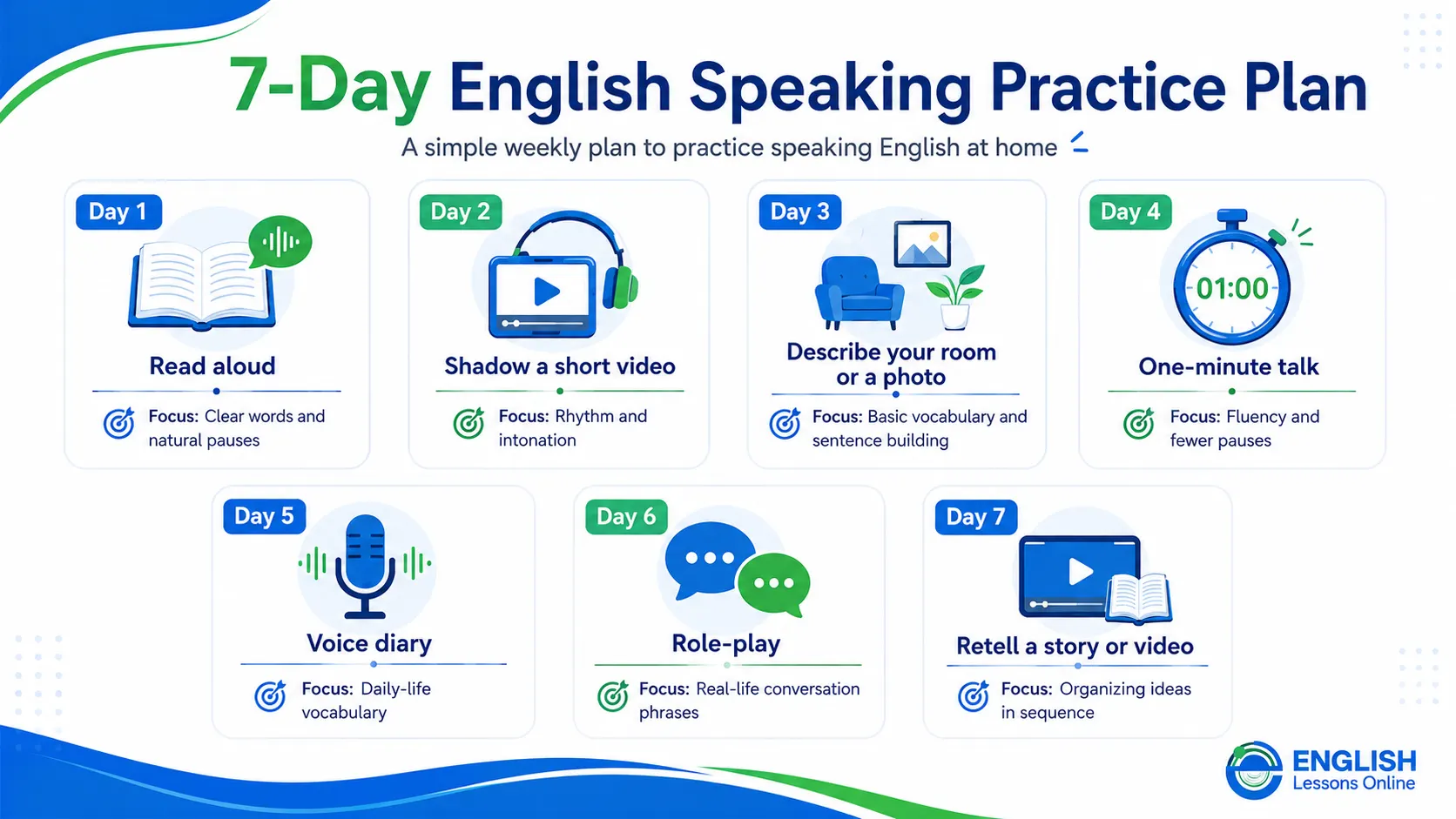
| Day | Main exercise | Speaking focus |
| Day 1 | Read aloud | Clear words and natural pauses |
| Day 2 | Shadow a short video | Rhythm and intonation |
| Day 3 | Describe your room or a photo | Basic vocabulary and sentence building |
| Day 4 | One-minute talk | Fluency and fewer pauses |
| Day 5 | Voice diary | Daily-life vocabulary |
| Day 6 | Role-play | Real-life conversation phrases |
| Day 7 | Retell a story or video | Organizing ideas in sequence |
Repeat the plan with new topics the following week. Small daily practice is more effective than waiting for one long study session.
How can you correct yourself when practicing alone?
You can correct yourself by recording your speech, comparing it with a reliable model, and focusing on repeated errors. Self-correction works best when you choose one area at a time.
Use this process:
- Record a short answer or speaking task.
- Listen once for fluency. Notice where you stop or restart.
- Listen again for one grammar or pronunciation issue.
- Write the corrected sentence.
- Record the same answer again.
For pronunciation, compare your speech with dictionary audio or a clear lesson recording. For grammar, check whether you used the right verb tense, word order, or article.
Keep a small “speaking mistakes” list. Include only errors you make often. For example:
- “He go to work” → “He goes to work.”
- “I am here since 2022” → “I have been here since 2022.”
- “She work in a bank” → “She works in a bank.”
What mistakes should you avoid during home speaking practice?
Avoiding a few common mistakes will make your speaking practice more useful and less stressful.
- Practicing silently: Reading and thinking in English help, but speaking requires using your voice.
- Stopping after every mistake: Continue your idea first. Review the mistake after you finish.
- Using material that is too difficult: Choose topics and audio you can mostly understand.
- Memorizing only single words: Practice useful phrases and full sentences.
- Repeating the same easy topic forever: Gradually add workplace, travel, and social situations.
- Ignoring pronunciation: Clear pronunciation helps listeners understand you, even when your grammar is not perfect.
- Waiting until you feel confident: Confidence often grows because you practice, not before you start.
What should beginners talk about in English?
Beginners should start with personal, familiar topics because they require less vocabulary and allow repeated practice. You do not need advanced words to build speaking confidence.
Good beginner topics include:
- Your name, family, and hometown
- Your daily routine
- Your job or studies
- Food you like
- Your home and neighborhood
- Your plans for tomorrow
- A recent activity
- A movie, song, or sport you enjoy
If you need a guided starting point, basic English classes for beginners online can help you learn the sentence patterns and everyday vocabulary used in these conversations.
When should you practice with a teacher or conversation partner?
Practice with a teacher or conversation partner when you need feedback, real conversation experience, or support with a specific goal. Home exercises build a strong base, but another person can help you notice errors you may not hear yourself.
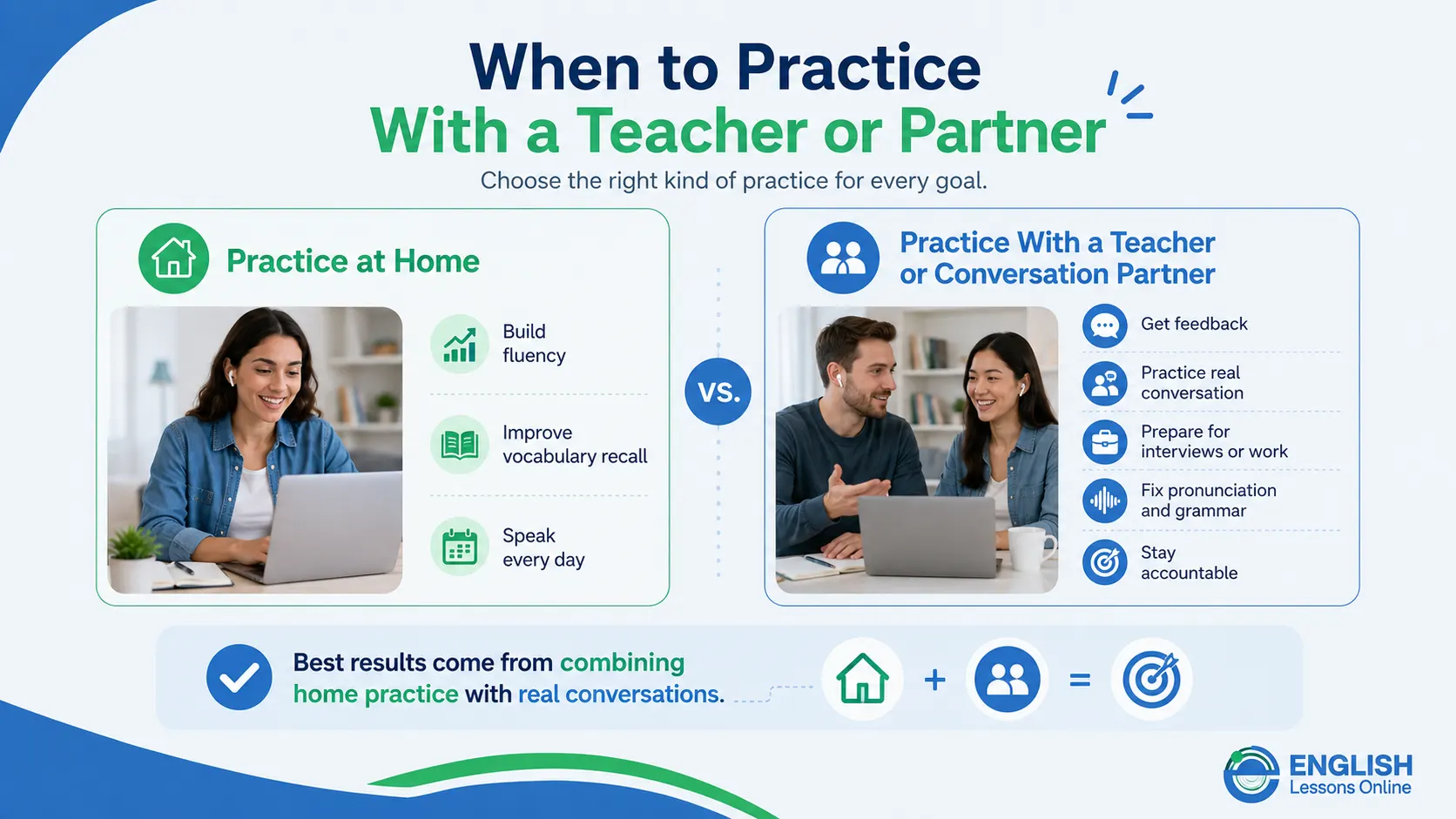
A teacher can be especially helpful when you want to:
- Prepare for a job interview
- Improve workplace English
- Correct recurring pronunciation problems
- Build confidence for conversations
- Prepare for TOEFL or another English test
- Follow a personalized study plan
For one-to-one speaking support, private English language lessons online can give you time to practice your own goals and receive direct feedback.
Frequently asked questions
Can I improve my English speaking without a partner?
Yes. You can improve fluency, pronunciation, and confidence by speaking aloud, recording yourself, and practicing daily topics at home. A partner is helpful for feedback, but you can build strong speaking habits alone.
How many minutes should I practice English speaking each day?
Practice for 15 to 30 minutes a day if possible. A short daily routine is easier to maintain and gives you more regular chances to recall words and form sentences.
Which English speaking exercise is best for beginners?
Describing your surroundings and talking about your daily routine are two of the best beginner exercises. They use familiar vocabulary and help you create simple, useful sentences.
How can I stop translating in my head?
Use short, simple English sentences about familiar topics. Daily narration, photo description, and voice diaries help you connect ideas directly to English words instead of translating long sentences.
How can I become more confident speaking English?
Confidence grows when you practice speaking regularly in low-pressure situations. Start alone, record short answers, and move gradually toward live conversations with supportive teachers or partners.
Start your English speaking practice at home
Speaking English at home does not need to feel complicated. Choose one exercise, speak aloud for a few minutes, and repeat it regularly. Your first goal is not perfect grammar. Your goal is to express one clear idea, then another.
With daily practice, you can speak with fewer pauses, use more useful phrases, and feel more prepared for real conversations at work, in your community, and online.
Continue your English speaking practice
These guides can help you build a complete speaking routine:
- How to Practice English Speaking: Complete Guide
- How to Speak English Fluently: 12 Daily Habits That Work
- How to Learn English Step by Step: Beginner Roadmap
Practice English with live support from home
Home exercises help you build a regular speaking habit. Live classes also give you real conversation practice, teacher feedback, and support matched to your level.
Not sure which class matches your English? Take the free English placement test to find the right starting level.