
Do you know English words but struggle to use them in a conversation? You may pause too often, forget simple words, or worry about making mistakes.
These problems are normal for English learners. Speaking requires more than knowing grammar and vocabulary. You also need practice choosing words, building sentences, listening, and responding in real time.
The following English speaking practice tips will help you make each practice session more useful. You will learn how to prepare, reduce pauses, remember phrases, improve clarity, and review your mistakes without losing confidence.
This article focuses on practical tips you can use during a speaking session. For a broader learning plan, read our complete guide on how to practice English speaking.
What Are The Best English Speaking Practice Tips?
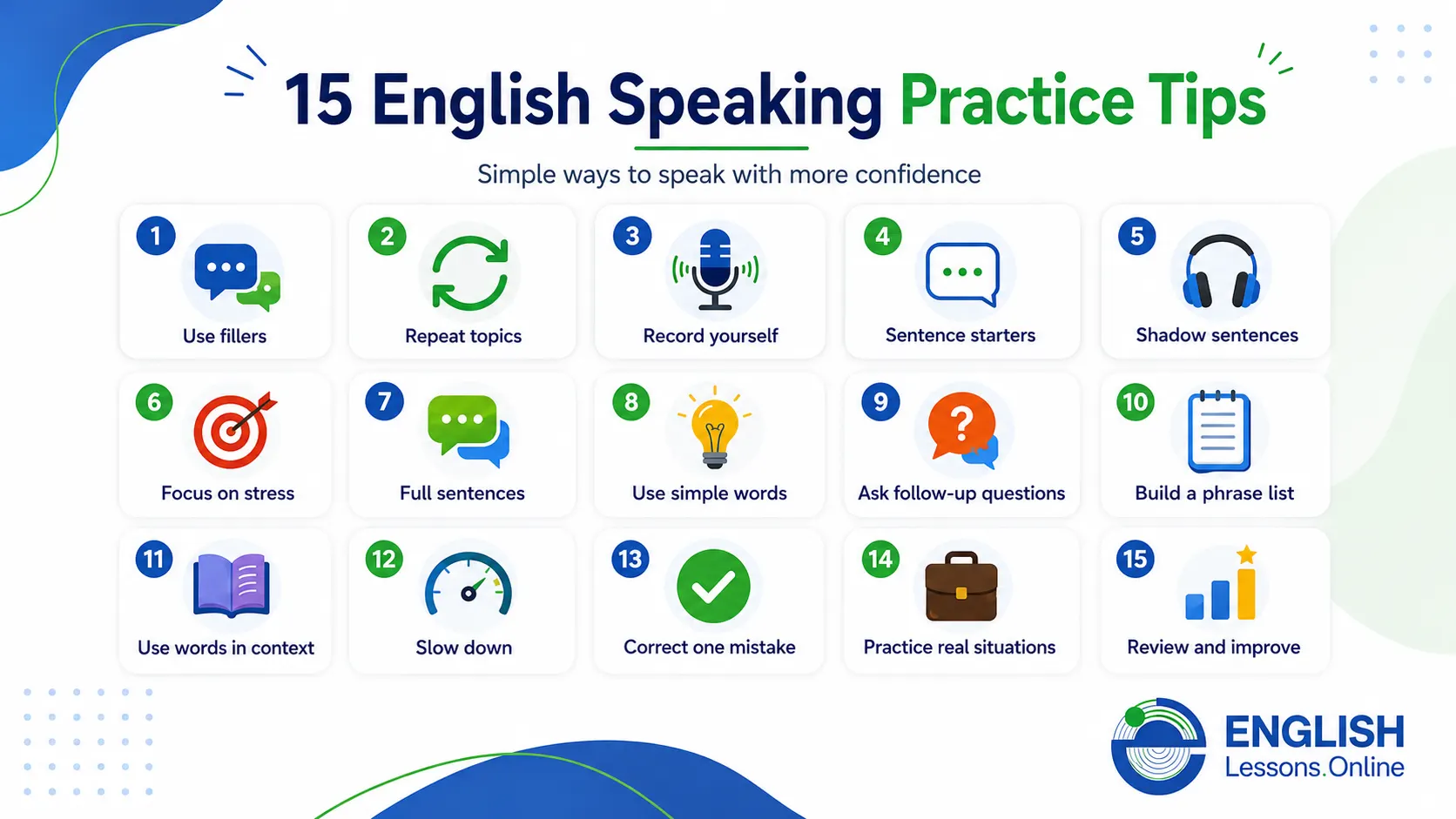
The best English speaking practice tips are to prepare useful phrases, speak in complete sentences, repeat familiar topics, record short answers, ask follow-up questions, and correct one important mistake at a time. These actions help you practice fluency, vocabulary, pronunciation, and confidence together.
Key takeaways
- Choose one goal for each speaking session.
- Prepare phrases connected to the topic.
- Speak in short, complete sentences.
- Use simple words when you forget a term.
- Repeat topics to reduce hesitation.
- Review mistakes after you finish speaking.
- Practice real situations you may face at work or in daily life.
According to the ACTFL language proficiency, it is the ability to use language to complete communication goals in real-world situations. This means useful speaking practice should help you communicate, not only remember grammar rules.
Here are 15 practical tips to try.
Tip 1: Use Filler Phrases to Avoid Long Pauses
Skill: Fluency and confidence
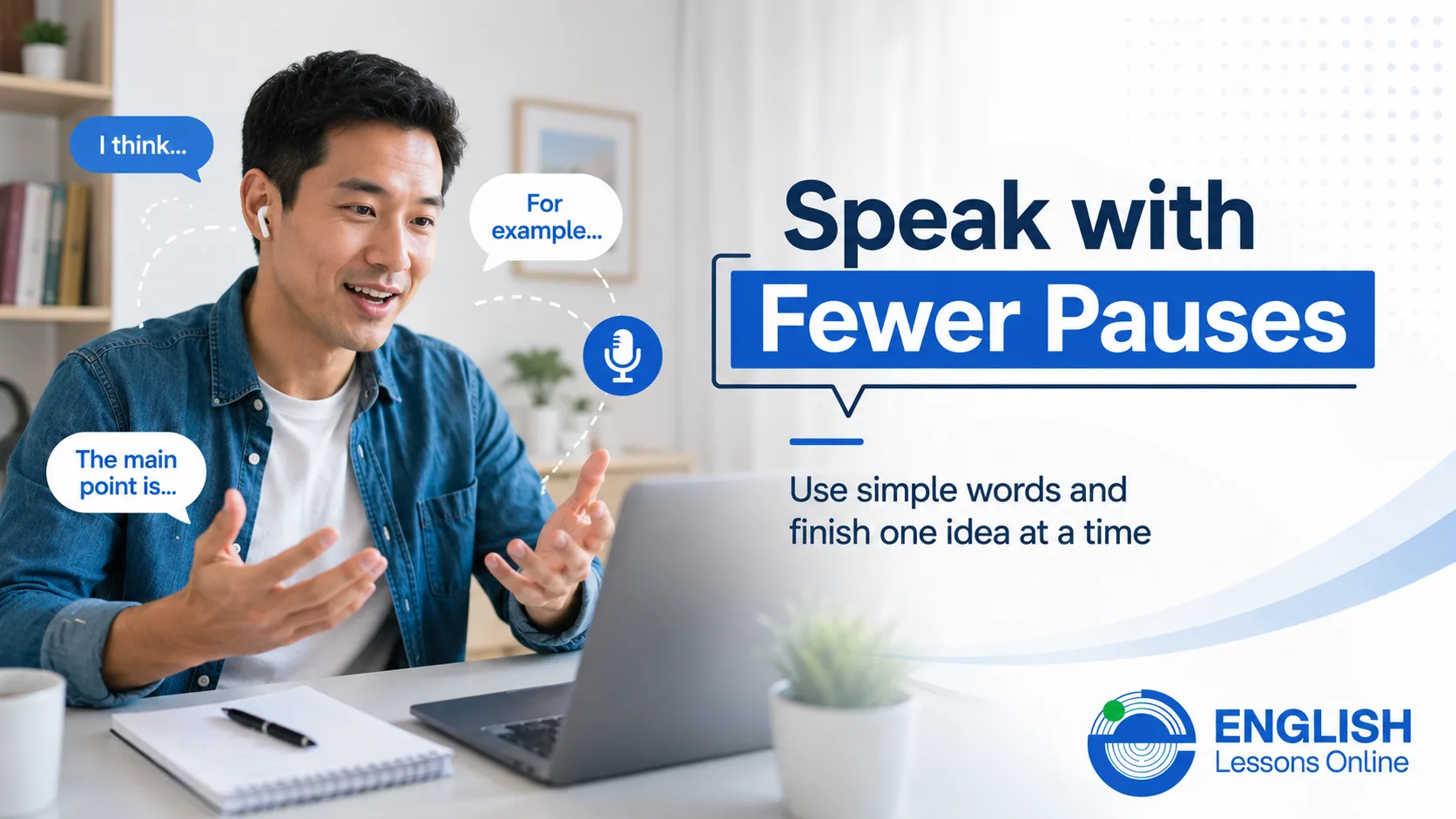
Long pauses make conversations feel stuck. Filler phrases give your brain a moment to think while keeping the conversation moving.
Filler phrases are short expressions native speakers use naturally. They are not mistakes. They are tools.
Useful filler phrases:
- “That’s a good question.”
- “Let me think about that.”
- “Well, I think…”
- “Actually, I believe…”
- “How can I say this…”
- “What I mean is…”
Example: Someone asks, “What do you think about working from home?” Instead of staying silent, say: “That’s a good question. Let me think about that for a moment… Well, I think it has good and bad sides.”
How to apply this today: Choose three filler phrases. Write them on a piece of paper. Practice using them when you answer questions aloud. Repeat until they feel natural.
Tip 2: Practice One Topic Three Times in a Row
Skill: Fluency
Repeating the same topic multiple times trains your brain to speak with fewer pauses and better sentence control.
The first time you speak about a topic, your brain searches for words. The second time is easier. By the third time, you focus on fluency rather than vocabulary.
Example topic: “My job”
- First try: “I work in a store. I help customers.”
- Second try: “I work in a grocery store downtown. I help customers find products and answer their questions.”
- Third try: “I work in a grocery store downtown. I’ve been there for two years. I help customers find what they need and I also train new staff sometimes.”
How to apply this today: Choose a topic from your real life. Speak about it for 60 seconds. Repeat twice more. Notice how much smoother the third version sounds.
Tip 3: Record Yourself and Listen Back
Skill: Pronunciation and accuracy
Most learners do not notice their speaking mistakes while they are talking. Recording gives you a listener’s perspective on your own speech.
You can hear long pauses, missing final sounds, unclear words, and repeated grammar errors. These are difficult to notice in the moment.
How to apply this today: Record 60 seconds about your day. Then listen and ask yourself:
- Did I pronounce the final sounds? (For example: “walked,” not “walk”)
- Did I pause too long between sentences?
- Did I use the correct verb tense?
- Was the sentence easy to understand?
Do not judge harshly. Notice one thing. Fix it. Record again.
Tip 4: Learn Sentence Starters, Not Just Vocabulary
Skill: Fluency and vocabulary
Single words are useful, but sentence starters help you speak faster. A sentence starter is a ready-made beginning that helps you open a sentence without hesitation.
Useful sentence starters:
- “The main reason I think this is…”
- “From my experience…”
- “I’m not completely sure, but…”
- “One thing I’ve noticed is…”
- “To be honest…”
- “What I usually do is…”
Example: Instead of struggling to begin an answer, you say: “To be honest, I find phone calls harder than in-person conversations. From my experience, I understand people better when I can see their face.”
How to apply this today: Pick two sentence starters from the list above. Practice using each one in three different sentences today.
Tip 5: Shadow Short, Simple Sentences
Skill: Pronunciation and rhythm
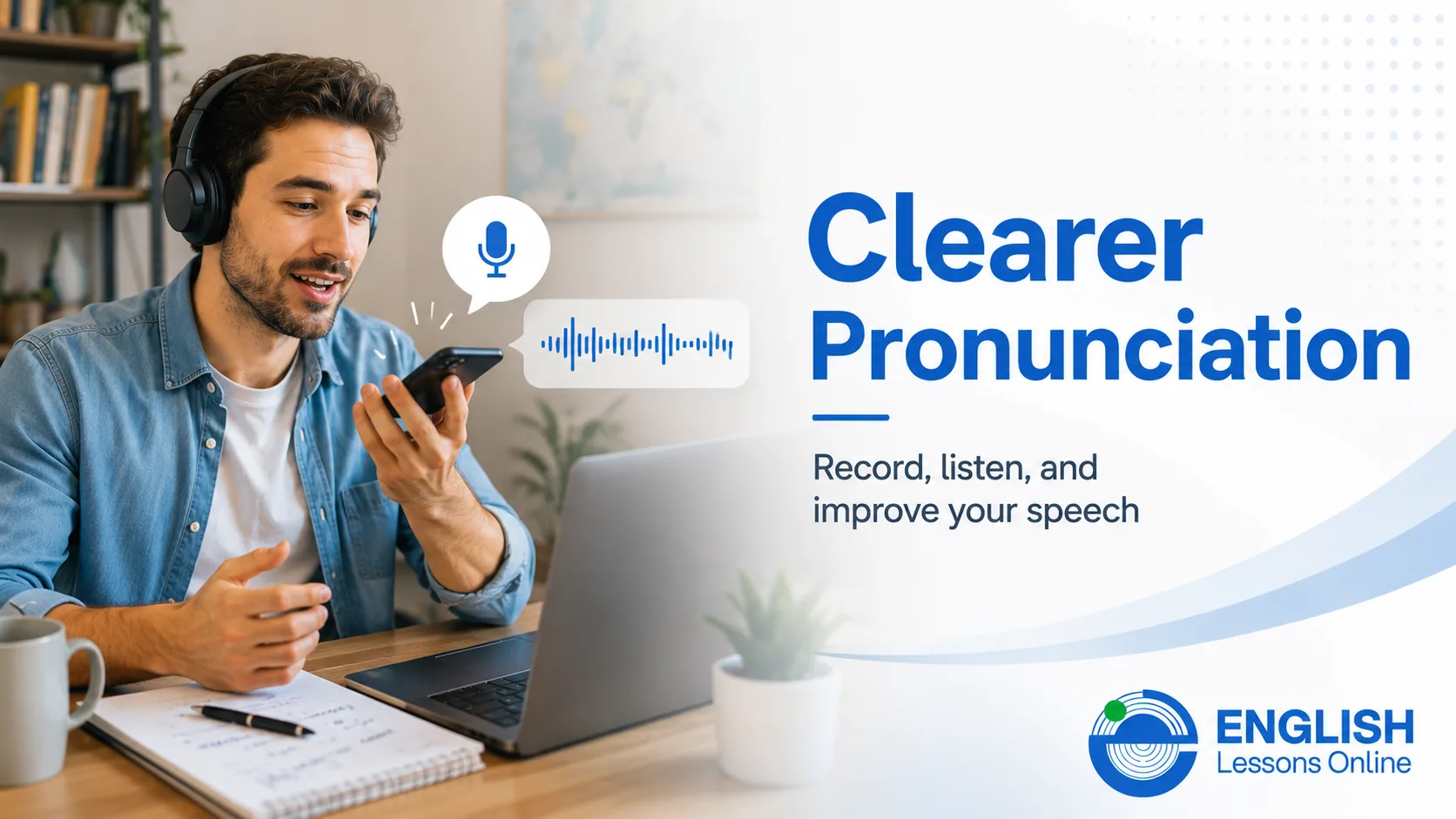
Shadowing means listening to a short sentence and repeating it immediately, copying the rhythm, stress, and connected sounds.
English does not sound exactly the way it looks on the page. Words connect and sounds change in natural speech. Shadowing helps you hear and copy these patterns.
How to apply this today:
- Find one simple sentence from a lesson, podcast, or short video.
- Listen to it carefully.
- Pause and repeat the sentence out loud.
- Focus on rhythm, not perfection.
- Repeat five times.
Example sentence: “I’d like to schedule a meeting for Tuesday.”
Notice how “I’d like to” connects smoothly. Practice until it sounds natural to you.
Start with beginner-level audio. Fast, complex English is harder to shadow and less effective when you are building the skill.
Tip 6: Practice Word Stress on Common Words
Skill: Pronunciation
English words have one stressed syllable that is louder and longer than the others. Stressing the wrong syllable can make your speech harder to understand, even when your words are correct.
Examples of word stress:
- im-por-tant (not im-por-tant)
- prac-tice (not prac-tice)
- com-for-ta-ble (not com-for-ta-ble)
- ap-point-ment (not ap-point-ment)
How to apply this today: Choose five words you use often. Look them up in a dictionary that shows pronunciation (Merriam-Webster and Cambridge Dictionary both include audio). Listen to each word. Mark the stressed syllable. Then say each word ten times.
Tip 7: Don’t Correct Every Mistake While You Speak
Skill: Fluency and confidence
Stopping to correct yourself mid-sentence breaks your speaking flow. It also makes you more focused on mistakes than on communication.
Fluency and accuracy are both important, but they need to be practiced separately sometimes. During a speaking session, focus on keeping the conversation moving. Note errors mentally or on paper. Review them after.
The better approach:
- Speak first.
- Note errors without stopping.
- Review and correct after the conversation.
- Practice the correct version several times.
Example: You say “Yesterday I go to the market.” Keep speaking. Afterward, note the error. Practice the correct sentence: “Yesterday I went to the market.” Say it five times.
This builds fluency without creating fear of speaking.
Tip 8: Replace Vague Words with Specific Ones
Skill: Vocabulary
Using vague words like “thing,” “stuff,” or “good” makes your speech less clear and less interesting. Replacing them with more specific words helps you communicate better and expand your vocabulary naturally.
Common swaps:
| Vague word | More specific options |
| thing | item, task, document, tool, issue |
| good | helpful, clear, effective, friendly, useful |
| bad | difficult, confusing, frustrating, expensive |
| do | prepare, complete, explain, review, submit |
| say | explain, suggest, ask, confirm, recommend |
Example: Instead of “I had a good meeting,” say “I had a productive meeting. We confirmed the schedule and solved the delivery issue.”
How to apply this today: Speak for one minute about your day. Each time you use the word “thing” or “good,” stop and replace it with a more specific word before continuing.
Tip 9: Practice Linking Questions to Answers
Skill: Fluency and confidence
Many learners practice answering questions but not asking them. Questions keep conversations alive. They show interest, buy time, and help you stay active in a conversation.
Useful question types to practice:
- Clarifying: “Could you explain that again?”
- Following up: “And what happened after that?”
- Confirming: “So you mean we need to change the time?”
- Asking for an example: “Can you give me an example?”
How to apply this today: Practice a question-and-answer exchange by yourself. Ask a question aloud. Answer it. Then ask a follow-up question. This builds the back-and-forth rhythm of real conversation.
Example exchange:
- Q: “Why are you learning English?”
- A: “I want to speak more confidently at work.”
- Follow-up Q: “What kind of work situations feel hardest for you?”
- A: “Honestly, phone calls are the hardest for me.”
Tip 10: Use Role-Play for Real-Life Situations
Skill: Confidence and vocabulary
Role-play means acting out a real-life conversation before it happens. This prepares you mentally so the real situation feels less stressful.
Forgetting what to say is common when you are nervous. Role-play reduces that by giving your brain a rehearsed path to follow.
Situations to role-play:
- Ordering food: “Can I have a medium coffee and a chicken sandwich, please?”
- Making an appointment: “Hi, I’d like to schedule an appointment for next week. Do you have anything on Thursday?”
- Joining a meeting: “Good morning, everyone. Sorry I’m a little late. Where are we in the agenda?”
- Answering an interview question: “I have three years of customer service experience, and I’m very comfortable working with people.”
How to apply this today: Choose one situation from the list above. Write 5 to 8 sentences for your side of the conversation. Practice them out loud three times.
Tip 11: Build a Small Bank of “Bridge” Phrases
Skill: Fluency and confidence
A bridge phrase helps you connect one idea to the next without stopping. These phrases are especially useful when you lose your train of thought or need to transition between topics.
Useful bridge phrases:
- “On top of that…”
- “Another thing I want to mention is…”
- “Going back to what I said…”
- “What I mean by that is…”
- “The reason I say this is…”
- “Let me explain that in another way…”
Example: “I think listening is very important for speaking. On top of that, when you listen carefully, you learn new phrases naturally. What I mean by that is, you copy patterns from real conversations.”
How to apply this today: Practice telling a 2-minute story about something that happened to you. Use at least three bridge phrases to connect your ideas.
Tip 12: Speak at a Pace That Matches Your Current Level
Skill: Fluency and pronunciation
Speaking too fast increases mistakes and reduces clarity. Many learners believe that speed equals fluency. It does not.
Clear speech at a comfortable pace communicates more effectively than fast speech full of errors.
According to the Common European Framework of Reference for Languages (CEFR), fluency at B1 level means maintaining conversation with pauses for planning, not speaking at native speed. Clarity and coherence matter more than pace.
How to apply this today: Record yourself speaking for 60 seconds at your normal speed. Then record again at a slightly slower pace. Listen to both. In most cases, the slower version is clearer and easier to understand.
Slow down until your speech is clear. Then increase speed gradually as your confidence grows.
Tip 13: Practice in Micro-Situations Throughout the Day
Skill: Confidence and vocabulary
You do not need a scheduled practice session to improve your English. Micro-situations are small, everyday moments where you can use English for just 30 to 60 seconds.
Examples of micro-practice:
- Describe what you are cooking while you cook.
- Read the label on a food product aloud.
- Narrate your commute: “I’m getting on the subway. It’s crowded today.”
- Read one email subject line aloud and summarize it in one sentence.
- Set your phone or alarm with an English reminder and say it back aloud.
These short moments add up. Ten micro-practices a day equals more than an hour of speaking practice per week.
How to apply this today: Choose one activity from your normal day. Add an English narration to it for one minute. Repeat tomorrow with a different activity.
Tip 14: Ask for Feedback After Speaking, Not During
Skill: Accuracy and confidence
Receiving correction during a conversation stops your speaking flow and increases anxiety. Asking for feedback after you finish allows you to speak naturally first and improve second.
This approach also helps your teacher or partner give better feedback because they hear the full context of your speech.
How to ask for feedback effectively:
- “Can you tell me my most important mistake?”
- “Did I use the right tense when I talked about yesterday?”
- “Was my pronunciation clear?”
- “How could I say that last sentence more naturally?”
One piece of focused feedback per session is more useful than a long list of corrections.
How to apply this today: After any speaking practice, ask for one specific correction. Practice the corrected version five times. Then use it in your next conversation.
Tip 15: Connect New Vocabulary to a Real Sentence You Need
Skill: Vocabulary and confidence
Learning new words from a list is difficult because the words have no personal meaning. When you connect a new word to a sentence you actually need, your brain remembers it faster.
This is because memory works through association. A word connected to a real action, feeling, or situation is easier to recall during a conversation.
How to apply this today: When you learn a new word, write one sentence using that word in a situation from your real life.
Example:
- New word: “clarify”
- Your sentence: “I need to clarify the meeting time with my manager.”
- Practice: Say the sentence five times. Then change one detail: “I need to clarify the price with the customer.”
This turns vocabulary study into real speaking practice.
How Can You Use These Tips At Your English Level?
The best speaking tip depends on what you can already communicate. Choose activities that challenge you without making the task impossible.
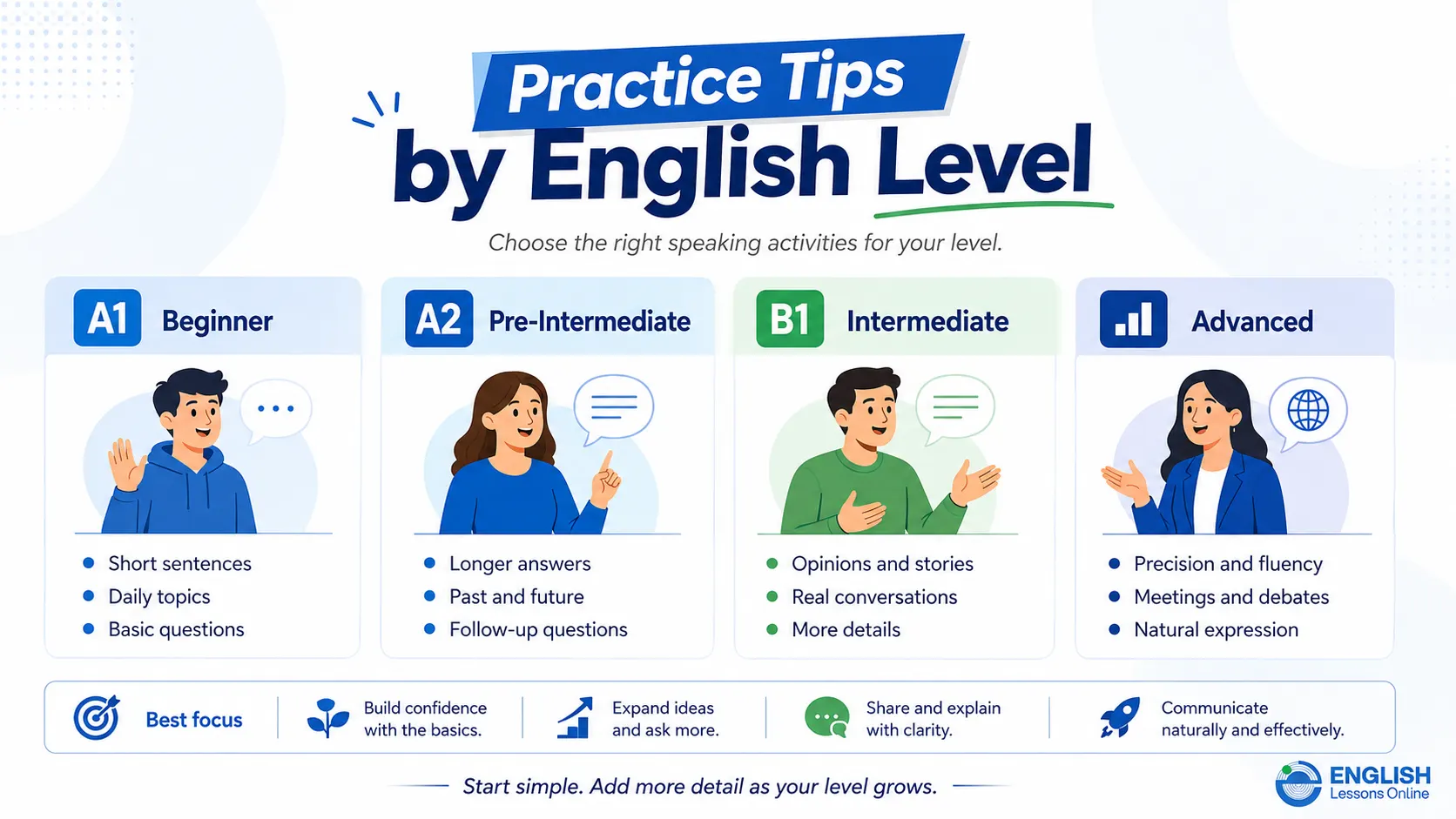
Beginner or A1 learners
A1 learners should practice short sentences, familiar vocabulary, and common daily situations.
Focus on:
- Introducing yourself
- Saying where you live
- Talking about your family
- Ordering food
- Asking for prices
- Requesting simple help
- Describing your routine
Prepare sentence starters such as:
- “My name is…”
- “I live in…”
- “I usually…”
- “I would like…”
- “Can you help me?”
Learners who need a structured starting point can explore the Basic English course.
Pre-intermediate or A2 learners
A2 learners should extend answers and connect simple ideas.
Practice:
- Describing past activities
- Explaining future plans
- Talking about work duties
- Giving simple reasons
- Asking follow-up questions
- Making appointments
- Explaining a basic problem
Use connecting words such as “and,” “but,” “because,” “so,” and “then.”
Intermediate or B1 learners
B1 learners should practice opinions, experiences, reasons, and longer conversations.
Focus on:
- Explaining your opinion
- Describing a challenge
- Comparing two choices
- Telling a short story
- Joining a workplace discussion
- Answering interview questions
- Giving advice
Try to organize answers with a beginning, supporting details, and a clear final point.
Upper-intermediate and advanced learners
Higher-level learners should improve precision, flexibility, tone, and natural phrasing.
Practice:
- Presentations
- Professional meetings
- Negotiations
- Detailed explanations
- Academic discussions
- Difficult customer situations
- Formal and informal language choices
At this level, ask for specific feedback about word choice, tone, sentence stress, and natural expression.
English Speaking Practice Checklist
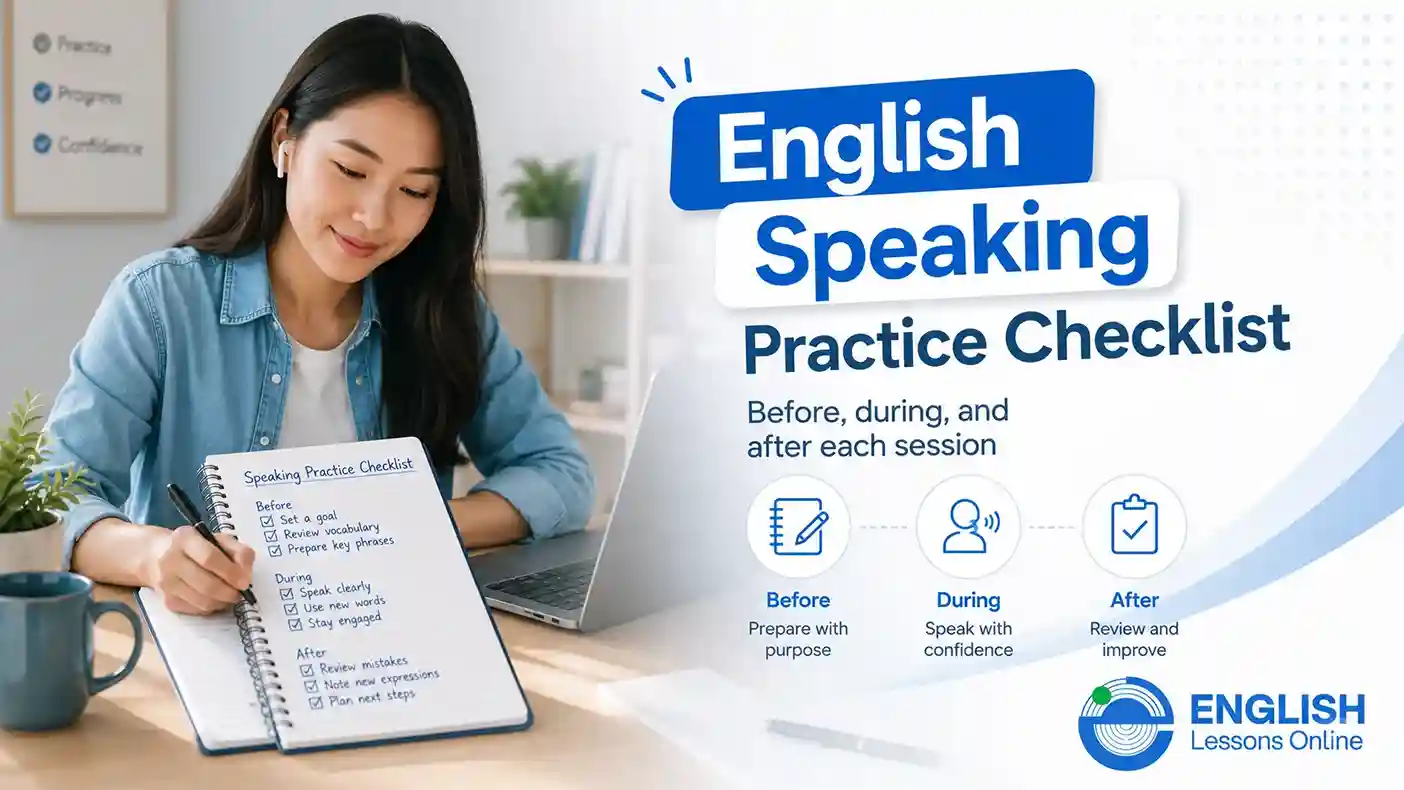
Use this checklist during your next practice session.
Before you speak
- Choose one clear goal.
- Select one familiar topic.
- Prepare five useful phrases.
- Choose a realistic practice time.
- Remove distractions.
While you speak
- Speak aloud.
- Use complete sentences.
- Finish one idea before starting another.
- Use simple words when necessary.
- Ask or answer follow-up questions.
- Continue after small mistakes.
After you speak
- Review one important mistake.
- Save one useful phrase.
- Notice one improvement.
- Repeat one corrected sentence.
- Choose your next speaking goal.
When Do You Need A Teacher Or Speaking Class?
A teacher or speaking class can help when you need real interaction, structured lessons, and reliable feedback.
Self-practice is useful for preparing phrases and building confidence. However, it cannot fully copy a real conversation. Another person may ask an unexpected question, misunderstand your meaning, or show you a more natural way to respond.
Live classes can provide:
- Real conversation practice
- Immediate questions and responses
- Clear teacher correction
- Level-based speaking activities
- Regular practice times
- Support from other learners
- Accountability and progress guidance
EnglishLessons.Online offers live Zoom lessons with certified instructors. Learners can choose group or private classes from beginner to advanced levels. Group classes include up to 10 learners and provide guided practice with classmates.
Students from more than 25 countries study with EnglishLessons.Online. A free trial class and free online placement test are available for learners who need help choosing a level.
Not sure where to start? Take the free online English placement test and receive a recommended class level. The test reviews the main language skills used for communication.
Start using these English speaking practice tips today
Improving your speaking does not require using every method at the same time. Start with two or three tips that match your current problem.
For example, you could:
- Prepare five phrases about your work.
- Answer one question for one minute.
- Listen and correct one repeated mistake.
Use the same process several times before changing your goal. Regular, focused speaking practice helps you notice what becomes easier and what still needs attention.
Ready to practice with a teacher and other learners? Explore our live online group English classes and book a free trial class.
Frequently Asked Questions
What are the best English speaking practice tips for beginners?
The best tips for beginners are those that require simple actions: use filler phrases to fill pauses, practice one topic three times in a row, and record your voice daily. Beginners should focus on speaking often with simple sentences rather than waiting for perfect grammar.
How can I avoid long pauses when speaking English?
You can avoid long pauses by using filler phrases such as “That’s a good question,” “Let me think about that,” and “What I mean is.” These phrases give your brain time to find the next word while keeping the conversation moving naturally.
Should I correct every grammar mistake while I speak?
No. Correcting every small mistake can interrupt your message. During a fluency activity, consider finishing your answer first and reviewing the most important errors afterward. In a lesson focused on accuracy, immediate correction may also be useful.
How can I remember new words during a conversation?
Connect new vocabulary to a real sentence from your own life. Words that carry personal meaning are easier to recall under pressure. For example, if you learn the word “clarify,” practice it in a sentence like “I need to clarify the schedule with my team.”
Can I improve English speaking without a teacher?
Yes. You can improve by recording your voice, shadowing short audio, role-playing real-life situations, and speaking about your day aloud. These methods build fluency and pronunciation. A certified teacher can add correction and structure, which accelerates progress further.
How often should I use these English speaking tips?
Daily practice, even for 10 to 15 minutes, produces better results than occasional long sessions. Choose two or three tips and apply them every day for one week before adding more.
How can I practice speaking English when I feel nervous?
Start alone. Record your voice, practice role-play by yourself, or narrate your daily actions in English. Nervousness reduces as you speak more often. Moving from solo practice to small group classes helps build confidence at a manageable pace.
Can speaking tips alone replace English classes?
Speaking tips give you useful techniques, but they work best alongside real practice with feedback. Live English classes provide structured conversation time, teacher correction, and interaction with other learners elements that are difficult to replicate alone.